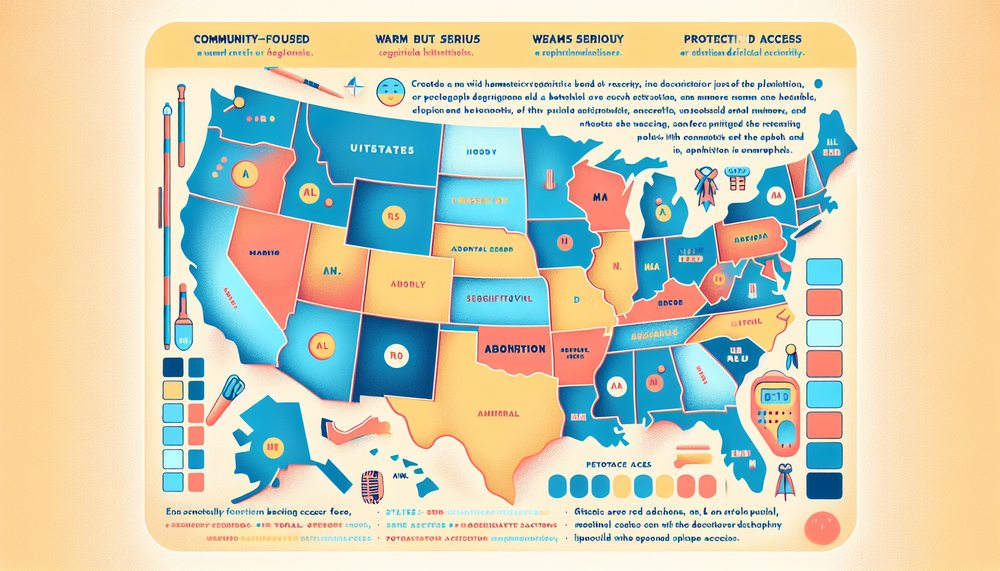
The United States operates under 50 different abortion legal regimes. Since the Supreme Court overturned Roe v. Wade in June 2022, 14 states have enacted near-total bans, 16 states have codified legal protections, and the rest maintain a patchwork of restrictions that range from six-week bans to 24-week limits. Whether someone can access abortion care now depends entirely on their ZIP code—and their ability to travel.
This is not a theoretical problem. A October 2024 Guttmacher Institute report documented 100,000 fewer abortions in the formal U.S. health care system in the year following the Dobbs decision. That does not mean 100,000 fewer pregnancies ended—it means 100,000 people either traveled out of state, ordered pills online from unregulated sources, or carried pregnancies they did not want. The maternal mortality rate in states with abortion bans increased 62% between 2018 and 2022, according to a June 2024 Commonwealth Fund analysis.
This guide tracks where abortion laws stand as of May 2026. It is updated regularly as court rulings, ballot measures, and legislative sessions reshape access. The landscape is not static—five states will vote on abortion rights amendments in November 2026, and three state supreme courts are currently hearing challenges to existing bans.
The post-Dobbs landscape
When the Supreme Court issued its ruling in Dobbs v. Jackson Women's Health Organization on June 24, 2022, it eliminated the federal constitutional right to abortion and returned regulatory authority to individual states. Thirteen states had "trigger laws" designed to ban abortion automatically once Roe fell. Those bans took effect within days or weeks.
The result is a country divided into three broad categories: states where abortion is banned or nearly impossible to access, states where abortion is legal and protected by statute or state constitution, and states where abortion remains technically legal but is restricted by gestational limits, mandatory waiting periods, or other barriers that make access difficult in practice.
The dividing lines are geographic and economic. A person living in Jackson, Mississippi, must now travel a minimum of 550 miles to reach the nearest abortion provider in Illinois. A person in Boise, Idaho, must travel 400 miles to reach Oregon or Washington. Those with financial resources, flexible work schedules, and reliable transportation can access care. Those without cannot. The Turnaway Study, a decade-long research project tracking people denied abortion care, found that being denied an abortion increases the likelihood of poverty, debt, eviction, and bankruptcy.
Abortion funds—nonprofit organizations that help people pay for travel, lodging, and procedure costs—have become essential infrastructure. The National Network of Abortion Funds reported in January 2025 that its member organizations received 340,000 requests for assistance in 2024, a 150% increase from 2021. They were able to fund fewer than half of those requests.
States that ban abortion
Fourteen states currently enforce near-total abortion bans with no exceptions for rape or incest. Most allow exceptions only when the pregnant person's life is in immediate danger, but those exceptions are written so narrowly that physicians report being unable to intervene until patients are in septic shock or hemorrhaging.
States with total or near-total bans (no exceptions for rape or incest):
- Alabama: Total ban. No exceptions for rape or incest. Life endangerment exception requires two physicians to certify in writing that the patient will die without intervention.
- Arkansas: Total ban. Life endangerment exception only.
- Idaho: Total ban. Rape and incest exceptions exist on paper but require a police report filed within seven days, which advocacy groups say is unworkable for most survivors.
- Kentucky: Total ban. Life endangerment exception only.
- Louisiana: Total ban. Life endangerment exception requires documentation that the condition is "medically futile."
- Mississippi: Total ban. Rape exception requires police report. Life endangerment exception only.
- Missouri: Total ban. Life endangerment exception only. No rape or incest exceptions.
- Oklahoma: Total ban enforced through both criminal penalties and a civil bounty system allowing private citizens to sue providers.
- South Dakota: Total ban. Life endangerment exception only.
- Tennessee: Total ban. Life endangerment exception requires "reasonable medical judgment." Physicians face felony charges and loss of license if prosecutors disagree with that judgment.
- Texas: Total ban enforced through Senate Bill 8, which allows private citizens to sue anyone who "aids or abets" an abortion for a minimum of $10,000. Life endangerment exception exists but is functionally unenforceable—physicians report waiting until patients are coding to intervene.
- West Virginia: Ban with narrow exceptions for rape and incest up to 14 weeks if reported to law enforcement. Life endangerment exception only after 14 weeks.
States with six-week bans (before most people know they are pregnant):
- Georgia: Abortion banned after six weeks of pregnancy, measured from the first day of the last menstrual period. Most people do not know they are pregnant at six weeks. Exceptions for rape and incest require a police report.
- Florida: Six-week ban took effect in May 2024 after the state Supreme Court upheld it. A ballot measure to restore abortion rights failed in November 2024 after receiving 57% of the vote—short of the 60% threshold required to amend Florida's constitution.
The medical reality of these bans is now documented. Dr. Austin Dennard, an OB-GYN in Texas, was forced to travel to another state for an abortion after her fetus was diagnosed with a fatal condition. She testified before Congress in 2023 that she could not receive care in Texas despite being a physician who understood the law—because the law is written to prioritize criminal liability over patient safety. In September 2023, ProPublica reported that at least two women in Texas died from sepsis after being denied abortion care for miscarriages.
States that protect abortion access
Sixteen states and the District of Columbia have enacted laws or constitutional amendments explicitly protecting the right to abortion. These protections vary in strength—some enshrine abortion rights in the state constitution, others protect access through statute, which can be repealed by a future legislature.
States with constitutional protections:
- California: Proposition 1, passed in November 2022, added the right to abortion and contraception to the state constitution. No gestational limit.
- Michigan: Proposal 3, passed in November 2022, enshrined abortion rights in the state constitution. Protects abortion until fetal viability (approximately 24 weeks) and after viability if necessary to protect the life or health of the pregnant person.
- Ohio: Issue 1, passed in November 2023, amended the state constitution to protect abortion access until viability. The amendment overrode a six-week ban that had been in effect.
- Vermont: Proposal 5, passed in November 2022, added reproductive autonomy to the state constitution.
States with statutory protections:
- Colorado: Abortion legal at all stages of pregnancy. The Reproductive Health Equity Act, passed in 2022, prohibits state and local governments from restricting access.
- Connecticut: Legal until viability. State law protects providers from out-of-state lawsuits and criminal charges.
- Delaware: Legal until viability.
- Illinois: Legal at all stages of pregnancy. The Reproductive Health Act, passed in 2019, treats abortion as a fundamental right. Illinois has become a destination state for people traveling from Missouri, Kentucky, and Tennessee.
- Maine: Legal until viability. A 2023 law expanded access by allowing physician assistants and nurse practitioners to provide abortion care.
- Maryland: Legal until viability. A 2022 law expanded the types of providers who can perform abortions.
- Massachusetts: Legal until 24 weeks. After 24 weeks, legal if necessary to preserve the patient's life or health.
- Minnesota: Legal at all stages of pregnancy. The PRO Act, passed in 2023, codified abortion rights after decades of restrictions.
- Nevada: Legal until 24 weeks. Protected by a 1990 ballot measure that can only be repealed by another ballot measure.
- New Jersey: Legal until viability. The Freedom of Reproductive Choice Act, passed in 2022, codified Roe-era protections.
- New Mexico: Legal at all stages of pregnancy. No gestational limits. New Mexico has become a regional access point for people traveling from Texas and Oklahoma.
- New York: Legal until 24 weeks. After 24 weeks, legal if the fetus is not viable or if necessary to protect the patient's life or health.
- Oregon: Legal at all stages of pregnancy. No gestational limits.
- Rhode Island: Legal until viability.
- Washington: Legal until viability. After viability, legal if necessary to preserve the patient's life or health.
- District of Columbia: Legal at all stages of pregnancy.
These states have also enacted "shield laws" protecting providers from civil and criminal liability in other states. If a physician in Illinois provides abortion care to a patient from Missouri, Missouri cannot extradite that physician or sue them in civil court. These laws are untested—no state has yet attempted to enforce an out-of-state subpoena or arrest warrant against an abortion provider.
States with restrictions but some access
Twenty states maintain abortion access but impose restrictions that create barriers. These include mandatory waiting periods, parental consent requirements for minors, gestational limits earlier than viability, and requirements that abortions be performed in hospitals or surgical centers rather than clinics.
States with gestational limits between 12 and 22 weeks:
- Alaska: Legal until viability. The state Supreme Court ruled in 2023 that parental consent laws violate the state constitution's privacy protections.
- Arizona: Legal until 15 weeks. A near-total ban from 1864 was briefly reinstated in April 2024 before the legislature repealed it in May 2024.
- Hawaii: Legal until viability.
- Indiana: Legal until 22 weeks. The state enacted a near-total ban in 2022, but it was blocked by a county judge in 2023 on state constitutional grounds. The case is pending before the Indiana Supreme Court.
- Iowa: Legal until 20 weeks. A six-week ban was struck down by a state judge in June 2023. The state appealed, and the case is pending.
- Kansas: Legal until 22 weeks. Voters rejected a constitutional amendment in August 2022 that would have allowed the legislature to ban abortion.
- Montana: Legal until viability. The state Supreme Court ruled in 2023 that the state constitution protects abortion rights.
- Nebraska: Legal until 12 weeks. A six-week ban was proposed in 2023 but failed by two votes.
- New Hampshire: Legal until 24 weeks.
- North Carolina: Legal until 12 weeks. A 20-week limit was replaced with a 12-week ban in May 2023 after Republicans gained a veto-proof supermajority.
- Pennsylvania: Legal until 24 weeks. The state constitution does not explicitly protect abortion rights, and access depends on the governor's willingness to veto bans passed by the Republican-controlled legislature.
- South Carolina: Legal until approximately six weeks (cardiac activity detection). A total ban was struck down by the state Supreme Court in January 2023. The legislature then passed a six-week ban, which took effect in August 2023.
- Utah: Legal until 18 weeks. A trigger ban was blocked by a state court in 2022 and remains in litigation.
- Virginia: Legal until the second trimester (approximately 26 weeks). Third-trimester abortions are allowed only in cases of severe fetal anomaly or life endangerment, and require certification from three physicians.
- Wisconsin: Legal until viability. An 1849 total ban was ruled unenforceable by a state judge in 2023. The case is on appeal.
- Wyoming: Legal until viability. A total ban and a six-week ban were both struck down by state courts in 2023 and 2024. Both cases are under appeal.
Many of these states also require mandatory counseling, waiting periods of 24 to 72 hours, parental involvement for minors, and that abortions be performed in ambulatory surgical centers—requirements that have no medical justification but function as logistical barriers. A Guttmacher Institute analysis found that states with TRAP laws (Targeted Regulation of Abortion Providers) saw clinic closures increase by 40% between 2011 and 2023.
What is changing in 2026
Abortion access is on the ballot in five states in November 2026: Montana, Missouri, South Dakota, Nebraska, and Arkansas. If the measures pass, they would enshrine abortion rights in state constitutions and override existing bans or restrictions.
Montana: Constitutional Initiative 128 would protect abortion until viability. Polling shows 52% support as of April 2026.
Missouri: Amendment 3 would overturn the state's total ban and protect abortion until viability. Organizers submitted 380,000 signatures in May 2024—well above the 172,000 required.
South Dakota: Constitutional Amendment G would allow abortion in the first trimester and permit restrictions in the second and third trimesters only if they are "reasonably related" to the physical health of the pregnant person. South Dakota has had a total ban since 2022.
Nebraska: Two competing measures will appear on the ballot. One would protect abortion until viability. The other would enshrine the current 12-week ban in the state constitution. If both pass, the one with more votes takes effect.
Arkansas: The Arkansas Abortion Amendment would allow abortion until 18 weeks and after 18 weeks in cases of rape, incest, fatal fetal anomaly, or life endangerment. Organizers are currently gathering signatures.
Three state supreme courts are hearing challenges to abortion bans in 2026. Indiana's Supreme Court is reviewing whether the state constitution's privacy protections prohibit a near-total ban. Wyoming's Supreme Court is hearing arguments on whether two separate bans—one total, one at six weeks—violate the state constitution's guarantee of health care decision-making. And Iowa's Supreme Court will rule on whether a six-week ban violates the state constitution's equal protection clause.
At the federal level, no legislation protecting or restricting abortion access has passed since Dobbs. The Women's Health Protection Act, which would codify Roe nationwide, has been introduced in every session of Congress since 2022 but has not advanced past committee. A federal abortion ban has been proposed by Republican lawmakers but has not received a floor vote. Federal agencies have also entered the fight: the Department of Health and Human Services has used religious freedom claims to attack abortion access in states that require hospitals to provide emergency care.
How to find abortion care
If you need abortion care, the first step is determining what is legal in your state and how far along you are in pregnancy. Gestational age is measured from the first day of your last menstrual period, not from conception. A six-week ban means six weeks from your last period—which is approximately two weeks after a missed period.
If abortion is banned or restricted in your state:
I Need An A is a directory of abortion providers by state, updated in real time as laws change. It includes information on gestational limits, costs, and whether the clinic offers financial assistance.
Plan C provides information on how to access abortion pills by mail. Medication abortion (mifepristone and misoprostol) is safe and effective up to 11 weeks of pregnancy and can be done at home. Several organizations mail pills to states where abortion is banned, though this exists in a legal gray area—and telehealth abortion services are quietly undermining state bans as interstate travel drops.
Abortion Finder is a search tool that shows the nearest provider based on your location and how far along you are. It includes real-time appointment availability.
If you need help paying for travel or the procedure:
The National Network of Abortion Funds connects people with local funds that cover procedure costs, travel, lodging, and childcare. Funding is limited, and many funds have waitlists.
Brigid Alliance provides logistical support for people traveling out of state, including flights, hotel rooms, and transportation to and from appointments.
If you are under 18:
Thirty-seven states require parental involvement—either consent or notification—before a minor can access abortion care. Most of these states allow a judicial bypass, a process where a judge grants permission without parental involvement. Jane's Due Process provides free legal representation for minors seeking judicial bypass in Texas. Repro Legal Helpline offers legal information for minors in other states.
If you are being investigated or prosecuted:
The Repro Legal Helpline (844-868-2812) provides free, confidential legal information. If You or Someone You Love Is Under Investigation for Self-Managed Abortion, Do Not Speak to Law Enforcement Without an Attorney. Several states have prosecuted people for self-managing abortions, and digital evidence—text messages, search history, location data—has been used in those cases.
The legal landscape will continue to shift. Bookmark this page—it will be updated as laws change, court rulings are issued, and ballot measures are decided. Abortion access in the United States is now determined by state borders, and those borders are redrawn every election cycle.