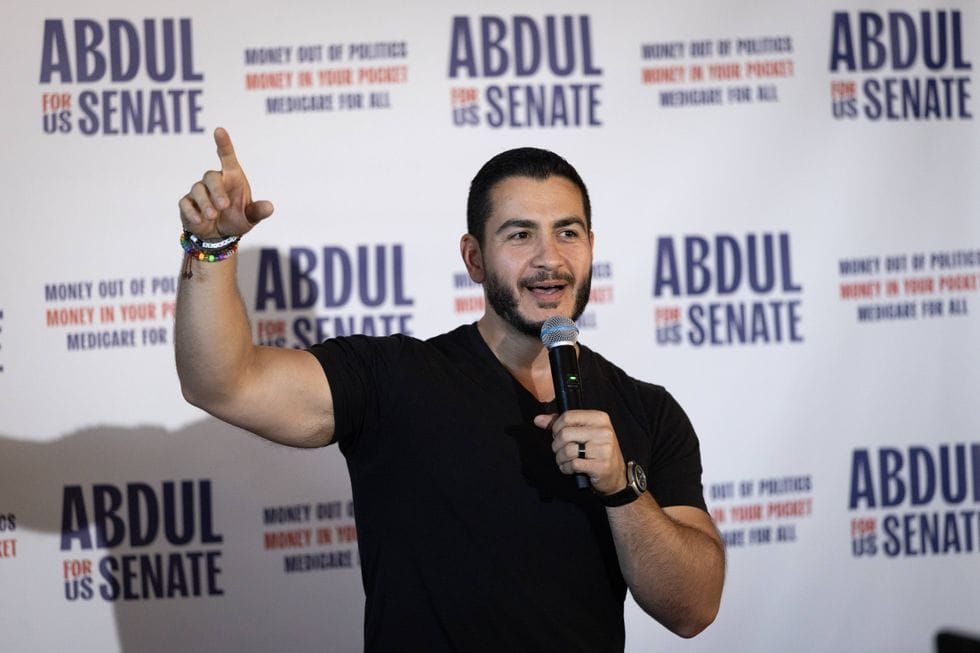
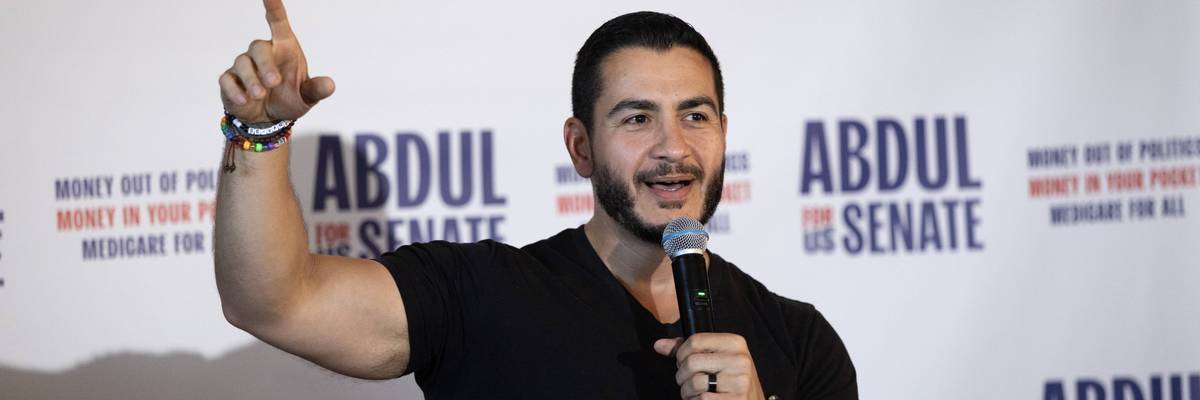
$30.6 million. That is the amount a single lobbying organization has spent to defeat a single candidate in a single Democratic primary — before a single general election vote has been cast. Common Dreams reported Monday, citing an analysis by investigative outlet Sludge, that AIPAC's political action committee and super PAC, the United Democracy Project, have directed more money at Abdul El-Sayed's Michigan Senate race than the organization has ever spent on any contest in its history. The figure is not a rounding error. It is a strategic choice — and it tells you something specific about what AIPAC is actually defending.
El-Sayed is a progressive epidemiologist running for the Democratic nomination in Michigan. His opponent, US Rep. Haley Stevens, has received substantial AIPAC backing. The framing from AIPAC's side is that this is ordinary electoral politics — a well-funded organization supporting candidates who align with its policy priorities. But that framing obscures what is structurally new: AIPAC is no longer primarily a lobbying operation that influences elected officials. It has become a primary-shaping machine whose purpose is to determine which candidates are permitted to run as Democrats at all.
The $104.3 million total reported by Sludge is itself an undercount. That figure does not include spending by super PACs that AIPAC bankrolls but does not formally control. The American Prospect documented this summer that AIPAC has been routing campaign cash through what it called "anodyne-sounding pop-up shell PACs" — groups with names like "Elect Chicago Women" and "Affordable Chicago Now" — that received $5.3 million from the United Democracy Project for four races in Illinois. The shell PAC structure is not a legal technicality. It is an architecture designed to ensure that voters in targeted races cannot easily trace the money opposing their preferred candidate back to a foreign-policy lobbying organization. The anonymization is the point.
This is where the accountability analysis becomes unavoidable. AIPAC's super PAC ads, Sludge noted, often contain no mention of Israel whatsoever. They run against progressive candidates on unrelated grounds — health care, crime, economic policy — using messaging calibrated to each district's political temperature. A voter in Michigan seeing an attack ad against El-Sayed may have no way of knowing it was funded by a pro-Israel lobby. That gap between the funding source and the stated rationale is not a side effect of campaign finance law. It is the operating model.
The pattern extends beyond Michigan. AIPAC is backing incumbent US Rep. Wesley Bell against Cori Bush in Tuesday's Democratic primary for Missouri's 1st Congressional District — the same race where AIPAC spending helped Bell unseat Bush in 2024. The Intercept's Akela Lacy reported that AIPAC's super PAC pumped more than $3 million into that Missouri contest last month. Lacy also noted that while Bell has a significant financial advantage, Bush has a grassroots organizing infrastructure that AIPAC money cannot replicate — including the St. Louis chapter of Democratic Socialists of America, whose members spent the 2024 cycle being saturated with negative ads and have spent the time since preparing for the rematch.
According to The American Prospect, AIPAC's United Democracy Project routed $5.3 million into four Illinois races through groups named "Elect Chicago Women" and "Affordable Chicago Now." The strategy allows AIPAC to spend in Democratic primaries without its name appearing in attack ads — giving local voters no way to connect opposition spending to a foreign-policy lobbying organization. The $104.3 million total reported by Sludge does not include this shell PAC spending.
US Rep. Shri Thanedar, also facing a primary challenge Tuesday in Michigan from progressive Donavan McKinney, has likewise received significant AIPAC funding. As Tinsel News has previously reported, two-thirds of Thanedar's campaign cash flows through AIPAC-connected bundlers — a dependency that shapes not just his fundraising but his political positioning on every issue adjacent to U.S. foreign policy.
US Sen. Bernie Sanders, who is supporting El-Sayed, framed the Michigan race in explicitly structural terms. "The Michigan Senate primary is a fight as to whether billionaires and their super PACs will continue to control American politics, or whether we can have a government that represents working families," Sanders wrote Monday. The framing is accurate as far as it goes. But it understates the specific mechanism at work. This is not generic billionaire influence — it is a foreign-policy lobby using domestic electoral spending to enforce ideological compliance on a party whose base has shifted substantially on the question of U.S. support for Israel.
That shift is the context AIPAC's spending is designed to suppress. Polling consistently shows that a majority of Democratic voters now hold views on Gaza that would have been considered outside the mainstream of Democratic politics five years ago. AIPAC's intervention in Democratic primaries functions as a correction mechanism — a way to ensure that elected Democrats remain to the right of their own voters on this specific issue, regardless of what those voters actually want. The $30.6 million spent against El-Sayed is not just an effort to defeat one candidate. It is an effort to demonstrate to every future progressive candidate what it costs to run on a platform that diverges from AIPAC's position.
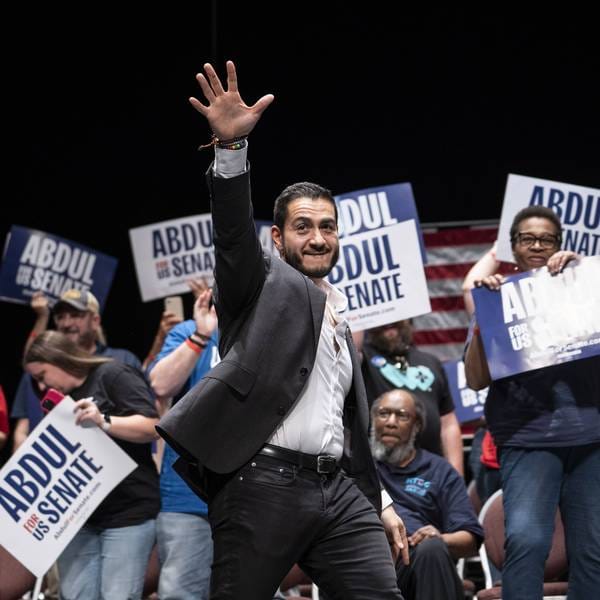
The demonstration effect is the investment. If El-Sayed loses decisively, the lesson absorbed by the next generation of Democratic candidates will be that certain positions carry a financial penalty so severe that no grassroots coalition can overcome it. That lesson does not require AIPAC to spend $30 million in every race. It requires AIPAC to spend $30 million in one race, visibly, and let the math do the rest.
The Democratic Party's relationship with this dynamic is increasingly uncomfortable. Prospective 2028 presidential contenders have begun distancing themselves from AIPAC publicly — while the party infrastructure continues to accept its money and its organizational support. That contradiction is not sustainable. The base is watching the Michigan and Missouri primaries specifically to understand whether AIPAC's financial firepower can be beaten by organizing, or whether the lesson of 2024 — when Bell unseated Bush with AIPAC backing — is the permanent new normal.
What the $104 million total makes clear is that AIPAC is not behaving like a traditional lobbying organization that works the margins of policy through access and persuasion. It is behaving like a party faction with its own electoral apparatus — one that operates inside the Democratic primary system without any of the accountability structures that apply to the party itself. Its ads don't mention Israel. Its shell PACs don't mention AIPAC. Its candidates don't campaign on the organization's core issue. The money moves through structures designed to be invisible, and the outcome it purchases — a Democratic caucus more aligned with AIPAC's positions than Democratic voters are — is presented as the natural result of electoral competition.
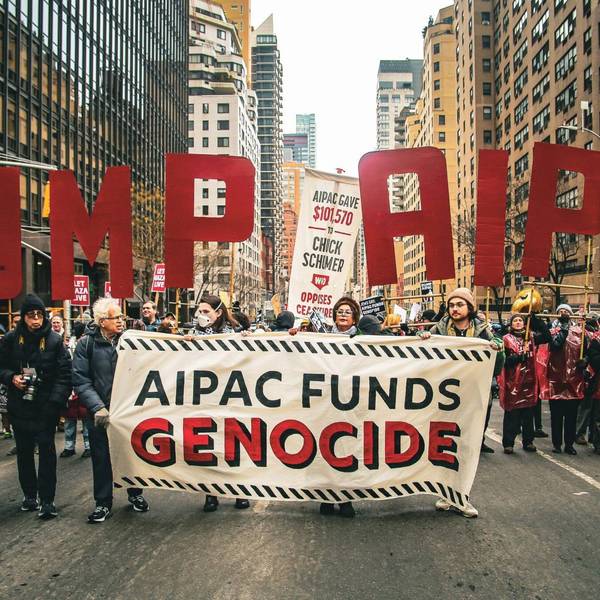
The $80 million in cash AIPAC's super PAC still held at the end of June means this is not close to over. Whatever happens Tuesday in Michigan and Missouri, the organization retains the capacity to intervene in every competitive Democratic primary between now and November — and in every cycle after that. The question the Democratic Party has not yet forced itself to answer is whether it intends to remain the venue where that intervention happens, or whether it will develop any mechanism to distinguish between candidates who earn their nominations and candidates who are selected by outside money before the voters have spoken.