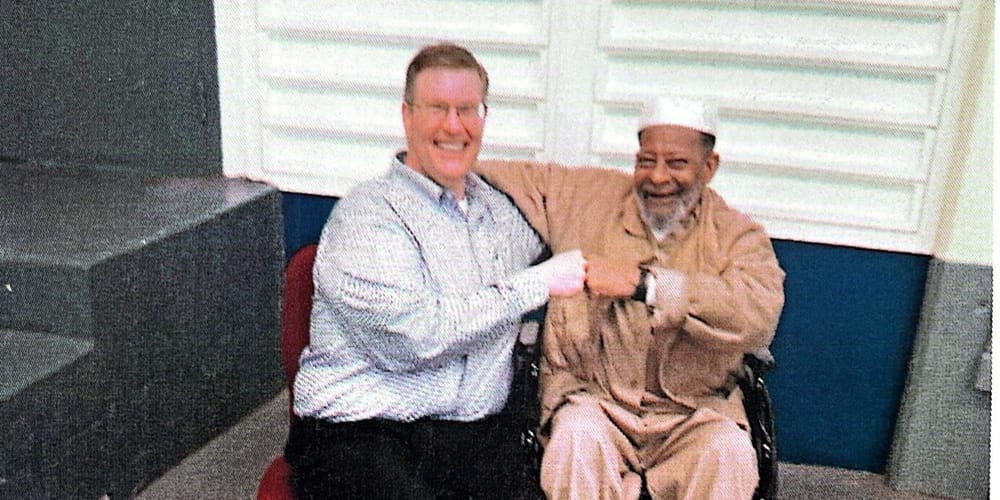
Sonny Burton was standing in the room where Alabama kills people when he learned he would live. The death chamber's holding area — where condemned prisoners say their final goodbyes to mothers, children, and loved ones — became the site of an extraordinary reversal that The Intercept witnessed firsthand.
Burton had been scheduled to die by nitrogen gas, the same experimental method Alabama used to kill Kenneth Smith in January after botching his lethal injection in 2022. The reporter who was supposed to witness Burton's execution instead watched him celebrate a last-minute commutation from the governor — a decision that arrived so late, Burton was already in the execution facility.
The scene crystallizes everything wrong with American capital punishment: its randomness, its cruelty, and its reduction of human life to bureaucratic procedure. That Burton learned of his reprieve in the very room designed for final farewells reveals how close the state came to killing someone it ultimately decided should live. The margin between life and death in America's execution chambers is measured not in moral certainty but in fax machine timing.
Alabama has become the national laboratory for experimental execution methods after traditional lethal injection drugs became scarce due to pharmaceutical company boycotts. The state's embrace of nitrogen hypoxia — marketed as more "humane" despite causing visible suffocation in its first use — represents the latest attempt to make state killing palatable to a public increasingly uncomfortable with capital punishment.
Burton's case fits a pattern: Black defendants convicted of killing white victims are far more likely to receive death sentences in Alabama, according to Equal Justice Initiative data. His commutation, while welcome, does nothing to address the systemic racial disparities that determine who enters that goodbye room in the first place. Nor does it change the fact that Alabama has executed 67 people since 1983, with several cases later revealing significant doubt about guilt or mental competency.
The arbitrariness extends beyond race. Whether someone lives or dies often depends on factors having nothing to do with their crime: the county where they were tried, the quality of their court-appointed lawyer, the political ambitions of the local prosecutor. Burton's reprieve came from the same governor who has overseen multiple executions and championed the nitrogen gas method. What changed? The Intercept's reporting doesn't specify, which itself highlights the opaque nature of clemency decisions that literally determine life or death.
This near-execution also exposes the psychological torture inherent in the death penalty process. Burton experienced what psychologists call "execution trauma" — the mental anguish of preparing to die at a specific time, saying goodbye to loved ones, making peace with one's end. That he endured this in the execution facility itself, only to be told he would live, amounts to a form of state-sanctioned psychological torture that parallels other forms of state cruelty against vulnerable populations.

The broader context is a national death penalty system in decline but refusing to die. Public support has dropped to near-record lows, executions have decreased 75% from their 1999 peak, and major pharmaceutical companies now refuse to supply execution drugs. Yet states like Alabama respond not by abandoning capital punishment but by experimenting with new methods of killing — treating human beings as test subjects for the machinery of death.
Burton's commutation is not a victory for justice — it's evidence of a system so broken that life-and-death decisions happen at the last possible second, in rooms designed for grief. A just society would not celebrate sparing one person while maintaining the infrastructure to kill others. It would recognize that any system capable of such arbitrary cruelty has no place in a civilized nation. The room where Burton learned he would live should be the last such room America ever builds.