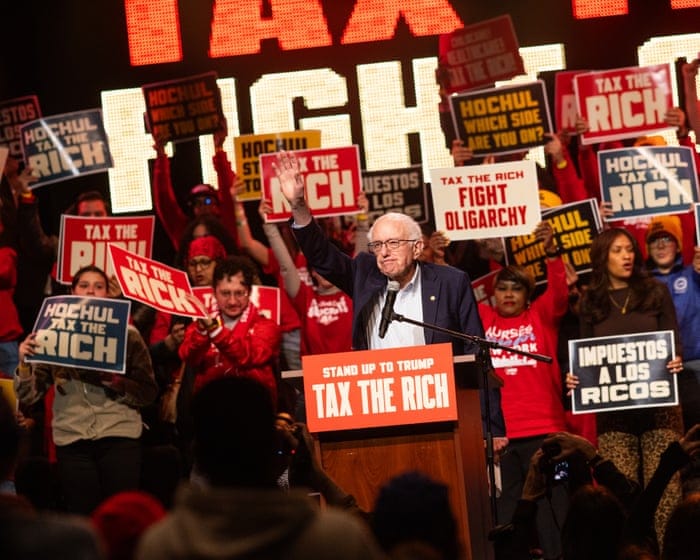
The United States now has more billionaire wealth than at any point in its history. That fact sits alongside another: the federal government is cutting food assistance, defunding hospitals, and shrinking education budgets while spending at a pace that analysts estimate could cost trillions on military operations with no congressional authorization and no exit plan. These two facts are not unrelated. They are the same story.
What makes the current moment different from previous cycles of inequality is not the scale of wealth concentration — though that scale is genuinely staggering — but what is happening in response to it. Residents in at least 10 states are organizing campaigns to tax billionaire and ultra-high-net-worth wealth, directing the proceeds toward public schools, hospitals, food programs, and the social infrastructure that federal austerity is now dismantling. The campaigns range from ballot initiatives to state legislative pushes. Taken together, they amount to a distributed, grassroots fiscal policy experiment running in parallel to — and in direct opposition to — what Washington is doing.
The thesis these campaigns are operating on is simple, and worth stating plainly: when the federal government withdraws from its obligations to public welfare while simultaneously expanding military expenditure, someone has to fill the gap. These organizers have decided that someone should be the people who have accumulated the most while everyone else absorbed the cost.
In California, according to The Guardian US, that effort has taken the form of a ballot initiative sponsored by SEIU — United Healthcare Workers West. The proposal would impose a one-time 5% wealth tax on the state's more than 200 billionaires. The stated purpose is direct: cover lost federal funding for California hospitals and emergency services, and fund public education and food assistance programs. Karen Sanchez, a volunteer collecting signatures for the measure, told The Guardian that most people she approaches at trivia nights and local events want to sign — and want to go further.
That detail is worth sitting with. Sanchez is not canvassing at progressive political events. She is meeting people at breweries, at concerts, at the kinds of ordinary social spaces where political persuasion is usually considered impolite. The fact that her opening line — "How do you feel about taxing the rich?" — is landing with enthusiasm rather than awkwardness tells you something about where public sentiment has moved. Polling has consistently shown majority support for wealth taxes across party lines. What has consistently failed to translate that support into policy is not public opinion. It is the structure of federal legislative power and the donor relationships that shape it.
This is the accountability gap that state-level campaigns are trying to route around. Congress has not passed a federal wealth tax. It has not come close. The reasons are not mysterious: the political donor class and the legislative class overlap significantly, and the people who would pay a wealth tax are among the most active funders of the people who would vote on one. As we've noted in our coverage of billionaire intervention in state primaries, ultra-wealthy donors do not just fund general elections — they shape which candidates survive long enough to appear on ballots. The federal route to wealth taxation is not blocked by lack of public support. It is blocked by structural capture.
State ballot initiatives exist precisely to bypass that capture. They are one of the few remaining mechanisms by which a majority of voters can enact policy that organized money opposes. California's initiative process has its own distortions — wealthy interests fund counter-campaigns, ballot language gets litigated, courts intervene — but the basic architecture of direct democracy still allows a coalition of nurses, teachers, and union volunteers to put a question directly to voters that their representatives in Washington will not ask.
The Power and Money lens here runs in both directions. On one side: the beneficiaries of current federal fiscal priorities are not evenly distributed. War spending flows to defense contractors. Tax cuts flow to high-income households. Federal withdrawal from Medicaid, food assistance, and education funding flows as savings to a federal budget that is simultaneously expanding in other directions. The people bearing the cost of that reallocation are the people who depend on public hospitals, public schools, and food programs — a population that skews working-class, that skews non-white, and that has no equivalent lobbying infrastructure to the industries that benefit from the current arrangement.
On the other side: the 10-state organizing push is not spontaneous. It is being driven by labor unions, community organizations, and advocacy networks that have spent years building the infrastructure to run ballot campaigns. SEIU's involvement in California is not incidental. Unions are among the few institutional actors whose financial interests align with expanding public services rather than contracting them, and whose membership gives them a canvassing base that can compete, at least partially, with the advertising budgets of opposition campaigns. The class politics here are explicit and intentional.
The systemic pattern this moment fits is one that recurs throughout American fiscal history: when federal policy consolidates resources upward, pressure builds at the state and local level to redistribute them downward. The New Deal was partly a response to states and cities that could not manage the social costs of the Depression alone. The Great Society programs emerged from documented failures of state-level welfare systems. What is different now is that the federal retrenchment is happening faster than the state response can scale, and the states organizing wealth tax campaigns are doing so in a legal environment where federal courts have repeatedly limited state taxing authority on certain asset classes.
That legal vulnerability is real. Several state-level wealth tax proposals have faced constitutional challenges, and the Supreme Court's 2024 ruling in Moore v. United States — which upheld a one-time tax on unrepatriated foreign earnings but did so narrowly — left significant uncertainty about how far states can go in taxing unrealized gains. California's proposal, structured as a one-time levy rather than an ongoing unrealized-gains tax, is designed in part to navigate that uncertainty. Whether it survives legal challenge if it passes is a separate question from whether voters will approve it.
The broader political significance of the 10-state push may not be whether any individual measure passes. It may be what the campaigns themselves accomplish as organizing infrastructure. The volunteers collecting signatures in California are building lists, testing messages, and identifying the community-level appetite for redistributive fiscal policy. That infrastructure does not disappear if a ballot measure fails. It becomes the foundation for the next attempt — and for the electoral campaigns of the candidates who run on the same platform.
Federal fiscal policy has a way of making state-level experiments look either radical or obvious depending on the moment. Medicare started as a state-level idea. Medicaid expansion happened state by state before it became a national floor. The wealth tax campaigns now running in at least 10 states are not fringe experiments. They are the leading edge of a fiscal argument that the federal government has foreclosed — and that the people most affected by federal austerity are now taking into their own hands, one signature at a time.
The question of whether billionaires should fund the schools and hospitals that federal policy is defunding has a straightforward answer in the polling. The question of whether the political system will allow that answer to become law is the one these campaigns are now forcing into the open — not in Washington, where the answer is already known, but in the states, where it still might matter.