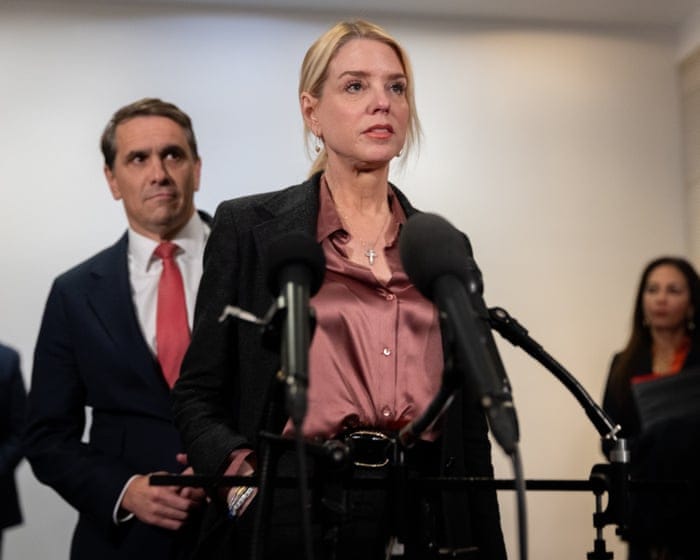
The Guardian US reported that Attorney General Pam Bondi refused to commit to testifying under oath about Jeffrey Epstein files during a closed-door congressional briefing, prompting Democratic lawmakers to walk out in protest and immediately begin drafting articles of impeachment. Bondi claimed executive privilege over documents that implicate powerful political allies, despite a congressional subpoena demanding her sworn testimony.
The briefing, described by attendees as "fake" and evasive, represents the latest instance of the Trump administration blocking congressional oversight on documents that could expose the extent of Epstein's connections to current and former officials. Democrats who attended the session said Bondi provided no substantive information about the files' contents, refused to answer questions about why certain documents remain classified, and would not commit to appearing before Congress under oath—a requirement that would make false statements a federal crime.
According to The Guardian US1014, the walkout came after Bondi repeatedly invoked executive privilege when pressed on whether the Justice Department would release Epstein-related materials that do not involve ongoing criminal investigations. Congressional Democrats argue that executive privilege cannot be used to shield information about crimes committed by private citizens, particularly when those citizens had documented relationships with sitting officials.
The impeachment effort faces long odds in a closely divided Congress, but it exposes a structural problem: an attorney general who serves at the pleasure of the president has little incentive to investigate or disclose information that could damage the administration. Bondi's refusal to testify under oath follows a pattern established across multiple administrations, where executive branch officials cite privilege to avoid accountability while Congress lacks enforcement mechanisms to compel testimony.
This is not the first time the Trump administration has used executive privilege to block oversight. When War Reporting Becomes 'Treason,' Democracy Dies in Broad Daylight documented how the administration has expanded claims of executive authority to shield information from public scrutiny. The Epstein files represent a test case: if an attorney general can refuse sworn testimony about documents that implicate powerful allies, congressional oversight becomes a procedural formality rather than a constitutional check on executive power.
The Democratic impeachment effort will likely fail on a party-line vote, but Bondi's refusal to testify under oath has created a public record. Voters now know that the attorney general considers protecting powerful allies more important than transparency about a convicted sex trafficker's political connections. That calculation may prove costly in an election year, particularly as polling shows growing public distrust of institutions that appear to operate by different rules for the politically connected.