This morning, the President of the United States posted on Truth Social, a post that may define how history remembers this war — and how the rest of the world remembers America.
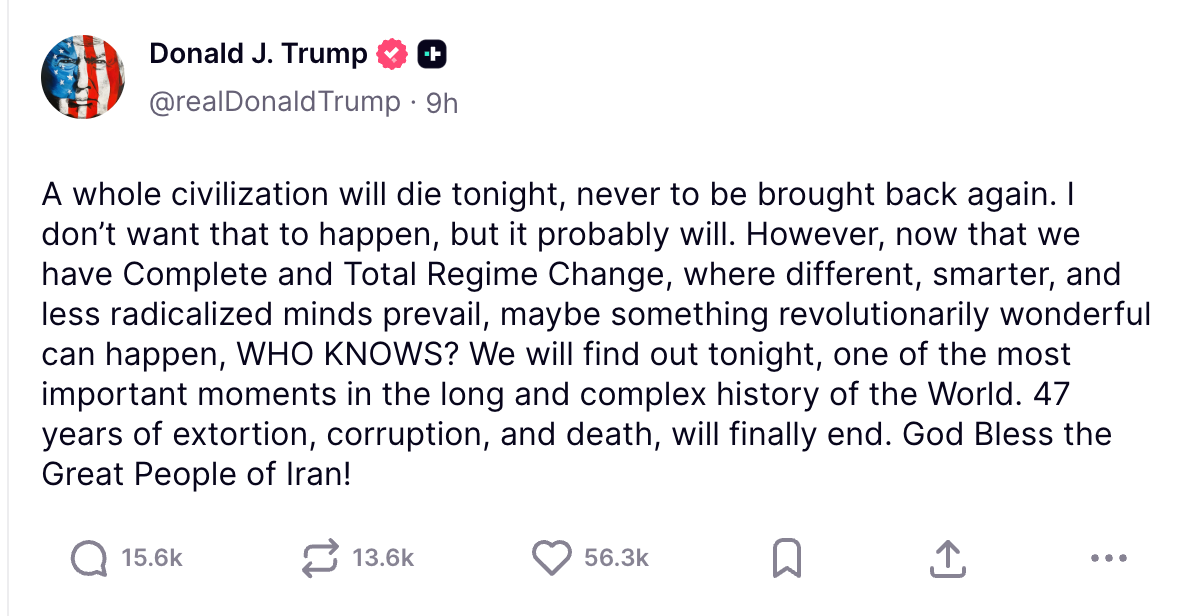
The post came less than 12 hours before Trump's self-imposed deadline: if Iran does not agree to reopen the Strait of Hormuz by 8:00 PM Eastern tonight, the United States will launch what the president has described as attacks on Iran's infrastructure so devastating that a civilization will be destroyed.
Human rights expert Kenneth Roth called it what it is: "Trump is openly threatening collective punishment, targeting not the Iranian military but the Iranian people." More than a dozen Democrats in Congress have called to invoke the 25th Amendment.
But what matters more than the domestic reaction is what happened at the United Nations today — and what it tells us about how the rest of the world is processing this moment.
Iran Turns Trump's Words Against Him
At the UN Security Council, Iran's representative used the president's own language as evidence of American unfitness for global leadership. The rhetoric, Iran's delegation argued, is "unfitting of any political leader, let alone the head of a permanent member of the Council entrusted with the maintenance of international peace and security."
Iranian embassies around the world amplified the message. The Iranian embassy in South Africa urged American officials to "seriously think about the 25th Amendment, Section 4" — the constitutional provision for removing a president deemed unfit. The Iranian mission in Vienna wrote that "POTUS has stooped to an unprecedented level of begging, laced with bitter, hollow rudeness and threats."
The message is clear: Iran is not just responding to Trump's threats. It is using them to make a case to the international community that the United States — the country that holds a permanent seat on the body responsible for maintaining global peace — is the one behaving irrationally.
The Security Council Vote That Failed
Today, the UN Security Council voted on a Bahrain-led resolution aimed at reopening the Strait of Hormuz — the chokepoint through which roughly 20% of the world's oil supply flows. Iran has effectively blockaded the strait since the United States and Israel launched the war on February 28.
Eleven nations voted in favor. Two — China and Russia — vetoed. Pakistan and Colombia abstained. The resolution died.
It is worth understanding how aggressively this resolution was weakened before the vote — and how it was still vetoed.
Bahrain's Foreign Minister Abdullatif bin Rashid Al Zayani did not hold back. He accused the Security Council of allowing the international community to be "held hostage to economic blackmail" from Iran, calling the Strait of Hormuz an international waterway whose closure under the watch of the world's most powerful diplomatic body is indefensible.
Russia's envoy Vassily Nebenzia called the resolution "unbalanced, inaccurate and confrontational" — arguing that it placed all blame on Iran while ignoring the fact that the United States and Israel started the war.
China's Play
Pay close attention to what China did today. It is more important than the veto itself.
China's UN Ambassador Fu Cong blamed the United States and Israel for starting the war and for the spiraling global crisis it has caused. He called the resolution "highly susceptible to misinterpretation or even abuse" and warned that its adoption would have "serious, very serious consequences."
But the subtext of China's position goes far beyond a single vote. While the President of the United States is on social media threatening to destroy a civilization, China is telling the world: look at the chaos America causes. Look at us. We do not do this. We build infrastructure. We make trade deals. We are the stable, rational alternative.
And the world is listening.
Under sanctions, Iran has developed alternative trade channels — exporting oil through settlements in Chinese yuan. This is not a minor detail. Iran has reportedly told tankers they may pass through the Strait of Hormuz — provided the oil is sold in Chinese currency. The petroyuan is no longer theoretical. It is emerging from this war as a real alternative to the petrodollar.
The Dollar Question
The United States carries $39 trillion in national debt. The dollar's dominance as the world's reserve currency is the only reason that debt is manageable. That dominance rests on two pillars: the global oil trade being denominated in dollars, and the belief that America provides reliable security guarantees to its allies.
Both pillars are cracking.
Since the war began, Spain and Switzerland refused access to their territory or airspace for American aircraft bound for Iran. Australia and Japan — both heavily dependent on oil shipped through the Strait of Hormuz — have been unenthusiastic about deploying ships to help reopen it. NATO allies set conditions — a ceasefire and clear international mandate — before participating. America's Gulf allies, who have hosted US military bases for decades, are staying out of a war they did not sign up for.
When your allies refuse to support your war, refuse to let you use their airspace, and begin questioning whether to hold their sovereign wealth in your currency — that is not a diplomatic disagreement. That is the early stage of a structural realignment of the global order. The United Kingdom is already pivoting toward Brussels. The BRICS nations see this war as an accelerant for de-dollarization.
If you have no idea how that affects you, consider this: the $39 trillion national debt is only sustainable because the world trusts the dollar. The moment that trust erodes — the moment oil begins trading in yuan instead of dollars at meaningful scale — interest rates rise, borrowing costs explode, and every American who carries a mortgage, a car loan, or student debt feels it directly.
What the World Sees
Step outside the American media bubble for a moment.
The rest of the world watched the President of the United States threaten to destroy a civilization on social media. They watched Iran's diplomats use his own words to argue that America is unfit to lead. They watched a UN resolution — watered down three times to remove any authorization of force — still get vetoed because China and Russia see more strategic value in the chaos than in resolution. They watched America's closest allies refuse to participate in a war that Congress never authorized. And they watched China quietly offer itself as the alternative.
China is not winning this war. But it may be winning the peace that follows — by doing nothing except standing still while the United States sets fire to the international order it built.
The question is no longer whether Iran will reopen the Strait of Hormuz by 8:00 PM tonight. The question is whether the United States can rebuild the credibility it is destroying in the process of trying to force it open.