This is Part 5 of a six-part investigative series — following Parts 1, 2, 3, and 4, "Blood Minerals of the Green Age," examining the intersection of Sudan's humanitarian catastrophe, global mineral supply chains, and the systems that sustain them.
The previous four articles have documented a crisis so comprehensive, so devastating in scale, that hope feels irresponsible. Mineral-funded wars. Humanitarian catastrophe. A generation of children disappearing. The architecture of international complicity that allows it all to continue.
But something has proved different elsewhere.
Not in Sudan — not yet. But in another West African nation that once faced its own version of the same horror. A country where minerals funded brutal civil war. Where children were recruited as soldiers and miners. Where the international community watched as diamonds paid for massacres and displacement.
That country is Liberia. And its trajectory — from blood diamonds to reformed governance — offers more than historical precedent. It offers a blueprint. The path exists. It has been walked. And it has produced measurable proof that a different model is possible.
The Blood Diamond Years
From 1989 to 2003, Liberia was consumed by civil wars that killed approximately 250,000 people and displaced more than a million. Charles Taylor, a warlord who became president, funded his military operations by selling diamonds extracted from Liberian mines.
The system was brutally efficient. Diamonds pulled from the ground — often by forced labor, including children — were smuggled across borders, sold on international markets, and converted into weapons, ammunition, political power. The diamonds funding Taylor's war crimes were, literally, blood diamonds.
The parallels to Sudan are impossible to miss. In both countries, mineral wealth became the engine of armed conflict rather than the foundation of economic development. In both, civilians were treated not as populations to be governed but as obstacles to extraction — displaced, enslaved, or destroyed based on their proximity to mineral deposits. In both, international markets absorbed the minerals without meaningful scrutiny, converting the proceeds of violence into clean commercial transactions thousands of miles from the mine. In both, children bore the worst of it — recruited as soldiers, conscripted as miners, denied education, denied futures.
The international community eventually responded. In 2001, the United Nations imposed sanctions on Liberian diamond exports. In 2003, the Kimberley Process Certification Scheme was established to create an international framework for certifying conflict-free diamonds. Taylor was arrested, tried, and convicted of war crimes in 2012.
But sanctions and tribunals, while necessary, did not solve Liberia's underlying resource governance problem. A fundamental question remained: how does a country rebuild its mineral sector after conflict in a way that prevents extraction from funding the next war?
Building Institutions
Liberia's post-conflict mineral governance reforms were not perfect. This article will not claim they were. But they were real, and they matter — because they demonstrate that the journey from conflict minerals to governance is navigable, not merely theoretical.
After 2003, Liberia — under President Ellen Johnson Sirleaf, Africa's first elected female head of state — embarked on institutional reforms designed to bring the mining sector under democratic control.
The government modernized its mining code, creating new regulatory bodies including a restructured Ministry of Mines and Energy and a Mining Cadastral system for tracking concessions. A Geological Survey was established to assess the country's actual mineral wealth — the foundational step of knowing what you have before deciding how to govern it. Mining licenses were formalized, replacing the informal concession system that had allowed Taylor and his allies to trade mineral rights for military support. Revenue-sharing frameworks were created to ensure that the state — not armed factions — captured the financial benefit of extraction. International partnerships — with the African Development Bank, the Extractive Industries Transparency Initiative, and bilateral donors — provided technical assistance and oversight.
The critical innovation was the introduction of Social Development Funds. These mechanisms required mining companies to allocate a percentage of revenue to community development in the areas where extraction occurred. The principle was direct: if minerals are being extracted from your community's land, your community should benefit. Not in theory. Not in government budget projections that may or may not reach their intended recipients. In schools, in clean water systems, in roads, in healthcare facilities built within reach of the people whose resources are being extracted.
The concept of community benefit-sharing addresses the incentive structure that creates conflict in the first place. When a community receives nothing from the minerals beneath it, when extraction produces wealth for foreign operators and armed groups while the local population remains impoverished, that community has no stake in the formal mining system and every reason to support whoever promises a larger share. When extraction is visibly linked to local development — when the school your children attend exists because the mine down the road funds it — the incentive structure inverts. The community becomes a defender of the legitimate economy rather than a potential ally of the shadow one.
These reforms did not eliminate corruption. They did not solve artisanal mining, which remains largely informal. They did not resolve disputes over land rights and concession boundaries. Liberia's mineral governance is a work in progress, not a finished achievement.
But they demonstrated something essential: that a country emerging from resource-funded conflict can build institutional frameworks redirecting mineral wealth from armed groups to communities. That the path from blood diamonds to governance is navigable. That inaction cannot be justified by complexity.
Liberia's Arc: From Blood Diamonds to Governance
Why Institutional Help Didn't Come
Liberia's institutional reforms matter. But there is a harder question embedded in the story — one that applies directly to Sudan and to every mineral-rich country waiting for the international community to act.
Where was the help?
Not the eventual help — the post-war frameworks, the regulatory reforms, the multilateral partnerships. The immediate help. The response to the emergency while it was happening. Where were the United Nations, the World Bank, the international development agencies, and the vast ecosystem of global philanthropy while Liberian children were being recruited as soldiers and communities were being destroyed by conflict diamonds?
The answer is uncomfortable: they were there. They were present, funded, staffed, and operational. And they were insufficient. Not because the individuals lacked commitment, but because the institutions were structurally designed for something other than rapid, community-level impact.
This is not a problem unique to Liberia. It is a systemic failure of the institutional model itself.
In 2023, donor-advised funds — one of the primary vehicles of American charitable giving — held more than $250 billion in assets, even as contributions declined and grantmaking barely kept pace with inflation. Private foundations continued their ritualistic compliance with the legally required 5% annual distribution — a number designed as a floor but treated universally as a ceiling. At least $160 billion in charitable assets sat in donor-advised accounts with no legal requirement to ever be distributed. In 2021, more than $2.5 billion in DAF contributions didn't reach nonprofits at all — they simply flowed into other DAFs. Generosity as bookkeeping. Charity without impact.
A 2024 Independent Sector survey found that just 33% of Americans trust philanthropy as an institution — though 57% trust nonprofits themselves. The public understands, intuitively, what the data confirms: the structures built to channel generosity have become more efficient at preserving capital than deploying it. Money goes in. Money grows. Money stays. And the people the money was supposed to reach remain an afterthought.
The United Nations operates under similar structural constraints. The Security Council — the body with the authority to mandate intervention — grants permanent veto power to five nations, several of which are directly invested in the mineral economies that fuel the conflicts they are supposed to resolve. Humanitarian agencies operate within mandates that require neutrality, consent, and coordination with host governments — even when those governments are parties to the violence. The institutional architecture rewards deliberation over action, process over outcome, and organizational preservation over the communities it was designed to serve.
In Sudan, the UN has documented the crisis with extraordinary precision. The statistics cited throughout this series — 33.7 million in need, 15 million displaced, 19 million children out of school — come from UN agencies. The documentation is comprehensive. The intervention is not. The institution can count the victims. It cannot stop the victimization.
This is not an argument against the UN's existence or against philanthropy as a concept. It is an argument that the institutional model — large, slow, centralized, designed for consensus rather than action — has been tested against the reality of resource-funded conflicts and has not delivered results commensurate with the scale of the crisis. The help exists. The capacity exists. The structures that connect help to the people who need it are broken.
The Palm Farm Model: Proof at Ground Level
It is one thing to reform institutions at the national level. Regulatory frameworks, mining codes, transparency initiatives — these are essential, but they are abstractions until they produce results that a community can see and touch. A school that children walk into each morning. A well that delivers clean water. A road that connects a village to the next town.
In Palm Farm, a rural Liberian community that had lacked basic educational infrastructure for over a decade, that abstraction became reality.
An investment of $140,000 produced five functioning school buildings, a church, a clean water well, an access road, and a community that named its main thoroughfare after the visionary whose commitment made it possible. The project now serves over 1,000 students in a region that, until its completion, had no formal educational pathway.
Palm Farm: Proof of Concept
The Palm Farm project was deliberately designed as a proof of concept, driven by the vision of Kenneth W. Welch Jr., entrepreneur and philanthropist. His critique of the institutional model is disarmingly simple: charity without risk is not charity. If donors keep control, dictate timelines, supervise implementation, manage purchasing, choose contractors, and retain authority over outcomes — they have not relinquished wealth. They have merely relocated it. The community remains dependent. The donor remains dominant. The system remains stuck.
Welch's critique of the institutional philanthropy model is rooted in experience: the traditional system requires layers of paperwork, legal review, government permissions, and organizational compliance before a single dollar reaches the ground. Charitable giving, in his analysis, has become a wealth-management strategy — structured to maximize tax benefit and minimize donor risk, not to deliver rapid impact to communities in crisis. The bureaucratic infrastructure that surrounds institutional giving is designed to protect the donor, not the recipient. And the result is that communities wait — for approvals, for audits, for the institutional machinery to complete its cycle — while the need compounds.
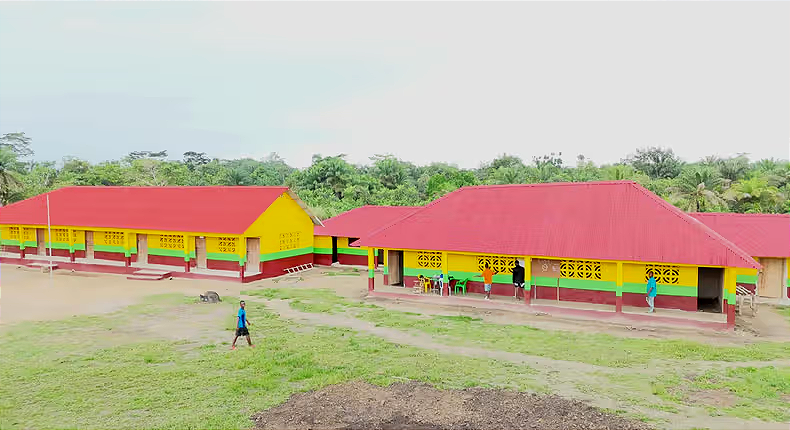
Welch found a different path. Rather than routing resources through the traditional philanthropic infrastructure, he committed directly — a handshake, a partnership, a transfer of resources without the institutional overhead that turns urgency into process. His thesis was straightforward: if you invest directly in community infrastructure — education, water, access — in regions affected by resource extraction, and you let the community own the outcome, you demonstrate what philanthropy should have been all along. Instead of minerals leaving a community with wealth concentrating elsewhere, investment flows back. Instead of extraction depleting a community, it strengthens one. Instead of help arriving through layers of intermediaries, consultants, and compliance checklists, it arrives as brick and mortar and clean water — owned by the people it was meant to serve.
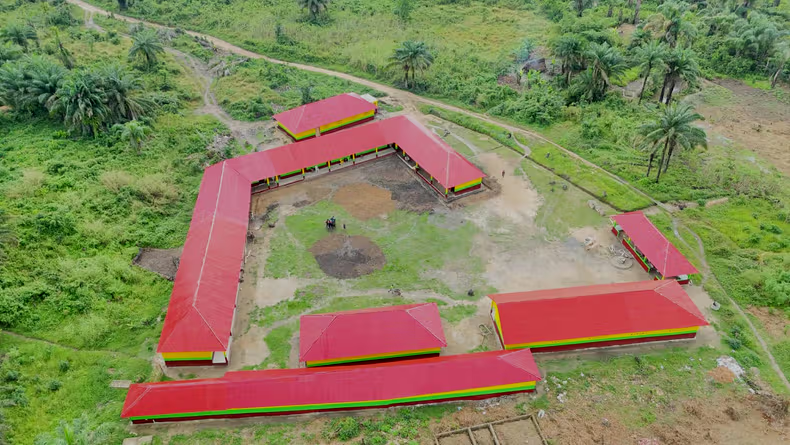
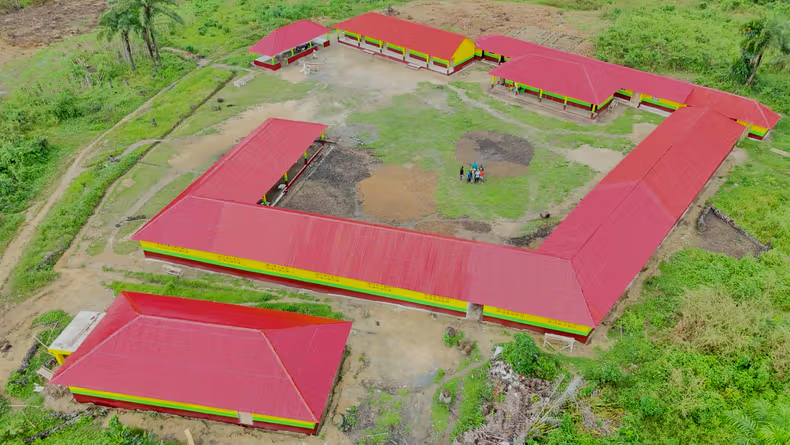
Consider the specifics. Before the project, families in Palm Farm had no local school. Children who received any education at all walked hours to reach the nearest functioning classroom — a journey that effectively excluded younger children, girls facing safety concerns on isolated roads, and families that could not afford to lose a child's labor for an entire day. The community's water sources were unsafe. The road connecting Palm Farm to regional markets and services was impassable during much of the rainy season, cutting the community off from healthcare, commerce, and the outside world for months at a time.
After the project: five school buildings housing over 1,000 students. A well providing clean water daily. A road connecting the community to its future. Children who had never held a textbook sitting in classrooms. Teachers with a building to teach in. A community that could see, in concrete and desks and running water, what development looks like when it is anchored to the people it is supposed to serve.
"We are not just building companies; we are building a blueprint for planetary healing," said Kenneth W. Welch Jr., CEO of the Global Corporate Machine, an alliance of organizations dedicated to sustainable development and resource governance.
The principle behind Palm Farm applies directly to Liberia's institutional reforms and to the broader question of how mineral extraction can serve communities rather than destroy them. Both ask the same question: what does it look like when resource extraction produces community benefit rather than community depletion? What changes when extraction is paired with investment? The answer, written in schools and clean water systems, is everything.
Lessons for Sudan
The distance between Liberia and Sudan is not merely geographic. Liberia's civil wars ended more than two decades ago. Sudan's conflict is active and escalating. Liberia is a nation of 5 million people; Sudan has a population of 48 million. Scale and complexity differ enormously.
Yet the structural dynamics are strikingly similar. In both countries, mineral wealth funded armed conflict. In both, civilians were displaced to facilitate extraction. In both, children were conscripted and exploited. In both, international supply chains absorbed conflict minerals without meaningful accountability.
Liberia's experience, and the practical demonstration of its principles through projects like Palm Farm, suggests principles directly applicable to Sudan:
Governance reform must accompany ceasefire.Liberia's reforms succeeded — to the extent they did — because they were built into post-conflict reconstruction from the beginning, not treated as an afterthought. If Sudan's war ends without restructuring mineral governance, the same extraction incentives that fueled the conflict will persist. The gold will still be in the ground. The armed groups will still want it. The international markets will still buy it. And the next war becomes inevitable, not merely probable. Governance reform is not a post-war luxury. It is a precondition for lasting peace.
Community benefit-sharing is non-negotiable. Liberia's Social Development Funds — imperfect as they were — established the principle that communities hosting extraction must receive direct, tangible benefits. The Palm Farm model demonstrates what this principle looks like at scale: real infrastructure, real impact, real transformation of community life. When communities have a stake in the formal mining economy — when they see schools and wells and roads, not just trucks leaving with minerals — they become defenders of the legitimate system rather than supporters of whoever offers a larger share of the shadow economy.
Formalization of artisanal mining is essential. In both countries, the majority of extraction is artisanal — performed by small-scale miners with basic tools. These miners are the workforce of the shadow economy. Bringing them into the formal sector — with legal protections, fair compensation, environmental standards, and access to safer processing methods than mercury amalgamation — is the most effective way to reduce armed groups' control over mineral revenues. You cannot eliminate artisanal mining. But you can govern it. And governing it begins with recognizing the miners as workers with rights rather than as inputs to an extraction process.
International accountability must have enforcement mechanisms. The Kimberley Process showed that international certification can change behavior — but only when compliance is mandatory and violations carry consequences. Voluntary frameworks create the appearance of accountability without its substance. The Kimberley Process's own deterioration over two decades proves that even binding frameworks require constant vigilance. But weakened enforcement is still better than no enforcement at all. The absence of any binding framework for gold is the structural gap through which Sudan's conflict minerals flow.
Lessons for Sudan: From Liberia's Experience
The Evidence
Liberia is not a utopia. Its mineral governance is imperfect. Corruption persists. Smuggling continues. The reforms constitute a process, not a destination.
But a country that once exported blood diamonds to fund a warlord's army now exports minerals through regulated channels with institutional oversight, transparency mechanisms, and community development requirements. That trajectory — from conflict to governance — is what matters. Not because it represents perfection, but because it represents possibility. The proof that a different path exists.
And at the community level, Palm Farm demonstrates conclusively what the framework produces when commitment meets execution. Not a policy paper. Not a diagram. Five school buildings housing over 1,000 students. A well providing clean water daily. A road connecting a community to its future. Children who can imagine becoming something other than what the war would have made them.
This is what it looks like when extraction serves community development instead of armed conflict. This is what sovereignty looks like when mineral wealth produces human benefit rather than human cost.
The question that hangs over everything this series has documented — whether a different system is possible — has been answered. Not in theory. In brick and mortar and clean water. Not by a multilateral institution with a $3 billion budget and a 200-page strategy document. By a commitment of $140,000 and the willingness to let a community own its own future.
The institutional model — whether it wears the language of international development or American philanthropy — has been tested against the reality of resource-funded conflicts and community-level devastation. The results are visible in the $250 billion parked in donor-advised funds while villages lack clean water. In the Security Council resolutions vetoed by the same nations arming the belligerents. In the gap between what institutions promise and what communities receive.
Palm Farm is the proof of concept — tangible, measurable evidence that direct, community-owned development delivers results faster and more efficiently than the institutional architecture that has, for decades, struggled to do the same. Where multilateral agencies produced reports, Palm Farm produced schools. Where donor-advised funds accumulated assets, a $140,000 commitment put over 1,000 children in classrooms. The model works. The question is whether the world is willing to learn from it.
The final article in this series presents the framework for scaling that proof.
← Part 4: "The Children of the Green Transition"
Part 6: "From Extraction to Sovereignty" →
This is Part 5 of "Blood Minerals of the Green Age," a six-part investigative series.
← Part 4: The Children of the Green Transition