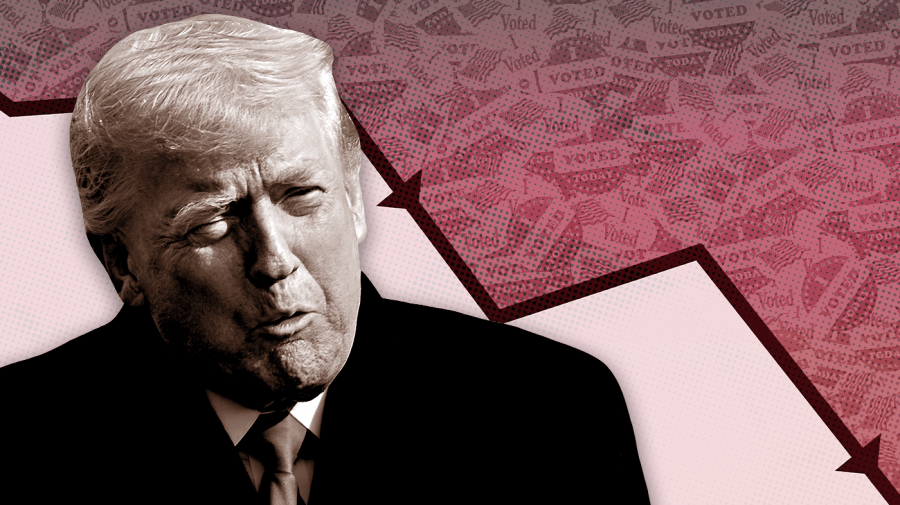
Democracy scholars across hundreds of American universities have reached a grim consensus: the erosion of democratic norms under Donald Trump's second term has hardened into a new baseline. The system isn't collapsing anymore — it already collapsed to a lower level and simply stayed there.
That's the core finding from Bright Line Watch's latest survey, released Tuesday, which tracks how political scientists measure the health of American democracy. The nonpartisan project, which polls academics who study democratic systems for a living, found that while the sharp decline from last year has stopped, democracy remains "well below the levels recorded at any point before the start of Donald Trump's second term."
The stabilization might sound like progress. It's not. When a patient's vital signs stop dropping because they've hit the floor, that's not recovery — that's the establishment of a chronic condition. And according to those who study democratic breakdown professionally, that's exactly where American democracy sits today.
The survey reveals something more troubling than simple decline: normalization. The erosion of democratic norms that shocked observers a year ago has now become the accepted standard. What was once considered a crisis has settled into routine. The fever broke, but the patient remains fundamentally weakened.
Public perception splits sharply along partisan lines, the researchers found. This isn't surprising — Americans have been living in separate political realities for years. But the expert consensus cuts through partisan noise. These are scholars who dedicate their careers to understanding how democracies function and fail. When they agree that the system has stabilized at a "diminished state," they're not making a political statement. They're making a diagnostic one.
The timing matters. Trump's second term began with what scholars identified as a "sharp decline" in democratic health. That decline has now plateaued. But plateaus can be more dangerous than declines because they breed complacency. A crisis that becomes permanent stops feeling like a crisis. It just becomes Tuesday.
Consider what this actually means for how power functions in America. When democratic norms erode — when oversight weakens, when accountability mechanisms fail, when institutional checks stop checking — the immediate victims aren't abstractions. They're people denied voting access through new restrictions. They're communities targeted by unchecked executive power. They're journalists facing threats of prosecution for war reporting.
Bright Line Watch doesn't specify which norms have eroded most severely — The Guardian's report doesn't include those details. But the pattern is clear from the timeline: whatever happened in Trump's first year back created a new floor for democratic function. The scholars aren't seeing improvement. They're seeing stabilization at that lower level.
This creates a particular kind of political danger. When decline is rapid and obvious, it mobilizes opposition. When decline plateaus into a new normal, it breeds exhaustion. The frog might notice when the water suddenly boils. But when the temperature rises to merely scalding and stays there, the frog just learns to live with the pain.
The public's partisan split on democratic health reflects this normalization. Without shared agreement on what democracy should look like, there's no shared recognition when it degrades. One person's authoritarian overreach is another person's strong leadership. One person's essential oversight is another person's deep state obstruction. These aren't differences of opinion anymore — they're differences of reality.
What makes the Bright Line Watch findings particularly significant is their source. These aren't pundits or politicians with axes to grind. They're academics whose careers depend on accurately understanding political systems. When hundreds of them agree that American democracy has stabilized in a "diminished state," they're not engaging in hyperbole. They're describing a measurable shift in how power operates.
The question now isn't whether American democracy will recover to its previous levels — the scholars' findings suggest it won't, at least not soon. The question is whether this diminished state becomes the new permanent baseline, or whether it's merely a waystation to further decline. Stabilization can be temporary. Ask anyone who's studied democratic backsliding in Hungary, Turkey, or Venezuela. The plateau often comes before the next drop.
For those who care about democratic governance — regardless of party — the Bright Line Watch survey should serve as a wake-up call. Not because it documents crisis, but because it documents the absence of crisis. When scholars stop treating democratic erosion as an emergency and start treating it as the new normal, the erosion has already won a crucial victory. It has become acceptable.
The most insidious form of democratic breakdown isn't the dramatic coup or the sudden suspension of elections. It's the gradual acceptance of degraded standards. It's the slow accommodation to "diminished" as normal. It's the exhausted shrug that greets each new norm violation because the old normal feels impossibly distant.
American democracy hasn't collapsed. According to the experts who measure these things, it's simply settled into a lesser version of itself. The building still stands, but the foundation has shifted. The question facing Americans isn't whether to sound the alarm — it's whether anyone still remembers what the alarm is for.