Florida already stripped sociology from its public university graduation requirements. It has ordered professors to submit to ideological surveys. It has banned books, rewritten AP curricula, and dissolved a university's board for insufficient political loyalty. Monday's signing by Gov. Ron DeSantis of a bill granting state officials unilateral authority to designate domestic terror organizations — and to remove university students accused of supporting them — is not a departure from that pattern. It is the pattern's logical conclusion.
The law, reported by The Hill, hands DeSantis and other Florida state officials the power to label organizations as domestic terror groups, a designation that triggers consequences for any public university student deemed to be supporting them. The bill does not require a federal designation. It does not require a criminal conviction. It does not specify what standard of evidence must be met before a student is removed. The governor's office becomes, in effect, its own terror-listing authority — accountable to no court it has not already helped shape.
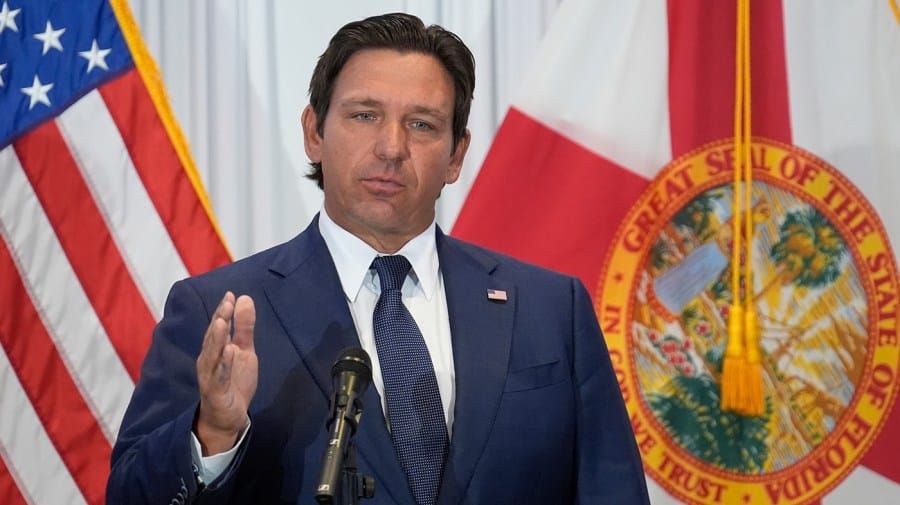
DeSantis framed the measure in constitutional terms. "To uphold the rule of law," he stated at the signing, "our state must operate under one legal system, the Constitution must remain…" The sentence, as reported, trails off — but the architecture of the law does not. What the law builds is a parallel enforcement structure: a state-level mechanism for criminalizing political association that bypasses the federal designation process entirely, with consequences that fall not on organizations but on students.
That distinction matters. Federal terror designations — even deeply contested ones — are subject to legal challenge, congressional oversight, and established evidentiary processes. They also target organizations directly. Florida's new framework targets individuals based on association, at the discretion of elected officials whose political incentives are nakedly visible. The question the law does not answer — and appears designed to avoid answering — is what separates a protest group from a terror organization in the eyes of a governor facing a primary electorate.
The answer, in practice, will be political. It has already been political. Pro-Palestinian student organizations at Florida universities have faced pressure, surveillance, and administrative action since October 2023. DeSantis moved to shut down Students for Justice in Palestine chapters at Florida public universities within weeks of the Hamas attacks, citing state law governing foreign influence — a legal theory that courts have since challenged elsewhere. This new law does not need that theory. It creates a cleaner instrument: the governor designates, the university acts, the student is removed.
The accountability structure here is worth examining with precision. Under this law, the official who makes the designation is an elected politician. The institution that enforces the consequence — the public university — depends on state appropriations and is already subject to a sweeping regime of political oversight that Florida has constructed over the past four years. The student facing removal has no guaranteed hearing before an independent arbiter. And the organization being designated has no clear path to challenge the label in a court that must weigh it against First Amendment protections before consequences flow.
This is the systemic pattern: not a single law, but a legal infrastructure assembled piece by piece. Florida stripped sociology from graduation requirements — the academic discipline most equipped to teach students how power concentrates. It pressured professors to self-censor or risk their positions. It restructured university governance to give political appointees direct authority over hiring and curriculum. Each measure, in isolation, could be defended as an administrative or budgetary decision. Together, they constitute a system designed to make dissent professionally and legally costly — and to make the tools of suppression available to whoever holds executive power in Tallahassee.
The human impact of that system is not abstract. Students at Florida public universities who participate in political organizing — particularly around foreign policy, immigration, or racial justice — now face a legal environment in which their continued enrollment can be conditioned on the political judgment of the governor's office. A student who attends a rally, shares a social media post, or joins an organization that a future state official decides to label a terror group has no guaranteed protection. The law does not require intent. It does not require action. It requires association — and association is the currency of all political organizing.
Critics of the law, including civil liberties organizations, have argued it is facially unconstitutional under the First Amendment's protection of freedom of association. The Supreme Court has held since NAACP v. Alabama (1958) that the government cannot compel disclosure of membership in organizations engaged in lawful activity, and that punishment based on association without proof of individual wrongdoing violates due process. Florida's law will almost certainly face legal challenge. But legal challenge takes time. Enrollment decisions do not.
That temporal gap is the point. A student expelled or suspended while a lawsuit works its way through federal courts loses a semester, a year, possibly a degree. The chilling effect on organizing does not wait for a judicial ruling. The law's power is not primarily punitive — it is preemptive. Students who know the designation authority exists will calculate their risks before joining, before attending, before speaking. That calculation is the law's intended function.
Florida is not operating in isolation. The broader federal environment — including the ongoing federal pressure on universities over Palestine solidarity speech and the use of immigration enforcement against student activists — has created a coordinated multi-front pressure on campus political life. What Florida has done is build a state-level instrument that does not require federal coordination. Other Republican-controlled states are watching. The legislative template is now available.
DeSantis leaves the governorship in 2026 due to term limits. The law he signed Monday does not leave with him. It passes to whoever holds that office next — and to every state official empowered by its language. A designation authority built for one political moment does not dissolve when the moment passes. It waits for the next one.