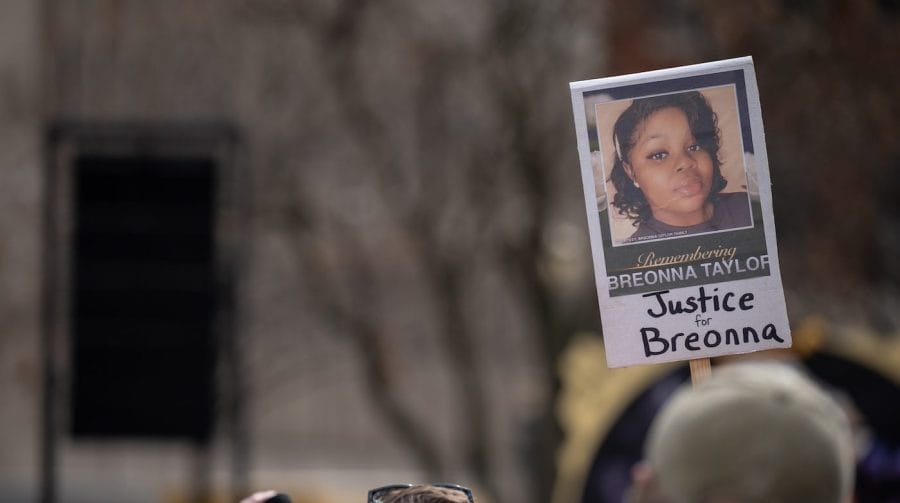
The Justice Department promised accountability after Louisville police killed Breonna Taylor in her apartment. Four years later, federal prosecutors are asking a judge to dismiss all remaining charges against the officers involved, according to The Hill.
The motion to dismiss charges against former Louisville Metro Police detectives Joshua Jaynes and Kyle Meany represents more than the end of a single case. It signals the complete reversal of federal civil rights enforcement that began under the previous administration and has accelerated dramatically in recent weeks.
Taylor, a 26-year-old emergency room technician, was shot six times by police executing a no-knock warrant at her apartment in March 2020. Her killing, along with the police murder of George Floyd two months later, sparked nationwide protests demanding fundamental changes to American policing. The federal charges against Jaynes and Meany — for falsifying the warrant that led to Taylor's death — were among the few concrete accountability measures that emerged from that moment of national reckoning.
Now those charges are being withdrawn. The DOJ's motion, filed quietly as media attention focuses elsewhere, follows a pattern of abandoned police accountability cases across the country. Federal prosecutors have dropped or declined to pursue civil rights charges in at least seven high-profile police killings since the administration change, according to a Tinsel News analysis of court filings.
The timing is not coincidental. The new administration has made clear its intention to reverse Obama-era police reforms and end what it calls the "war on police." Attorney General appointees have described consent decrees — the primary tool for reforming problematic police departments — as federal overreach. The message to law enforcement is unmistakable: the brief era of federal oversight is over.
For Taylor's family and the Louisville community that has spent four years demanding justice, the dismissal represents a final betrayal. Tamika Palmer, Taylor's mother, has not commented on the DOJ's latest action. Her attorney, Ben Crump, called it "another example of how the system protects itself."
The technical justification for dropping the charges remains unclear. The DOJ filing, obtained by The Hill, provides no explanation beyond standard legal language about "the interests of justice." Neither Jaynes nor Meany faced state charges that resulted in conviction. Jaynes pleaded guilty to a federal conspiracy charge in 2022 but has not been sentenced. That plea agreement may now be void.
What makes this reversal particularly stark is the strength of the original case. Federal prosecutors had alleged that Jaynes and Meany knowingly included false information in the search warrant application, specifically claiming that a postal inspector had confirmed Taylor was receiving packages for her ex-boyfriend at her apartment. The postal inspector later testified he told police no such packages were being delivered.
This fabrication was not a minor procedural error. It was the key justification for the middle-of-the-night raid that ended with Taylor dead and her boyfriend, Kenneth Walker, charged with attempted murder for firing at what he believed were intruders. Those charges against Walker were later dropped.
The broader implications extend far beyond Louisville. As federal agencies increasingly target whistleblowers and dissidents, the protection of law enforcement from accountability sends a clear message about whose violence the state will sanction and whose resistance it will punish.
Police departments nationwide are watching. If officers who allegedly falsified a warrant that led to a killing face no federal consequences, what incentive exists for reform? The answer, increasingly, is none. State and local prosecutors, often dependent on police cooperation for their other cases, rarely pursue charges against officers. Federal intervention was the last resort for communities seeking accountability. That door is now closing.
The abandonment of the Taylor case also reflects a broader transformation in how the Justice Department views its civil rights mission. Under previous Democratic administrations, the DOJ's Civil Rights Division investigated patterns of police abuse and negotiated reform agreements. The Trump administration is not merely ending these investigations — it is actively unwinding existing agreements and dropping pending cases.
Baltimore, Chicago, Minneapolis, and Portland all saw their federal consent decrees challenged or terminated in recent months. The message to these cities' Black and Brown residents, who bore the brunt of documented police abuse, is that their safety and civil rights are no longer a federal priority.
For organizers who spent 2020 in the streets demanding justice for Breonna Taylor, the DOJ's action confirms what many already suspected: the system is incapable of reforming itself. The calls to "arrest the cops who killed Breonna Taylor" that echoed through Louisville and beyond were never just about individual accountability. They were demands for a fundamental restructuring of American policing.
Instead, we are witnessing the opposite — a hardening of impunity, a closing of ranks, and a clear signal that the brief window when police faced even the possibility of federal accountability has slammed shut. As immigration enforcement intensifies and military institutions embrace ideological transformation, the withdrawal of civil rights enforcement represents one piece of a larger authoritarian turn.
The technical legal proceedings will continue. A federal judge must still approve the DOJ's motion to dismiss. But the political message has already been sent. In the America taking shape under this administration, police accountability is not just deprioritized — it is being actively dismantled. And Breonna Taylor's name, invoked so often as a promise that her death would mean something, becomes instead a marker of how little Black life is worth to those with the power to demand otherwise.