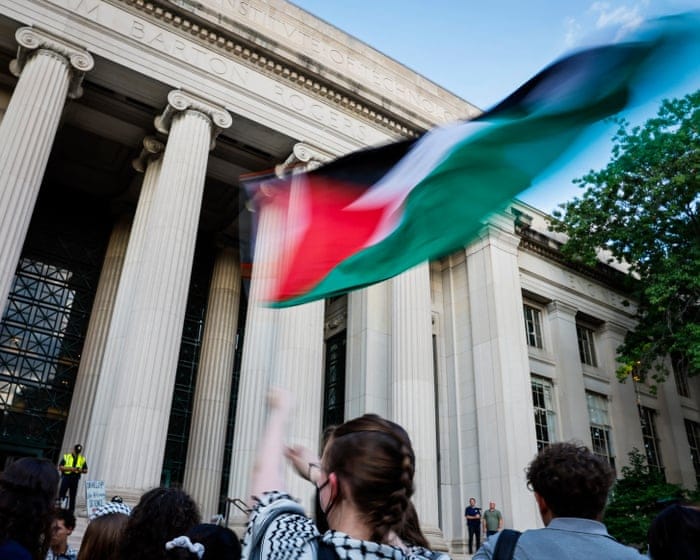
A federal judge in California last week dismissed a lawsuit that sought to ban the phrase "From the river to the sea, Palestine will be free" from UC Berkeley's campus. The ruling was the latest in a string of legal defeats for groups attempting to silence Palestine solidarity activism by redefining it as antisemitism — a strategy that has failed in courtroom after courtroom as judges affirm that criticism of Israel remains protected political speech under the First Amendment.
Since October 2023, pro-Israel advocacy groups have filed more than 300 lawsuits against universities, according to The Guardian US594, alleging that common expressions of support for Palestinian rights create hostile environments for Jewish students. The legal offensive has targeted everything from student government resolutions calling for divestment from Israel to faculty statements criticizing Israeli military actions. Universities, facing pressure from donors and politicians, have often capitulated — suspending student groups, canceling events, and disciplining faculty members who speak out on Palestine.
But when these cases reach federal court, judges have consistently ruled that the speech in question — phrases like "Free Palestine," criticism of Zionism as a political ideology, and calls for boycott and divestment — falls squarely within First Amendment protections. The rulings expose a fundamental contradiction in the campaign to equate anti-Zionism with antisemitism: American courts recognize that opposing a state's policies or questioning its legitimacy is core political speech, regardless of which state is being criticized.
The Berkeley case, filed by a coalition of pro-Israel students and faculty, claimed that allowing Palestinian solidarity protests created an environment where Jewish students felt unsafe. The plaintiffs sought an injunction that would have banned specific slogans and required the university to shut down any event where such phrases might be used. U.S. District Judge Charles Breyer rejected the argument entirely, writing that "political speech about foreign conflicts, however contentious, cannot be banned simply because some find it offensive or disturbing."
Similar rulings have emerged from federal courts in New York, Massachusetts, and Illinois. In each case, judges have distinguished between actual threats or harassment — which remain illegal — and political advocacy that some may find objectionable. A December ruling from the Southern District of New York was particularly pointed, with Judge Laura Taylor Swain writing that "discomfort with political views, even deeply held ones about issues of identity and nationhood, does not transform protected speech into unlawful conduct."
The legal campaign reflects a broader strategy that gained momentum after campus protests erupted in response to Israel's bombardment of Gaza. University administrators, under pressure from Congress and major donors, have implemented new policies restricting when and where students can protest, required advance approval for any event discussing Israel-Palestine, and created expansive definitions of antisemitism that sweep in political criticism of Israel. At Columbia University, administrators banned Students for Justice in Palestine and suspended dozens of students who participated in encampment protests.
The financial muscle behind the legal assault is substantial. Tax filings show that organizations like StandWithUs, the Brandeis Center, and the Lawfare Project — groups that have spearheaded many of the lawsuits — received over $50 million in combined donations in 2024, much of it earmarked specifically for campus litigation. Several of these organizations have direct ties to the Israeli government or operate as registered foreign agents. Meanwhile, pro-Israel political money has also flooded electoral races, with AIPAC funneling millions through shell groups to shape Democratic primaries.
For Palestinian students and their allies, the court victories provide crucial protection but haven't stopped the broader climate of suppression. Universities continue to impose administrative punishments that fall short of legal action but effectively chill speech — from blocking student group funding to denying tenure to outspoken faculty. The message is clear even when the courts rule otherwise: speaking up for Palestine comes with consequences, as illustrated by the case of a philosophy professor fired over Palestine speech after a coordinated pro-Israel campaign targeted him for remarks made at an off-campus event.
The latest ruling from Berkeley includes language that could prove significant for future cases. Judge Breyer explicitly rejected the notion that anti-Zionism — opposition to Israel as a Jewish state — constitutes antisemitism per se. "Political ideologies, including those that question the legitimacy of any nation-state, are protected viewpoints under the First Amendment," he wrote. The distinction matters because much of the legal campaign has rested on conflating criticism of Israel with hatred of Jewish people.
As these cases continue to fail in court, the question becomes whether universities will adjust their policies to comply with constitutional requirements or continue restricting speech until forced to stop. The pattern suggests the latter — administrators seem willing to violate students' rights repeatedly, knowing that only a fraction will have the resources to sue. The strategy imposes a tax on dissent: even when students ultimately win in court, they've spent months or years fighting for rights that should never have been questioned.
The federal judiciary's consistent message is that supporting Palestinian rights, criticizing Israel, and even questioning the legitimacy of any state remain core political speech deserving the highest constitutional protection. Universities that continue attempting to silence such speech aren't just losing in court — they're betraying their fundamental mission as spaces for debate, dissent, and the free exchange of ideas. Courts have shown a similar willingness to defend press freedom, as seen when a federal judge blocked a Pentagon media loyalty pledge that conditioned press access on prior restraint.