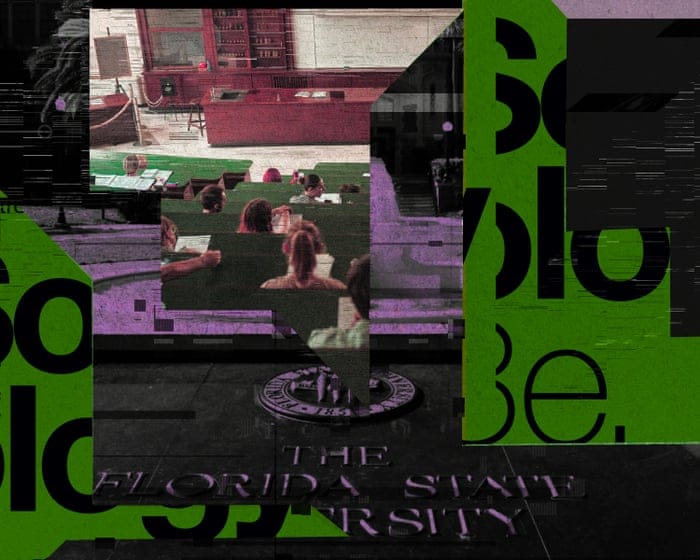
"This is how authoritarianism works," one Florida sociology professor told The Guardian US. "It doesn't announce itself with fanfare. It arrives through administrative guidelines and textbook committees."
Across Florida's public universities, sociology faculty are quietly refusing to comply with new state demands that would fundamentally alter their discipline. Rather than removing foundational material about race, gender, and inequality — the core subjects of sociological study — they continue teaching their courses as designed, viewing the preservation of academic integrity as a professional responsibility that outweighs personal risk.
The resistance represents more than individual acts of defiance. It exposes a fundamental tension in Governor Ron DeSantis's multi-year campaign to reshape higher education: what happens when state ideology collides with academic disciplines whose very existence depends on examining the systems the state wants hidden?
Florida's latest restrictions follow years of legislation targeting public university curricula under the banner of combating "woke ideology." The state has banned critical race theory, restricted diversity programs, and imposed new controls on how professors can discuss identity and discrimination. But the January guidelines represent an escalation — directly censoring textbook content and dictating which sociological concepts can be taught.
The proposed restrictions would prohibit discussions of "systemic discrimination," limit how professors can address gender and sexual identity, ban teaching about "race-conscious remedies," and prevent examination of "structural causes of inequality." For sociology — a field built on studying social structures and their impacts — these restrictions amount to intellectual dismemberment.
The risks for non-compliance are substantial. Untenured faculty face potential termination. Even tenured professors could face disciplinary action or see their departments defunded. Yet across the state, sociology faculty report continuing to teach their standard curricula, viewing anything less as a betrayal of their students and their discipline.
This quiet resistance illuminates a broader pattern in authoritarian educational policy. When Hungary's Viktor Orbán targeted gender studies programs, he didn't just restrict speech — he eliminated entire academic departments. When Brazil's Jair Bolsonaro attacked sociology and philosophy education, he framed these disciplines as luxury subjects that distracted from job training. The Florida restrictions follow a similar playbook: present academic inquiry into power structures as ideological indoctrination, then replace it with state-approved narratives.
The timing is particularly stark given Florida's social realities. The state has some of the nation's highest rates of income inequality, with systemic barriers to justice well-documented across multiple institutions. Preventing students from studying these structures doesn't make them disappear — it only ensures future leaders lack the analytical tools to address them.
The censored textbook introduced by the state attempts to reframe sociology as the study of individual behaviors divorced from social context. Chapters on institutional racism have been removed. Discussions of gender as a social construct have been eliminated. The word "systemic" appears nowhere in the approved text. Faculty reviewing the material describe it as "sociology with the sociology removed."
What makes Florida's approach particularly insidious is its bureaucratic veneer. Unlike dramatic book burnings or public denunciations, the state couches its censorship in the language of educational standards and appropriate content. This administrative authoritarianism — enforced through textbook committees and curriculum guidelines rather than police raids — makes resistance both more difficult and more necessary.
The sociology professors' quiet defiance also reveals the limits of top-down educational control. While the state can mandate textbooks and issue guidelines, it cannot easily monitor every classroom or control every discussion. This gap between policy and practice becomes a space for resistance, where faculty must balance their professional obligations against personal consequences.
Some departments have found creative ways to maintain academic integrity while avoiding direct confrontation. One university's sociology department officially adopted the state-approved textbook but listed it as "optional," while requiring students to read scholarly articles that cover the censored material. Another department reframed courses to focus on "historical" examples of systemic inequality, technically complying with restrictions on discussing contemporary systems while ensuring students still learn the analytical frameworks.
The broader implications extend beyond Florida. As other states consider similar restrictions, the question becomes whether academic disciplines can survive when their core concepts are declared off-limits. If sociology cannot examine social structures, if history cannot discuss systems of oppression, if political science cannot analyze power dynamics, what remains is not higher education but vocational training wrapped in ideological conformity. Florida has already moved to strip sociology from graduation requirements, signaling that the discipline itself is the target.
For now, Florida's sociology professors continue their quiet resistance, understanding that their choices shape not just what students learn but what kind of society those students will create. In classrooms across the state, discussions of systemic inequality proceed despite state prohibition. Textbooks may be censored, guidelines may restrict, but knowledge — once shared — cannot be easily contained.
The professors know their resistance may be temporary. Surveillance could increase. Punishments could escalate. Entire departments could face elimination. The vulnerability of faculty without tenure is not unique to Florida — a Texas professor's lawsuit over wrongful termination illustrates how swiftly institutions can move against faculty whose speech draws political pressure. But they also know that surrendering academic integrity in the face of authoritarian pressure would represent a different kind of ending — one where the university as a space for critical inquiry ceases to exist, replaced by an institution that teaches only what power wants heard. Against that future, teaching sociology as sociology becomes an act of preservation, protecting not just an academic discipline but the very possibility of understanding and changing the structures that shape our lives.