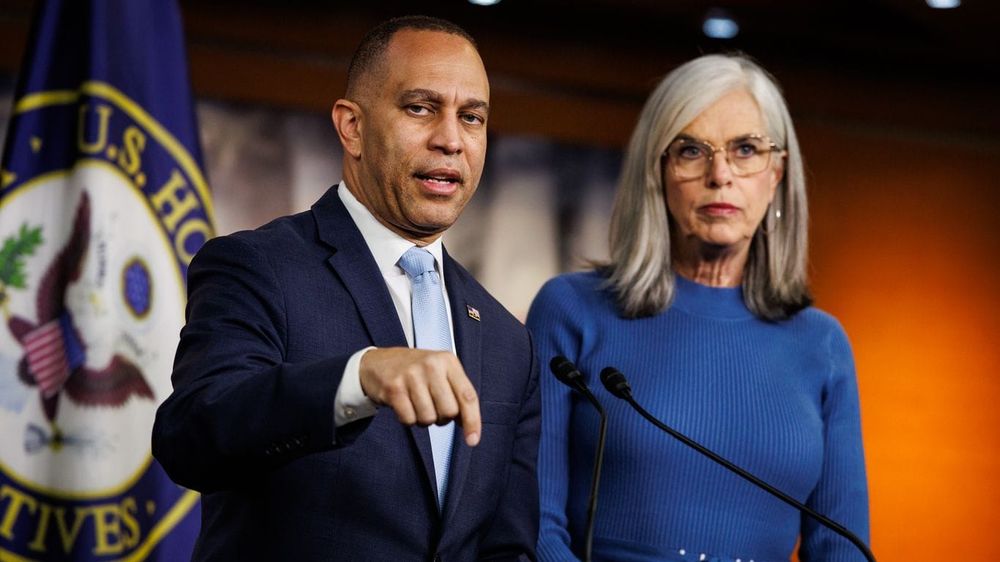
The last time the top two House Democratic leaders voted differently on a major procedural question, it was treated as a five-alarm institutional crisis. When Minority Leader Hakeem Jeffries and Minority Whip Katherine Clark split on a Republican-authored amendment to block all U.S. foreign aid to Israel, Axios described the divergence as "exceedingly rare." But rarity is not the point. The point is what the fracture tells us about where the Democratic Party actually is on Israel — and how far that is from where its leadership has tried to hold it.
The amendment, authored by Rep. Thomas Massie (R-Ky.) and attached to a State Department funding bill, would block any of that legislation's money from reaching Israel. Clark announced Wednesday she would vote yes. Jeffries announced Tuesday he would vote no. Neither outcome is especially surprising in isolation. What is striking is that they cannot coordinate — that the second-ranking House Democrat looked at the same vote as the first-ranking House Democrat and reached the opposite conclusion, and that Jeffries explicitly told his members they were free to vote their consciences rather than follow leadership. In a caucus that runs on whip counts and message discipline, that is a significant public admission of internal incoherence.
The amendment, proposed by Rep. Thomas Massie (R-Ky.) to a State Department funding bill, would block all foreign aid to Israel — including, critically, humanitarian funding for Palestinian refugees and civilians in Gaza. It contains no carveout distinguishing military from non-military assistance. Clark stated this directly in her announcement: she supports the vote's direction while objecting to the amendment's construction.
The leadership split is the news. What it points to is larger: this divergence does not represent a Democratic Party in the process of changing its Israel policy. It represents a party whose Israel consensus has already collapsed, and whose leadership is now managing the wreckage in real time, with no coherent alternative framework to offer. The Massie amendment is a badly drafted vehicle that gave Democrats a badly timed referendum they were not ready to hold.
Clark's statement is worth reading carefully. She will vote yes, she said, "not because I agree with the entirety of the amendment, or the GOP's cynical motivations for its consideration, but because I believe we must change course." This is not a ringing endorsement of the policy. It is a No. 2 House Democrat announcing that she has concluded the current U.S.-Israel relationship is untenable, and that she is willing to attach that conclusion to an imperfect Republican vehicle rather than wait for a Democratic leadership that has not produced one. That is a significant statement of institutional failure — not of the amendment, but of the party's own inability to build a serious legislative alternative.
Jeffries, meanwhile, wrote in a letter to colleagues that "a meaningful change in direction is needed" on the U.S.-Israel relationship while opposing the amendment because "there are more decisive ways to achieve the urgent change necessary when it comes to the far-right Netanyahu government." He did not name those ways. He did not point to legislation his office has introduced, a hearing his caucus has scheduled, or a diplomatic initiative his members have championed. The argument that better options exist is only credible if you can name them. As of this writing, Jeffries has not.
The anonymous Democratic lawmaker quoted by Axios is more honest than either leader. The member told Axios the vote is driven by fear — that the grassroots will "absolutely" punish anyone who votes against the measure, and that this political calculus overrides substantive objections to a "poorly drafted" amendment with "unanticipated consequences." That candor is useful. It confirms what the leadership split actually represents: a party whose members are making decisions based on primary threat assessment, not policy analysis. That is not a party building a new foreign policy. That is a party trying to survive the next election cycle while its old consensus burns.
The vote estimates reported by Axios tell the same story. Members tell the outlet the caucus could split nearly down the middle, with between 100 and 150 of the 212-member caucus voting yes. That range — spanning half the caucus — is itself evidence that no one in leadership has a firm grip on where their members are. A whip operation that cannot narrow a vote estimate to within 50 members is not functioning as a whip operation. Jeffries acknowledged this directly by announcing he would not whip the vote at all.
The amendment's core defect — that it contains no carveout for humanitarian aid to Palestinian civilians in Gaza — is a real problem. Clark named it herself: the measure "blocks all foreign aid to Israel, including humanitarian funding from Palestinian refugees and civilians in Gaza." The people most directly affected by that design flaw are not Democratic primary voters in Massachusetts or New York. They are the roughly two million people in Gaza for whom access to humanitarian assistance is a matter of survival. The amendment's supporters argue that the broader policy failure is severe enough that an imperfect vehicle is better than none. Its opponents argue that the humanitarian carveout matters. Both positions are being argued almost entirely in terms of their domestic political consequences — which is exactly the frame that produced this policy failure in the first place.
Follow the money. As Tinsel News has documented previously, the Democratic Party's institutional relationship with AIPAC and pro-Israel donor networks has not collapsed — it has simply become contested. The 2028 presidential field is already navigating this publicly, as we've reported: candidates denounce AIPAC in speeches while their party committees keep cashing the checks. The Massie amendment vote is a downstream symptom of that contradiction. Members are being asked to cast a public vote on a question their leadership has spent years avoiding, under conditions not of their choosing, with a vehicle designed by a Republican libertarian whose motivations Clark herself called "cynical."
What the Democratic Party does not have — and what this vote makes vivid — is a policy. It does not have a legislative framework for conditioning military aid to Israel that it has moved through committee. It does not have a unified caucus position on what accountability for the Netanyahu government should look like in practice. It has members who are afraid of their base, leaders who disagree with each other, and an anonymous lawmaker telling Axios that the amendment "doesn't make any sense" but the grassroots will punish a no vote regardless. That is not a party managing a difficult policy question. That is a party that outsourced its Israel policy to donor relationships for two decades and is now discovering that the base moved on without them.
The Massie amendment will pass or fail on its own terms. The more durable consequence is structural. A Minority Leader who cannot whip his own caucus on a foreign policy vote, a Minority Whip who announces she is voting against her leader's position, and a membership that estimates its own split at somewhere between 100 and 150 votes — that is a caucus that has lost the institutional capacity to act collectively on Israel. Whatever comes next, it will not be built from the top down. The pressure that moved Katherine Clark did not come from Hakeem Jeffries. It came from the people his party spent years asking to wait.