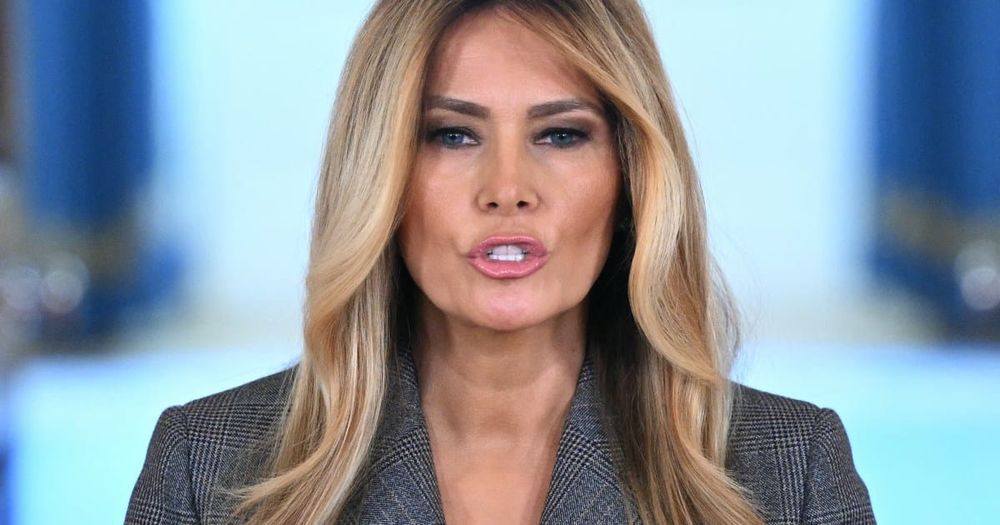
On Thursday afternoon, First Lady Melania Trump walked to the lectern in the Cross Hall of the White House, read a five-minute statement denying any meaningful connection to Jeffrey Epstein and Ghislaine Maxwell, called on Congress to hold public hearings for Epstein's survivors, and walked away without taking a single question.
It was, by every measure, one of the most unusual moments of the Trump presidency — and one of the most strategically incoherent.
To understand why this statement should raise far more questions than it answers, you have to look at it from two angles: the journalistic timing and the legal substance. Neither holds up.
The Timing Is Everything
The Trump administration has spent months waging a war in Iran that has consumed nearly all of Washington's bandwidth. It oversaw the extraordinary rendition of a political leader from Venezuela. It has done everything in its considerable power to ensure that the Epstein story stays buried beneath the fog of war.
And now, at the height of that war — with a fragile ceasefire barely holding, the Strait of Hormuz still contested, and Trump himself declaring premature victory — the First Lady steps forward to address the one topic the entire administration has been running from.
There are really only three explanations for the timing.
The first: a major Epstein-related story is about to break, and this is an attempt to get ahead of it. In political communications, this is a well-established pattern. You don't hold a press conference to deny something nobody is currently talking about.
"I can tell you that these kind of press conferences only come when a major bombshell story is about to drop on that exact topic," said Daniel de Castellane, a political communication consultant. "It's either that, or this is the worst possible distraction from the war in Iran that you could possibly come up with."
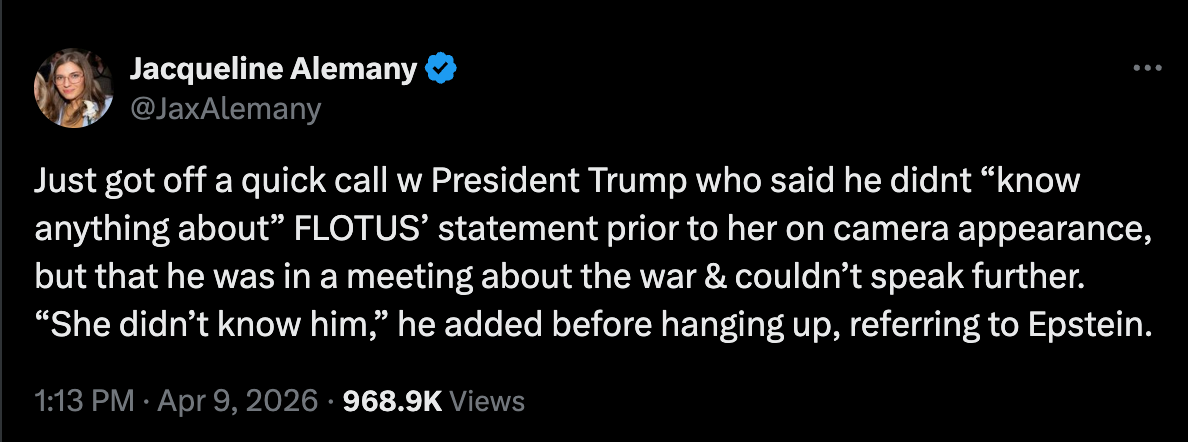
The second possibility: Melania Trump is genuinely breaking from her husband on this issue. That would be extraordinary — and the evidence is mounting that this may be part of it. According to MS NOW, President Trump told a reporter he did not know about his wife's statement before she delivered it. He said he was in a meeting about the war, added that "she didn't know him" — referring to Epstein — and then hung up. CNN later reported that the president had in fact received advance warning, and a spokesperson for the First Lady told The New York Times that "the president was aware." Someone is not telling the truth.
The third: Melania Trump is simply exhausted by the constant public association with Epstein and Maxwell and decided to say something. This is the most sympathetic reading, but it does not explain the call for congressional hearings, which introduces a set of legal and procedural problems that no one around the First Lady appears to have thought through.
The Legal Problems Are Worse
From a legal perspective, Melania Trump's statement is not just unusual — it is actively counterproductive to the goals it claims to serve.
Start with what she admitted. In calling for survivors to testify before Congress, the First Lady implicitly acknowledged that more people were involved in Epstein's crimes beyond those already prosecuted. That is a direct contradiction of Acting Attorney General Todd Blanche, who has spent his brief tenure at the DOJ signaling that the Epstein investigation is effectively closed. Blanche personally interviewed Ghislaine Maxwell — after which she was transferred to a minimum-security federal prison camp in Texas. The Justice Department announced last year it would not prosecute anyone else.
So the First Lady is publicly saying there are more perpetrators at the same time her husband's Justice Department is saying there aren't. That is not a policy disagreement. That is a factual contradiction at the highest levels of the executive branch.
Second — and this is the part that should alarm anyone who actually cares about the survivors — Congress is not the appropriate body to conduct these interviews. The Department of Justice is. The FBI is. They have the investigative infrastructure, the legal authority to compel testimony, and the capacity to protect witnesses. They have already conducted interviews with survivors. The question has never been whether survivors have spoken — it is why the government has refused to act on what they said.
Putting survivors under oath in front of Congress — where members are already skeptical, where proceedings are inherently political, and where there is no prosecutorial follow-through — does not help these women. It puts them on display.
But here is the part that makes the whole thing potentially dangerous: many of Epstein's survivors received compensation through the Epstein Victims' Compensation Program, which distributed nearly $125 million to approximately 150 claimants between 2020 and 2021. Others reached private settlements — including the landmark $290 million with JPMorgan Chase and the $105 million settlement with the U.S. Virgin Islands.
As part of these settlements, many survivors signed confidentiality provisions and nondisclosure agreements that restrict what they can publicly disclose. Calling on these women to testify under oath before Congress — in a proceeding that would be broadcast nationally — risks putting them in direct conflict with their own legal agreements. It sets them up to fail, either by exposing them to breach-of-contract claims or by forcing them to limit their testimony to the point of uselessness.
And that raises the most uncomfortable question of all: does the First Lady not know this, or does she not care?
The President's Meltdown
If Melania Trump's statement was meant to provide clarity, it achieved the opposite — including, apparently, inside the White House itself.
In the hours following the First Lady's appearance, President Trump went on what can only be described as one of the most significant public spirals of his presidency.
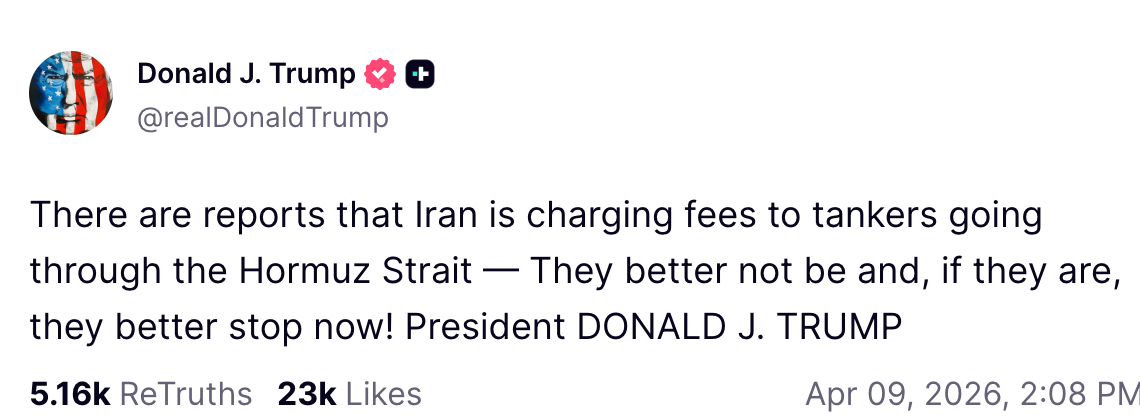
He posted a warning to Iran over reports that Tehran is charging fees to tankers transiting the Strait of Hormuz, writing "they better not be and, if they are, they better stop now" — apparently unaware that transit provisions were part of the ceasefire deal his own administration negotiated.
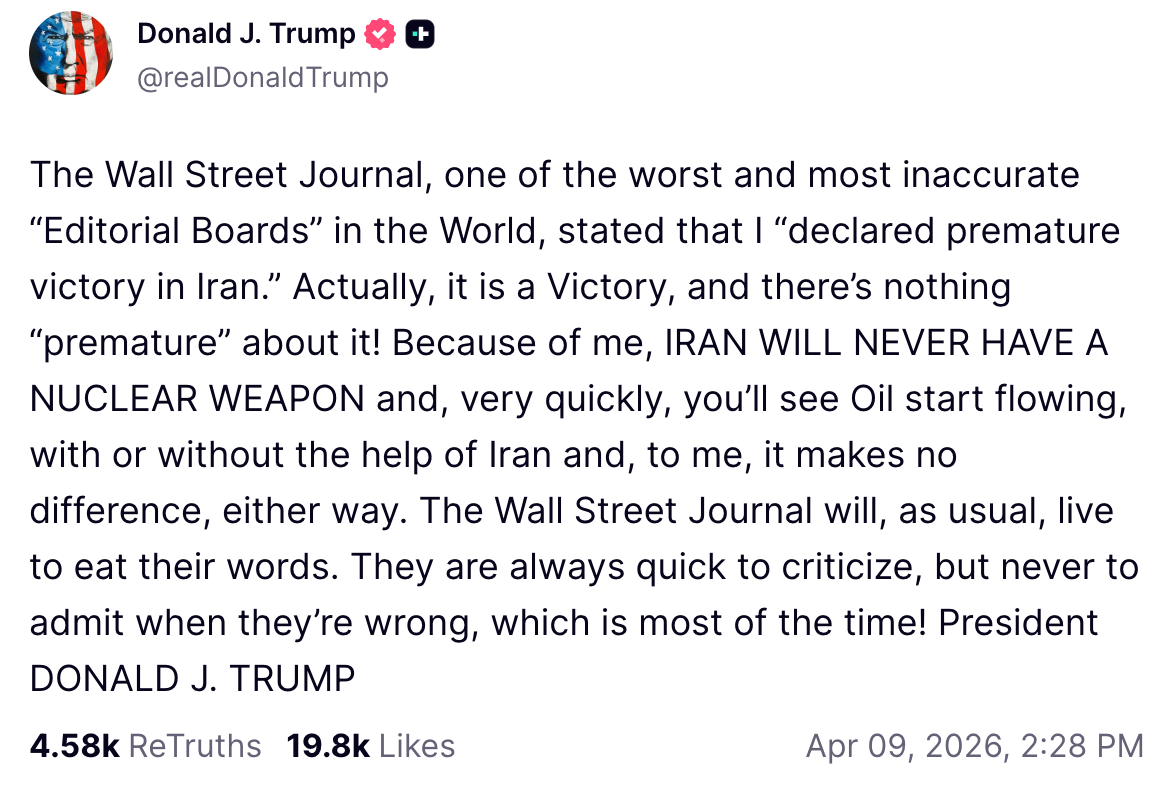
He attacked the Wall Street Journal — owned by Rupert Murdoch, one of his most important media allies — calling it "one of the worst and most inaccurate 'Editorial Boards' in the World" after the paper published an editorial titled "Trump Declares Premature Victory in Iran." The president has, by public count, declared victory in the Iran conflict on at least nine separate occasions.
Multiple White House officials told reporters they were caught off guard by the First Lady's statement. The typical communications infrastructure that coordinates statements from the East Wing and West Wing either was not consulted or was deliberately bypassed.
None of this is normal. And none of it is accidental.
The Question No One Is Asking
The dominant media frame around Melania Trump's statement has been straightforward: the First Lady denied ties to Epstein and called for justice for survivors. That framing takes the statement at face value.
But nothing about this adds up at face value. The timing contradicts the administration's strategy. The substance contradicts the administration's legal position. The mechanism she proposed — congressional hearings — would likely harm the very people it claims to help. And the president's response suggests he was either blindsided or performing the part of someone who was.
So the real question is not what Melania Trump said. It is who wanted her to say it, and why now.
Is this a genuine break from a First Lady who has had enough of the Epstein association? Is it a coordinated attempt to get ahead of a story that is about to become unmanageable? Or is it the president using his wife to create a news cycle that distracts from the disintegrating Iran ceasefire and his increasingly erratic public behavior?
The answer matters — because the survivors Melania Trump claims to be championing are the ones who will pay the price if this is theater.