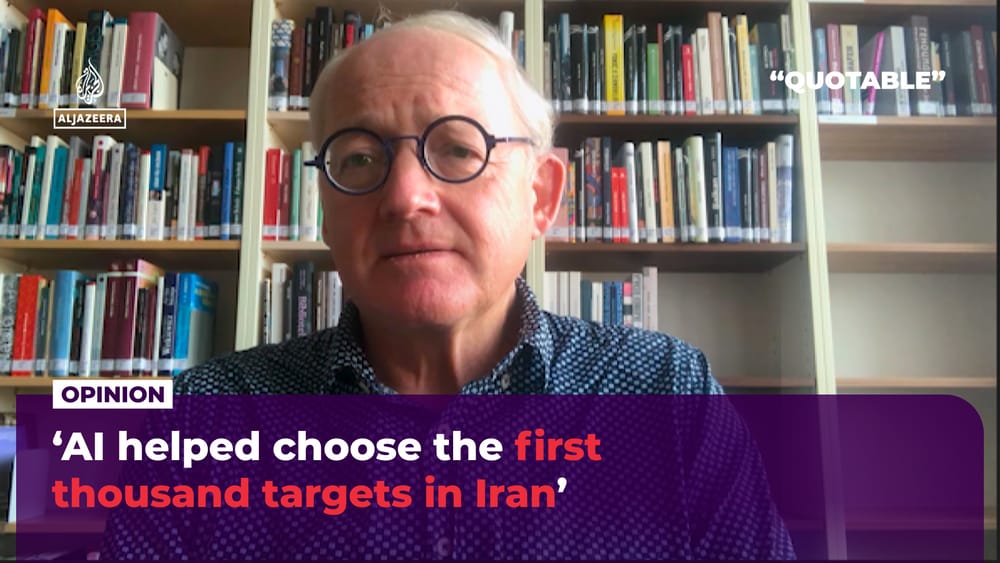
The Pentagon has confirmed that artificial intelligence systems selected the first 1,000 targets struck in the ongoing military campaign against Iran, according to Al Jazeera English. A senior defense official disclosed the information during a background briefing last week, marking the first public acknowledgment that machine learning algorithms — not human intelligence analysts — drove the initial targeting decisions in a major U.S. military operation.
The official described the AI system as "force-multiplying" technology that processed satellite imagery, signals intelligence, and open-source data to identify military installations, command centers, and weapons depots across Iranian territory. The disclosure comes three weeks into a conflict that has already killed over 2,000 Iranian civilians, according to Iranian state media, and displaced an estimated 400,000 people from border regions near Iraq and Afghanistan.
What the Pentagon framed as an efficiency breakthrough is actually a fundamental shift in how the United States wages war. For the first time, algorithmic systems — trained on data sets the public cannot examine, using criteria the military will not disclose — determined which buildings, facilities, and neighborhoods would be bombed. The human role, according to the official's description, was limited to reviewing AI-generated target lists and approving strikes in batches. That is not oversight. That is ratification.
The military has used computational tools in targeting for decades, but those systems functioned as decision-support aids — databases and mapping software that helped human analysts evaluate potential targets. What Al Jazeera English documented represents a qualitative change: machine learning models that autonomously generate target recommendations based on pattern recognition, not human intelligence collection. The difference matters because AI systems do not understand context. They identify correlations in data. A weapons facility and a food warehouse can look identical to an algorithm trained to recognize large metal structures near transportation infrastructure.
The Pentagon official told reporters that human operators retained "final authority" over strike decisions, but provided no details about the review process, the time allocated for evaluation, or the criteria used to reject AI-generated targets. In practice, algorithmic recommendations create enormous pressure to approve. Military command structures reward speed and decisiveness. Officers who slow operations by questioning AI outputs risk being seen as obstacles. When the system generates 1,000 targets and commanders approve 1,000 strikes, the claim of human oversight becomes semantic.
This is not speculative risk. Israel's military has used AI targeting systems in Gaza since October 2023, according to reporting by +972 Magazine and Local Call. Those systems generated thousands of targets in residential neighborhoods, leading to strike patterns that human rights organizations have documented as indiscriminate. The Pentagon's Iran operation appears to follow a similar model: machine-generated target lists, minimal human review, and strikes executed at a pace that precludes meaningful accountability.

The broader pattern is clear. The U.S. military is automating the decision to kill, and doing so without public debate, congressional oversight, or international legal frameworks that address algorithmic warfare. Congress never authorized this war. The public does not know what data trained these AI models, what assumptions are embedded in their code, or whether they can distinguish a military command post from a hospital. The Pentagon is not offering those answers. It is offering assurances.
What happens when an AI system misidentifies a target and a U.S. bomb kills 200 people at a wedding? Who is accountable — the algorithm's designers, the officers who approved the strike, or the system itself? The military has not answered that question because it has not been forced to. Algorithmic warfare operates in a legal and ethical void. There are no international treaties governing AI weapons systems. There is no domestic law requiring the Pentagon to disclose how these tools function. There is only the Pentagon's word that the technology works as intended.
The Iran campaign is now the proof of concept for a model of warfare the United States will export. If AI can select 1,000 targets in three weeks with minimal human input, every future conflict will use the same approach. The efficiency gains are too significant for the military to resist. The cost — measured in civilian lives, in eroded accountability, in the normalization of machine-driven killing — will be borne by populations who have no say in how these systems are built or deployed. The Pentagon just told us the future of American military power. We should believe them.