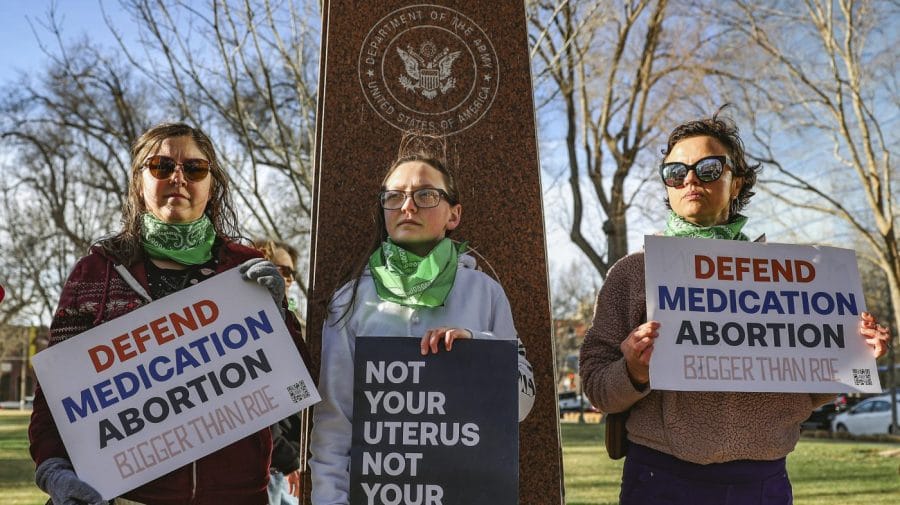
Three years after Texas banned nearly all abortions, Maria stopped planning her 600-mile drive to New Mexico. Instead, she opened her laptop, completed a 15-minute telehealth consultation, and received abortion pills by mail four days later — prescribed by a doctor in Massachusetts, shipped from a pharmacy in New York, delivered to her Houston apartment.
Maria's experience reflects a seismic shift documented in a new Guttmacher Institute report: telehealth abortion services have quietly created an underground network that bypasses state bans, reducing the number of people who must travel across state lines for care. The data reveals how technology has outmaneuvered legislation designed to eliminate abortion access entirely.
The numbers tell a story of adaptation under pressure. In states with total abortion bans, the rate of people traveling out-of-state for surgical procedures has declined even as demand remains steady. Meanwhile, telehealth prescriptions for medication abortion — which uses mifepristone and misoprostol to end pregnancies up to 12 weeks — have surged. What legislators didn't anticipate: the internet doesn't respect state borders.
This shift carries profound implications for reproductive justice. Travel for abortion was already a privilege reserved for those with money, time off work, childcare, and reliable transportation. A two-tiered healthcare system emerged post-Dobbs, where zip code and bank account determined access to constitutional rights. Telehealth hasn't eliminated those disparities — internet access and mailing addresses create their own barriers — but it has fundamentally altered the landscape of who can access care.
The Guttmacher data, drawn from abortion provider surveys and telehealth platform reporting, shows medication abortion now accounts for 63% of all abortions nationwide, up from 53% in 2020. In ban states specifically, researchers estimate telehealth prescriptions have offset roughly 40% of the procedures that would have required interstate travel before these services expanded.
"Shield laws" in states like Massachusetts, New York, and California make this possible. These laws protect healthcare providers from out-of-state prosecutions when they prescribe abortion pills via telehealth to patients in ban states. Providers operate in a legal gray zone — following the laws of their own states while knowingly facilitating actions illegal where their patients live.
The model works like this: A patient in a ban state schedules a video consultation with a provider in a shield-law state. The provider confirms the pregnancy's gestational age through the patient's reported last menstrual period and screens for conditions that would make medication abortion unsafe. If approved, the prescription goes to a mail-order pharmacy that ships the pills directly to the patient. The entire process takes less than a week and costs between $150-300 — a fraction of the $500-3,000 required for out-of-state travel and surgical abortion.
Anti-abortion legislators have noticed. Texas Attorney General Ken Paxton sued a New York doctor for prescribing abortion pills to Texas patients. Idaho passed a law making it illegal to help minors obtain abortion pills. Louisiana classified mifepristone and misoprostol as controlled substances. Yet enforcement remains nearly impossible — states can't prosecute doctors they can't reach, can't inspect packages they don't know exist, can't stop residents from receiving legal medical care via computer screen.
The reduction in interstate abortion travel carries hidden consequences. Brick-and-mortar clinics in states bordering ban states report decreased patient volumes, threatening their financial stability. These clinics provide not just abortion but full-spectrum reproductive healthcare — contraception, STI testing, cancer screenings. As federal agencies attack reproductive healthcare funding, the economic pressure on these providers intensifies.
For patients, telehealth abortion isn't without risks. Without in-person ultrasounds, ectopic pregnancies might go undetected. Patients experiencing complications may hesitate to seek emergency care, fearing prosecution. The pills themselves are safe — serious complications occur in less than 0.4% of cases — but the legal climate creates medical dangers that didn't exist before.
The Guttmacher report also notes demographic shifts in who accesses abortion care. Telehealth patients tend to be earlier in pregnancy (averaging 6 weeks gestation versus 9 weeks for in-clinic procedures), more likely to have children already (60% are parents), and more likely to cite inability to travel as their reason for choosing telehealth over in-person care.
Red state officials frame this as lawlessness — states refusing to enforce other states' abortion bans. Blue state officials frame it as healthcare — protecting providers who serve patients regardless of geography. The conflict exposes a fundamental question about American federalism: when state laws collide, whose residents get protected?
Major medical organizations support telehealth abortion access. The American College of Obstetricians and Gynecologists states that requiring in-person visits for medication abortion serves no medical purpose. The FDA permanently lifted in-person dispensing requirements for mifepristone in 2021, acknowledging decades of safety data. Yet political appointees hostile to evidence-based medicine could reverse these policies.
The data reveals something else: abortion bans don't stop abortions, they just change how they happen. Before Roe, people with money flew to states or countries where abortion was legal. People without money risked dangerous illegal procedures. Today's version replaces plane tickets with web browsers, back-alley providers with board-certified physicians practicing telemedicine.
As states escalate enforcement attempts — proposing laws to criminalize internet providers, threatening mail carriers, creating abortion pill "trafficking" felonies — the telehealth networks adapt. New platforms emerge monthly. Encryption protects patient data. International pharmacies ship pills from countries where American law doesn't reach. The harder states squeeze, the more creative the resistance becomes.
The Guttmacher findings document more than changing abortion methods — they reveal the limits of state power in a connected world. Legislators can ban procedures, close clinics, threaten doctors. They cannot ban chemistry, stop mail, or uninvent the internet. In trying to eliminate abortion, they've merely pushed it online, creating a system that operates beyond their control. For the million people who need abortion care annually, that digital underground railroad may be the difference between autonomy and forced pregnancy.