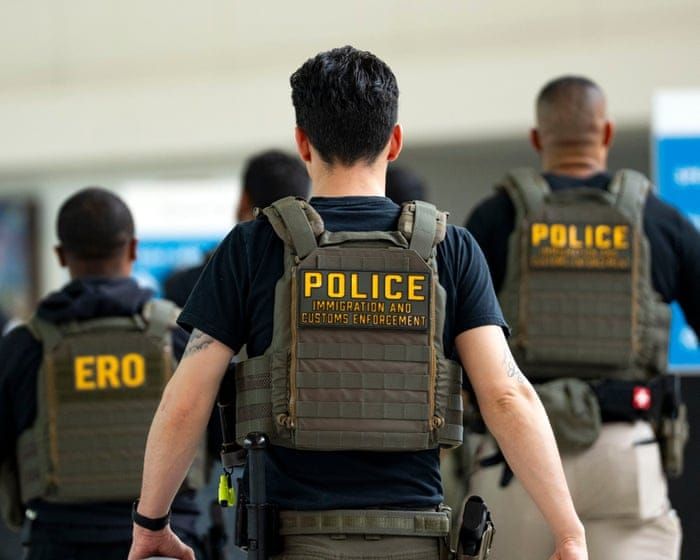
Every time a traveler passes through a TSA checkpoint, they hand over something they rarely think about: their identity. A government-issued ID. A boarding pass. A biometric scan. The deal, as most Americans understand it, is straightforward — you give the federal government enough personal data to confirm you are not a security threat, and in exchange you board your flight. What the Transportation Security Administration did not tell those 31,000 travelers is that their records were being forwarded to Immigration and Customs Enforcement for immigration enforcement purposes.
That number — 31,000 traveler records shared, more than 800 arrests made — comes from internal agency data reviewed by Reuters and reported by The Guardian US. The arrests took place from the start of Donald Trump's second presidency through February 2026. The figure is described as far above what was previously publicly known. No public announcement accompanied the program. No congressional authorization has been cited. No traveler who passed through a checkpoint during this period was notified that their information might be routed to immigration enforcement.
This is not a story about an agency exceeding its mandate in some abstract bureaucratic sense. It is a story about a specific infrastructure — built with specific public justifications, funded by specific congressional appropriations, and accepted by the traveling public under specific assumptions — being quietly redirected toward a completely different purpose. The terrorism-prevention apparatus the United States spent two decades and hundreds of billions of dollars constructing after September 11 has become, at least in part, a deportation machine. That conversion happened without a vote, without a debate, and without the knowledge of the people it now targets.
The TSA was created in 2001 specifically in response to the September 11 attacks. Its statutory mandate is aviation security — identifying threats to aircraft and passengers. It operates under the Department of Homeland Security, the same umbrella agency that houses ICE, but the two entities have distinct legal authorities and distinct public-facing justifications. The legal basis for TSA sharing immigration-related traveler data with ICE at this scale has not been made public. Whether the program was authorized under an existing information-sharing memorandum, a new directive, or an informal operational arrangement is not addressed in the available reporting — which is itself a form of answer.
The accountability gap here operates on two levels. The first is procedural: a federal agency collected data under one authority and shared it for enforcement under a different authority, and the public was not informed. The second is structural: the program is only visible now because Reuters obtained internal agency data. There is no public dashboard, no inspector general report, no congressional hearing record that would have allowed ordinary oversight to catch this. As Tinsel News has reported on ICE's broader data acquisition practices, the agency has developed a sophisticated capacity to acquire personal information through channels that bypass the warrant requirements and public scrutiny that would normally apply to law enforcement surveillance. The TSA pipeline fits that pattern — it is one more node in a surveillance architecture that has grown faster than the legal frameworks designed to govern it.
Eight hundred arrests sounds like a discrete enforcement outcome. It is also 800 data points in a larger argument about what airports have become. For immigrant communities — documented and undocumented alike — the airport checkpoint has always carried a particular anxiety. What the Reuters data makes concrete is that the anxiety was justified in ways that even the most cautious traveler could not have known. If you flew domestically during the first months of 2025 and TSA flagged your record for any reason, your information may have been in an ICE database before your plane landed.
The Human Impact Lens requires asking who specifically bears this cost. The answer is not evenly distributed. Undocumented immigrants who travel by air are a small subset of the undocumented population — domestic air travel requires government-issued ID, which creates its own filtering. But the 31,000 records shared with ICE almost certainly include people with pending immigration cases, people with temporary protected status, people whose documentation status is contested or in flux, and people who were flagged by TSA for reasons unrelated to immigration. The program, as described, has no public criteria for which records get shared. That absence of criteria is not a bureaucratic oversight. It is the program.
The Systemic Pattern Lens connects this to something broader than any single agency decision. The post-9/11 security state was built on a social contract: Americans accepted expanded surveillance, longer lines, biometric data collection, and the practical erosion of certain privacy expectations in exchange for the stated goal of preventing terrorism. That contract was debated, imperfectly, in public. The conversion of that infrastructure to immigration enforcement was not. The mission creep is not incidental — it is the predictable endpoint of building a surveillance system with no structural limit on how its data can be used. As we have previously reported, the use of airport deployments as a test environment for broader enforcement strategies has been acknowledged explicitly by figures close to the administration. The TSA data-sharing program is the operational infrastructure behind that strategy.
There is a version of the official defense of this program that goes roughly as follows: TSA and ICE are both components of the Department of Homeland Security; information sharing between DHS components is routine and legally authorized; the administration has a mandate to enforce immigration law; airports are federal jurisdiction. Each of those claims contains some truth. None of them, individually or together, constitutes public disclosure of a program that processed 31,000 people's travel records for immigration enforcement without their knowledge. The government's authority to do something and the public's right to know it is doing it are different questions. This program answered the first and ignored the second.
Congressional oversight of this program, to the extent it exists, is not visible in the public record. The relevant committees — Homeland Security in both chambers, Judiciary — have not held public hearings on TSA's role in immigration enforcement based on available reporting. Whether members were briefed in classified settings is unknown. What is known is that the program produced 800 arrests before it became public knowledge, which means the enforcement outcomes preceded any democratic accountability for the enforcement method.
The number that deserves the most scrutiny is not 800. It is 31,000. Eight hundred arrests represent roughly 2.6 percent of the records shared. The other 97.4 percent — approximately 30,200 people — had their travel records forwarded to an immigration enforcement agency and were not arrested. What happened to those records is not addressed in the available reporting. Whether they were retained, for how long, under what legal authority, and whether they could be used in future enforcement actions are questions the program's opacity makes impossible to answer from the outside.
The infrastructure that processed those 31,000 records did not emerge from nowhere. It was built checkpoint by checkpoint, database by database, over two decades, with public money and public consent — consent given for a specific purpose that has now been quietly expanded. The question facing Congress, and the courts, is whether a surveillance system built for one mandate can be legally and silently redeployed for another. The answer to that question will determine not just what happens at airports, but what the government can do with every other database it has built on the same terms. The expansion of ICE's enforcement infrastructure has proceeded faster than any legal or legislative check on it. The TSA program is the latest evidence of how far that expansion has already gone — and how little of it has been visible until someone with access to internal data decides to look.