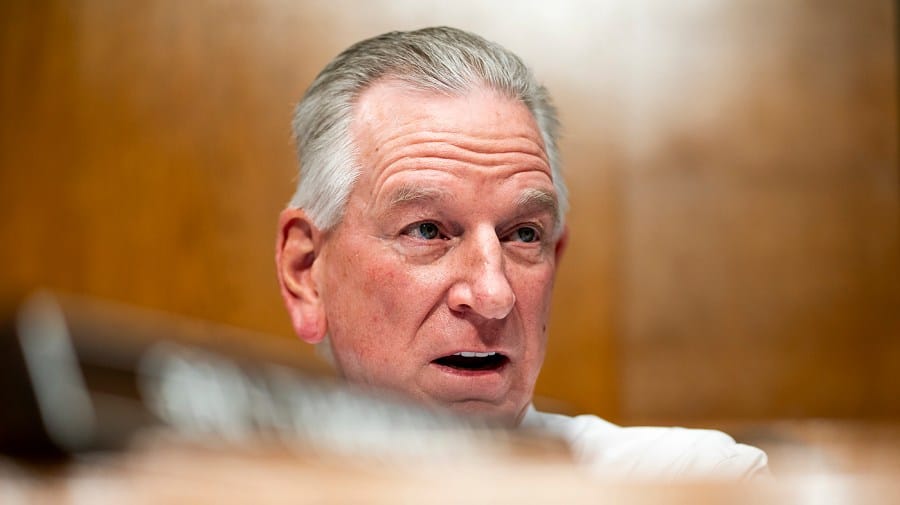
Alabama Senator Tommy Tuberville connected New York City mayoral candidate Zohran Mamdani to the September 11 terrorist attacks last week, then defended the baseless smear with a vague non-explanation that revealed more about the Republican Party's comfort with open bigotry than any policy position ever could.
When DC News Now's Reshad Hudson asked Tuberville on Tuesday to explain his social media post linking Mamdani — a Muslim American running for mayor — to 9/11, the senator offered no evidence, no clarification, and no apology. Instead, he downplayed whether such remarks were even offensive, treating the weaponization of a national tragedy against a political candidate based solely on religious identity as just another Tuesday in American politics.
The calculation is transparent: Tuberville knows he faces no consequences for this within his party. The Republican base has been primed for two decades to view Muslims as inherently suspicious, inherently foreign, inherently connected to terrorism. What started as dog whistles in the Bush era became foghorns during Trump's first term, and now exists as casual Tuesday afternoon bigotry that barely makes headlines.
This represents something darker than individual prejudice. When a sitting U.S. Senator can link an American political candidate to a terrorist attack without evidence — and face no rebuke from party leadership — it confirms that Islamophobia has moved from the margins to the mainstream of Republican politics. The party that once at least pretended to distinguish between Islam and extremism now treats the distinction as unnecessary.
Consider what Tuberville's non-defense actually tells us. He didn't claim he misspoke. He didn't say he was taken out of context. He didn't even bother constructing a bad-faith argument about Mamdani's policies or positions. The entire attack rested on religious identity alone — and when challenged, Tuberville saw no need to justify it beyond vague hand-waving.
This normalization has real consequences beyond hurt feelings or offensive rhetoric. Muslim Americans already face heightened surveillance, discrimination, and targeting in a political climate where their loyalty is perpetually questioned. When senators mainstream these attacks, they're not just engaging in ugly politics — they're creating permission structures for harassment, discrimination, and violence at every level of society.
The broader pattern is impossible to ignore. From Trump's Muslim ban to the demonization of Ilhan Omar and Rashida Tlaib, from surveillance of mosques to the equation of refugees with terrorists, the Republican Party has systematically otherized Muslim Americans as a political strategy. Tuberville's casual bigotry isn't an aberration — it's the logical endpoint of a party that has spent years telling its base that their Muslim neighbors might be secret enemies.
What makes this particularly insidious is how it corrupts democratic participation itself. When running for office while Muslim becomes grounds for suspicion, when religious identity alone invites connections to terrorism, the message to Muslim Americans is clear: public service isn't for you. Your participation in democracy will always be conditional, always suspect, always one senator's tweet away from being equated with mass murder.
The silence from Republican leadership is its own statement. No condemnation from McConnell. No pushback from conference chairs. No brave stand from the supposedly reasonable Republicans who occasionally furrow their brows at their party's extremism. The message is clear: linking Muslim Americans to terrorism based on nothing but religious identity is now acceptable Republican discourse.
This isn't just about one senator's bigotry or one candidate's treatment. It's about what kind of democracy we're building — one where full participation is available to all citizens, or one where religious minorities must endure accusation and suspicion as the price of civic engagement. Tuberville has told us which version his party prefers. The question now is whether anyone with power will challenge that vision, or whether casual Islamophobia has become so normalized that even connecting an American political candidate to 9/11 based solely on their faith no longer warrants serious pushback. The same party that blocks promotions of Black and female officers has made clear that exclusion by identity is not a bug but a feature of its governing philosophy.