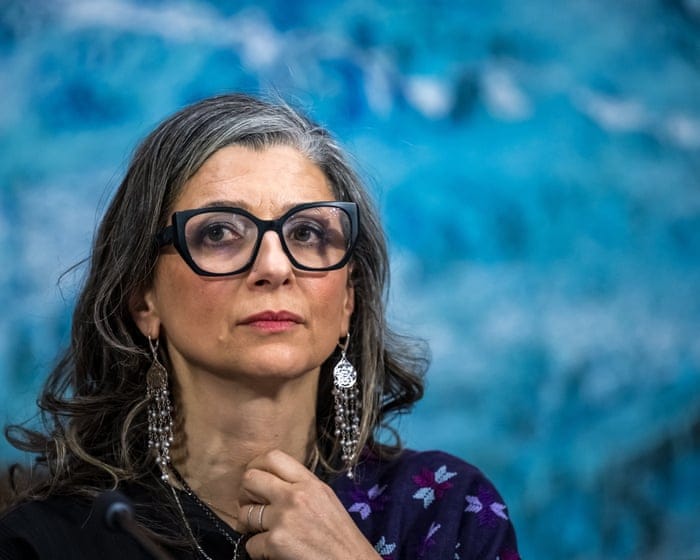
The United States government has imposed sanctions on Francesca Albanese, the UN Special Rapporteur on human rights in the Palestinian territories, for documenting evidence of war crimes in Gaza and recommending International Criminal Court investigations. The unprecedented move against a UN human rights official makes clear that criticizing American allies now carries the risk of civil penalties, asset freezes, and potential criminal prosecution.
Five prominent human rights lawyers and professors — Sandra Babcock of Cornell, Susan Akram of Boston University, Asli Bali of Yale, Thomas Becker of Columbia, and James Cavallaro of Yale Jackson School — warned in The Guardian US that the sanctions represent a dangerous escalation in the Trump administration's campaign to silence dissent on Israel's military operations. "In a country that purports to value democracy and human rights, we never imagined that we could face civil penalties or imprisonment for our work," they wrote.
The sanctions come after Albanese documented what the legal scholars describe as "overwhelming" evidence of Israeli war crimes, including the killing of an estimated 20,000 children and more than 1,000 babies during two years of warfare. Her reports detailed Israel's use of starvation as a weapon of war, the systematic destruction of Gaza's healthcare infrastructure, and the blockade of medical supplies that prevented civilians from accessing cancer treatment, maternal care, and basic antibiotics.
What makes this action particularly alarming is its target: not a hostile government official or sanctioned entity, but an independent UN expert fulfilling her mandate to document human rights violations. The Special Rapporteur system exists precisely to provide independent assessment of human rights situations worldwide, free from political pressure. By sanctioning Albanese for doing her job, the administration establishes a precedent that any international official who documents violations by U.S. allies faces potential retaliation.
The timing exposes a calculated strategy. These sanctions arrived alongside a series of executive orders and memoranda explicitly designed to "stifle speech and demonize dissent" regarding Israel's actions in Gaza, according to the legal scholars. The administration has moved beyond rhetorical attacks on critics to using the full weight of U.S. financial and legal systems against those who document inconvenient facts.
The human rights lawyers note that Israeli officials at "the highest levels of government" have used dehumanizing language, comparing Palestinians to "human animals" and "children of darkness." Yet it is Albanese — who documented these statements alongside evidence of systematic attacks on Gaza's civilian population — who faces sanctions, not those who made such declarations while conducting military operations.
This represents a fundamental shift in how the United States treats international human rights mechanisms. Previous administrations, regardless of party, maintained at least nominal respect for UN Special Rapporteurs even when disagreeing with their findings. They understood that attacking the messenger undermined the entire international human rights framework that the U.S. helped establish after World War II.
The implications extend far beyond one official or one conflict. If documenting war crimes becomes a sanctionable offense when the perpetrator is a U.S. ally, then the entire architecture of international accountability collapses. Human rights organizations, journalists, and academics must now calculate whether reporting on violations in allied countries could result in frozen bank accounts, travel bans, or criminal prosecution.
Consider what this means for academic freedom. The five professors who authored the Guardian piece teach and research human rights, including Palestinian rights. Under the new sanctions regime, their scholarship itself becomes a potential liability. A peer-reviewed article documenting civilian casualties, a conference presentation on international humanitarian law, even classroom discussions about war crimes — all could theoretically trigger sanctions if they involve criticism of U.S. allies.
The chilling effect extends to civil society organizations that rely on documentation and advocacy to protect vulnerable populations. Federal courts recently protected campus Palestine solidarity speech, recognizing that political criticism is core First Amendment expression. But sanctions operate outside the courts, imposing immediate financial consequences without due process or judicial review.
International human rights work depends on the ability to document violations wherever they occur, regardless of the perpetrator's relationship to powerful governments. When the U.S. sanctions a UN official for fulfilling this basic function, it sends a clear message to every human rights defender: document our allies' crimes at your own risk.
The professors warn that this represents a new phase in the erosion of democratic norms. It's one thing for authoritarian governments to threaten and punish human rights defenders — that's expected. It's quite another when a democracy uses its economic power to silence international officials who document uncomfortable truths. The very governments that human rights mechanisms exist to constrain are now dismantling those mechanisms through financial warfare.
This also lays bare the selective nature of U.S. human rights advocacy. The same administration that sanctions UN officials for documenting violations in Gaza continues to condemn human rights abuses by adversary nations. The message is clear: human rights matter only when their defense aligns with U.S. geopolitical interests. When documentation threatens those interests, the documenter becomes the target.
The broader pattern is unmistakable. When war reporting becomes 'treason,' when UN officials face sanctions for doing their jobs, when academics fear imprisonment for their research — these are not isolated incidents but elements of a systematic assault on the infrastructure of accountability.
The sanctions against Albanese won't stop documentation of what's happening in Gaza. The evidence is too overwhelming, the witnesses too numerous, the destruction too visible. But they will make such documentation more dangerous, more costly, and therefore less common. They will create gaps in the historical record, spaces where violations go unrecorded because those with the expertise and access to document them fear the consequences.
For the five professors who spoke out, the personal risk is now real. By publicly defending Albanese and affirming the evidence of war crimes, they've placed themselves in the potential path of similar sanctions. Their willingness to take that risk makes plain what's at stake: not just academic freedom or even Palestinian rights, but the fundamental principle that truth-telling about human rights violations must remain possible regardless of who commits them.
The transformation is complete. A government that once championed international human rights law now sanctions those who apply it consistently. The question facing human rights defenders, journalists, and scholars is no longer just how to document violations, but whether they can afford the price of doing so. When that becomes the calculation, accountability dies — not in dramatic fashion, but through the quiet accumulation of silence where truth once lived.