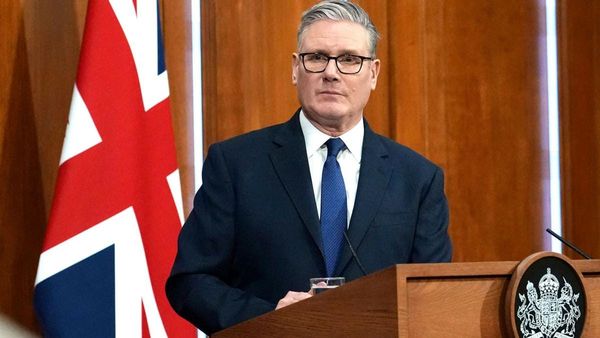
Three days before Hungarian voters go to the polls, the Vice President of the United States stood in Budapest and told them who to choose. JD Vance's visit to Hungary — framed by the White House as a diplomatic engagement — functioned in practice as a foreign campaign rally, complete with a ringing endorsement of Prime Minister Viktor Orbán and a broadside against the European Union that Orbán has spent fifteen years working to discredit. According to BBC News, Vance intervened directly in the Hungarian election campaign, backing Orbán's bid for re-election at the precise moment the race enters its final stretch.
This is not a story about Hungary. Hungary is where it happened. The story is about what the United States government has just declared it is willing to do — and to whom it is willing to do it.
The Trump administration has spent its first year treating allied governments as either assets to be cultivated or obstacles to be pressured. What Vance's Budapest visit makes explicit is the operating logic underneath that posture: the U.S. will now intervene in the internal democratic processes of its allies when the outcome serves the administration's ideological project. The question is not whether this is unprecedented — it is — but whether anyone in the Western alliance has the standing, or the will, to say so out loud.
Orbán has ruled Hungary since 2010, and his consolidation of power is not a matter of political interpretation. It is documented. Freedom House rates Hungary as only "partly free," the only EU member state to hold that designation. Orbán's government has systematically dismantled judicial independence, captured the national media landscape, rewritten electoral laws to entrench his party's advantage, and used constitutional amendments to cement policies on migration and gender that the European Court of Human Rights has ruled unlawful. The man Vance flew to Budapest to endorse has been formally censured by the European Parliament for undermining the rule of law. These are not allegations from political opponents. They are findings by the institutions Hungary voluntarily joined.
Vance did not go despite this record. He went because of it. Orbán is, for the Trumpist right, a proof of concept — evidence that an illiberal government can hold power inside a democratic framework, degrade its institutions systematically, and face no consequence from the West serious enough to matter. The visit is less an endorsement of a particular politician than an endorsement of a method. Vance's presence in Budapest says, to every authoritarian-adjacent leader watching: this administration is your coalition. Show up on the right side of the culture war, and America will show up for you.
The attack on the EU was not incidental. Vance's criticism of Brussels, delivered on Hungarian soil days before a Hungarian election, is a direct gift to Orbán's central campaign argument: that Hungary's sovereignty is under assault from unelected European bureaucrats, and that only his government stands between the Hungarian people and external control. The irony that this argument was being made by the Vice President of a foreign superpower — whose presence in Budapest is itself an exercise in external political influence — appears to have gone unaddressed. Vance did not come to defend Hungarian sovereignty. He came to weaponize the concept of it.
The accountability question is structural. No formal mechanism in the U.S. system prohibits a Vice President from endorsing a foreign leader during a foreign election. The norms against it were always informal — rooted in a bipartisan understanding that the United States, whatever its sins in covert foreign interference, did not do this sort of thing openly, to allies, on camera. Those norms are gone. What replaces them is not a new rule but an absence of rules, and absences of rules favor whoever is most willing to exploit them. The current administration has shown no reluctance on that front, as democracy watchdogs have been tracking since January 2025.
The European reaction will be instructive, and probably inadequate. EU officials have long struggled to respond to Orbán with anything more than procedural complaints and withheld cohesion funds — tools that have not changed his behavior in fifteen years. Vance's visit adds a new variable to that calculation: Hungary now has the explicit backing of the United States government, which means the EU's ability to pressure Budapest is effectively offset by Washington's political support. The Article 7 proceedings against Hungary for rule-of-law violations, already stalled for years, become harder to advance when the country under scrutiny can credibly argue it has a superpower patron.
For other European governments, the message is equally clear, if more uncomfortable to process. The Trump administration has already pressured NATO allies on defense spending, threatened tariffs against the bloc, and — in Vance's Munich Security Conference speech earlier this year — lectured European democracies about free speech while explicitly backing far-right parties across the continent. Budapest is not an outlier. It is a data point in a pattern. The pattern is that the U.S. under Trump is not a neutral actor in European democratic politics. It is a participant, and it has chosen a side. That side is not the side of democratic institutions.
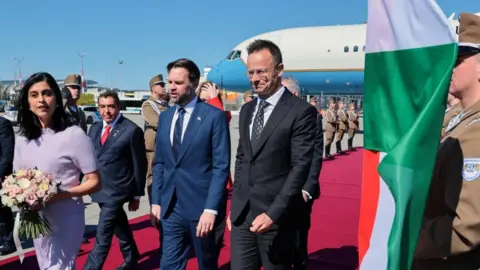
What makes the Budapest visit analytically distinct from earlier interventions is its openness. Previous U.S. interference in allied elections — and there has been plenty, across administrations of both parties — operated through proxies, funding channels, and strategic ambiguity. Vance stood in front of cameras and said the quiet part at full volume. The administration is not embarrassed by this. It is the message. Transparency about the intervention is itself a demonstration of power: we can do this, we are doing it, and there is nothing you can do about it.
The people bearing the cost of this calculation are not abstract. They are Hungarian opposition voters heading to polling stations knowing that the world's most powerful government has just told them their preferred outcome is the wrong one. They are civil society organizations in Budapest that have spent years documenting democratic backsliding, now watching an American Vice President arrive to ratify the government that has targeted them. They are the journalists working under Orbán's captured media environment — the same environment that press freedom advocates have flagged as a template for authoritarian media control — who now see their government validated by Washington.
The precedent set in Budapest will not stay in Budapest. If the Trump administration faces no political cost for openly campaigning for an authoritarian ally days before his election, the calculus for the next intervention shifts. Poland goes to the polls. Germany just formed a new government. France faces its own political pressures. The question of whether the United States will intervene in European democratic processes is no longer hypothetical. It has an answer. The answer was delivered in Budapest, on camera, three days before the vote.
Orbán may win without Vance's help — he has built electoral machinery specifically designed to make losing difficult. But the visit was never really about the margin. It was about establishing, in public, that the United States government considers his continued rule a desirable outcome. That designation has consequences that outlast any single election. When the next Hungarian government — Orbán's or whoever follows him — negotiates with Brussels over the rule of law, they will do so knowing that Washington has already weighed in. The EU's power to compel compliance does not just erode. It inverts. And every authoritarian leader in the Western alliance is watching to see whether they, too, can earn a visit.