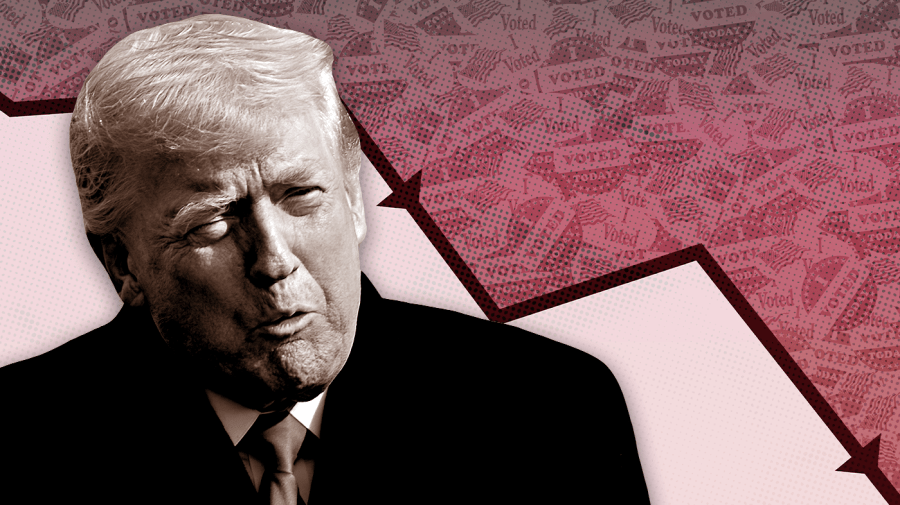
The political logic was clean enough to print on a bumper sticker: young men had abandoned the Democratic Party, and Republicans had caught them. The so-called bro vote — men under 35 who drifted right on podcasts, in comment sections, and at the ballot box — gave Trump a margin in 2024 that no analyst had fully predicted. According to reporting by The Hill, that coalition is now fracturing, with Republican strategists privately acknowledging that young male voters are drifting away faster than the party has any plan to stop.
What changed? Two things, arriving at roughly the same moment. A war in Iran that most of these voters did not ask for, and a gas pump that now reads four dollars a gallon — sometimes more. Neither issue is abstract. Both land in the body: the cost of a tank of gas on the way to work, the possibility of a draft letter in the mail. The political calculation that brought young men into the Republican tent in 2024 was built on vibes, economics, and a generalized contempt for progressive cultural politics. Two of those three pillars are now actively working against the party that courted them.
This is not a story about fickle voters. It is a story about what happens when a coalition is assembled on the basis of aesthetic grievance rather than policy alignment — and then a policy arrives that cannot be aestheticized away.
The bro vote was never ideologically coherent. It was a mood. Young men who felt culturally mocked by progressive institutions, who consumed media from figures like Joe Rogan and a constellation of smaller podcasters, who were told that the Democratic Party saw them as a problem to be managed rather than a constituency to be served. That mood was real. The Democratic Party's failure to address it was real. But moods are not platforms, and the Republican Party made a significant bet that it could hold this coalition together through 2026 and beyond without delivering anything concrete to the people who handed it power.
The Iran war complicated that bet immediately. As Tinsel News has reported, the conflict carries an estimated multi-trillion-dollar price tag and was launched without congressional authorization — a constitutional irregularity that the administration has shown no interest in resolving. For young men who were drawn to anti-establishment politics precisely because they distrusted institutional overreach, a war started by executive fiat with no exit strategy is not an easy sell. The very instinct that made them skeptical of progressive credentialism makes them skeptical of this, too.
Then there is the gas. The closure of the Strait of Hormuz and the broader disruption to global oil markets sent energy prices sharply upward. A gallon of regular gasoline now averages above four dollars in most of the country, with prices in some regions pushing toward five. For a demographic that skews toward trades, gig work, and commutes — not remote-office jobs with expense accounts — this is not a talking point. It is a monthly subtraction from a budget that was already tight. The political promise that animated much of the 2024 bro vote was economic: lower costs, less institutional friction, more room to live. A war that raised the price of everything is the opposite of that promise.
The accountability question here is specific. Republican strategists built a deliberate outreach apparatus targeting young men through podcasts, influencers, and platforms where the party's traditional messaging had no reach. That apparatus worked. The party earned those votes by speaking a language those voters recognized. The question now is whether the party made any reciprocal commitments — and whether it cares that it didn't. The evidence from The Hill's reporting suggests that Republican operatives are watching the polling numbers with concern but have no clear strategy for addressing the underlying causes of the erosion. That is not a communication problem. It is a policy problem dressed up as a communication problem.
The systemic pattern is worth naming. American political coalitions assembled around cultural identity rather than material interest tend to be unstable precisely when material conditions change. The white working-class realignment of the 2010s followed the same arc: voters moved toward a party that spoke their cultural language, and then discovered that cultural language does not pay rent or fill a gas tank. The bro coalition is younger, more digitally native, and more ideologically diffuse than that earlier realignment — which makes it, if anything, more volatile, not less. Loyalty built on vibes dissolves when the vibes change.
There is a global dimension to this that domestic political coverage tends to skip over. The Iran conflict's effect on energy markets is not a parochial American story. Asia's return to coal as LNG markets collapse, the cascading pressure on energy-dependent economies across the Global South — these are consequences of the same policy decision that is now showing up in American polling data. The young American voter watching his gas bill climb is connected to the Indonesian factory worker watching fuel subsidies evaporate. The war's costs are distributed globally and unevenly. The political fallout, however, lands first where the votes are.
What does the fracture actually look like in electoral terms? The 2026 midterms are the proximate pressure point. Republicans are defending a House majority that requires near-perfect performance in districts where young male voters were part of the 2024 surge. If even a fraction of that cohort stays home — not switches parties, just disengages — the arithmetic becomes difficult. Turnout among young men was notably higher in 2024 than in previous cycles; any reversion to mean, accelerated by disappointment, produces a different map. The Hill's reporting makes clear that Republican strategists understand this. What they do not appear to have is a credible answer to the question: what did these voters actually get?
The answer, so far, is a war, a gas price, and a set of culture-war gestures that play well in content but do not change material conditions. The influencer pipeline that delivered the bro vote in 2024 is not a reliable instrument for holding it. Podcasters and YouTube personalities respond to their audiences; if those audiences are expressing frustration with gas prices and war risk, the content will follow. Several prominent figures in the manosphere-adjacent media ecosystem have already begun distancing themselves from the Iran conflict, not out of principle but out of audience management. The information environment that built the coalition is now processing the coalition's discontent in real time.
None of this means the Democratic Party is positioned to recapture these voters. The party's structural failure to reconnect with working-class voters did not resolve itself because Republican approval numbers softened. Disillusionment is not the same as conversion. What it does mean is that the Republican coalition entering 2026 is less stable than the party's 2024 performance suggested — and that the instability is not primarily cultural. It is economic, and it has a cause with a name and a price per gallon.
The bro vote was won with promises that the current policy environment cannot keep. The voters who delivered it are noticing. The midterm question is not whether Democrats can win them back — it is whether Republicans can afford to lose them, even temporarily, and what they would have to abandon to stop the bleeding. A war with no exit strategy and a gas price with no ceiling are not problems that a podcast appearance solves.