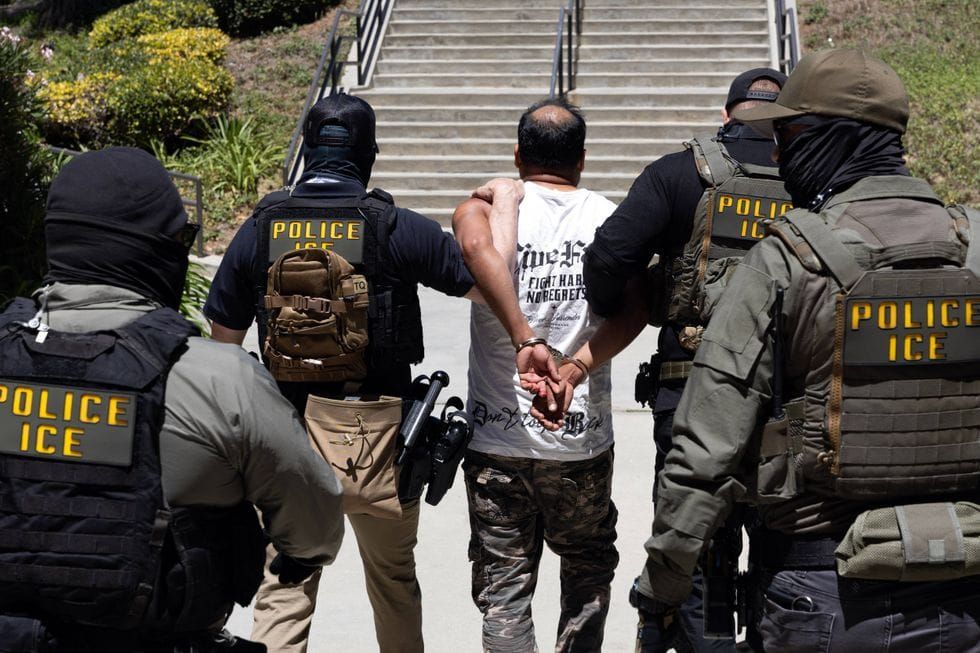
The Department of Homeland Security arrested more than 10,000 people in a single five-day span. At least 11 people have died during immigration enforcement operations since the administration escalated its campaign. Those figures don't come from DHS. They come from outside researchers, advocacy groups, and journalists piecing together what a federal agency once published as a matter of routine — and has now stopped releasing entirely.
Marc Rosenblum, who until this past weekend served as executive director of the DHS Office of Homeland Security Statistics, built that publication system over a decade. According to Common Dreams, Rosenblum's team grew from 11 people to 45 under the Biden administration, matured its data processing to monthly updates, and launched new lines of daily and weekly internal reports. Monthly breakdowns of ICE and Customs and Border Protection arrests and removals — data that had never before been published in that format — became standard. Then came January 2025.
"Such data has not been published since the first days of Trump's second term," Aaron Reichlin-Melnick, senior fellow at the American Immigration Council, told Common Dreams. Reichlin-Melnick has tracked the gap closely: DHS has repeatedly made public claims about the scale and success of its enforcement operations, but has released no underlying data to substantiate them. The transparency infrastructure that Rosenblum spent years constructing went dark precisely when the administration began its most aggressive enforcement push in modern American history.
Under Rosenblum's leadership, the DHS Office of Homeland Security Statistics published monthly data on ICE and CBP arrests and removals — figures that had never previously been released in that format. That publication stopped in January 2025, at the start of Trump's second term. No official explanation has been given for the suspension.
Rosenblum did not leave quietly. In a LinkedIn post cited by Common Dreams, he described a department operating under what he called "the war on immigrants, the war on feds, and the war on facts" — and added a pointed reference to "brazen corruption" and what he described as a "crazy war in Iran." His departure statement is notable not for its anger, which is legible enough, but for what it describes structurally: a federal statistical office whose career professionals are, in his words, "smart, mission-focused experts who produce high-quality results in a challenging and often hostile work environment." Those workers remain. The data they produce is no longer reaching the public.
The resignation story tends to miss the larger point: Rosenblum's departure is not primarily a story about one official's conscience. It is a story about the deliberate architecture of unaccountability. When enforcement data disappears at the same moment enforcement operations scale to historic levels, that is not coincidence. It is the operational logic of a system that cannot survive scrutiny.
David Bier, director of immigration studies at the libertarian Cato Institute — not an organization given to progressive complaint — told NOTUS last November that under the Trump administration, DHS was providing "no accountability, no way to assess, no public understanding about what's really going on that is not curated by a press release from the agency." The Cato Institute has separately documented that the majority of immigration arrests made last year were of people with no criminal convictions. That finding came despite the data blackout, assembled from what records could be obtained. Without Rosenblum's monthly releases, the picture becomes progressively harder to assemble.
The right-wing outlet America First Post attempted a different narrative: that Rosenblum's departure meant he "easily could've been underreporting deportations or illegal populations, ruining data." Reichlin-Melnick called that claim an "outrageous lie," noting that Rosenblum had built more transparent data infrastructure under both the first Trump administration and the Biden administration than had existed before. The smear follows a familiar pattern: when a career official leaves and criticizes the administration, discredit the official to discredit the data they produced. It is a move that serves the information blackout rather than challenging it.
Daniel Delgado, a former DHS deputy assistant secretary for immigration policy, assessed Rosenblum's legacy plainly: the department was "far better off for the work that Marc accomplished, no matter how hard the current incompetent leadership try to hide it." That phrase — "hide it" — carries more weight than it might appear to. Hiding it is precisely the point. The administration has made enforcement claims in press releases that cannot be verified, disputed, or contextualized without the underlying data. It has announced sweeping crackdowns whose scope and targets remain opaque. It has described operations as targeting criminals while independent researchers — using the data that does exist — find the majority of those arrested had no criminal record.

This pattern connects to a broader erosion of federal data infrastructure that Tinsel News has tracked across agencies. The DOJ's restructuring around loyalty rather than legal function and proposals to require federal workers to sign NDAs are part of the same operating logic: eliminate the internal mechanisms that generate accountability, and the accountability disappears with them. Rosenblum's office was one of those mechanisms. His departure removes a human being, but the structural problem is that the office he led has been effectively neutralized regardless of who sits in his chair.
The global dimension of this story matters too. The people most affected by the absence of DHS enforcement data are not American citizens trying to evaluate immigration policy in the abstract. They are the families of the more than 10,000 people arrested in five days. They are the communities in Guatemala, Honduras, El Salvador, and Mexico receiving deportees who had no criminal record. They are the asylum seekers who cannot assess the actual legal landscape they are navigating because the government that controls that landscape has stopped publishing the numbers. The data blackout is an American domestic political story. Its consequences are distributed across borders.
What Rosenblum built — monthly enforcement data, daily and weekly internal reports, a staff that grew from 11 to 45 — was not a progressive project. It was a basic function of democratic governance: the government tells the public what it is doing with public authority and public money. That function has been suspended. The administration has not announced its suspension. It has simply stopped. And the officials who built it are leaving, citing wars on immigrants, facts, and federal workers in the same breath.
The enforcement machine does not require data to operate. It requires data to be accountable. That is precisely why the data is gone.