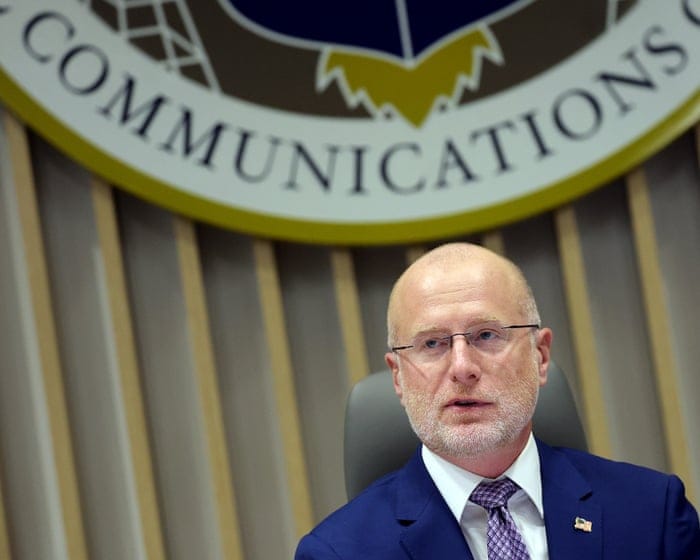
Federal Communications Commission chair Brendan Carr posted a threat on social media Saturday that should alarm anyone who understands how regulatory power works in practice: broadcasters who run what he calls "fake news" about Iran have "a chance now to correct course before their license renewals come up." The post, which The Guardian US reported, warned that "mainstream news" outlets pushing "hoaxes and news distortions" could lose their spectrum permits because "broadcasters must operate in the public interest."
The legal basis for this threat does not exist. The FCC's public interest standard — enshrined in the Communications Act of 1934 and upheld through decades of case law — has never been interpreted to give the agency authority to adjudicate the truthfulness of news coverage. That would be prior restraint, a form of censorship the First Amendment explicitly prohibits. The Supreme Court settled this in New York Times Co. v. United States, the Pentagon Papers case, and has reaffirmed it repeatedly: the government cannot suppress speech because it deems that speech false, misleading, or contrary to the public interest.
Carr knows this. He is a lawyer who spent years in telecommunications policy before Trump appointed him to lead the FCC. Which means the threat is not a legal argument — it is a political one. The message is not "we will win in court." The message is "we control the regulatory process, and we can make your life expensive and uncertain if you displease us."
This is how regulatory capture works in reverse. Normally, the term describes industries co-opting agencies meant to oversee them. But in the Trump administration's second term, regulatory agencies have become tools of political retaliation against industries that do not comply with the president's messaging priorities. The FCC does not need to actually revoke a broadcast license to achieve its goal. The threat itself is the weapon. Broadcasters now face a choice: cover Iran the way the administration wants, or spend millions in legal fees defending license renewals that should be routine.
The timing is not incidental. Carr's post came amid escalating tensions with Iran and reports that the administration is considering military action. Major broadcast networks have covered the possibility of war with varying degrees of skepticism about the administration's justifications — exactly the kind of scrutiny that authoritarian-minded officials cannot tolerate. Carr's reference to "hoaxes" suggests he believes questioning the administration's Iran narrative constitutes misinformation, a framing that collapses the distinction between journalism and propaganda.
The legal standard Carr cited — that broadcasters must "operate in the public interest" — is real, but it has never meant what he is claiming it means. The public interest standard governs technical issues like signal interference, spectrum allocation, and whether a broadcaster is serving its local community with programming. It does not give the FCC editorial control over news content. If it did, every administration could define "the public interest" as "coverage that makes us look good," turning the FCC into a state media regulator.
This is not the first time Trump appointees have threatened to use licensing and regulatory power as leverage against media companies. Trump himself has repeatedly called for revoking NBC's broadcast license over coverage he disliked, and his FCC has slow-walked merger approvals for companies whose news divisions have been critical of the administration. What makes Carr's threat different is the explicitness: he is stating, in public, that editorial decisions about Iran coverage will be considered when broadcast licenses come up for renewal.
The structural vulnerability here is real. Broadcast licenses must be renewed every eight years, and while renewals are almost always granted, the process gives the FCC significant discretion. A hostile FCC can delay renewals, demand additional documentation, hold up mergers and acquisitions, and impose costly compliance reviews. None of this requires proving anything in court. The agency's administrative power is the threat. Broadcasters who want to avoid that costly uncertainty have an incentive to soften their coverage — not because they fear losing in court, but because they fear the process itself.
This is why independent regulatory agencies are supposed to be insulated from political pressure. The FCC is structured as an independent agency precisely to prevent presidents from using spectrum licensing as a tool of political control. But structural independence only works if the people running the agency respect the norms that make independence meaningful. Carr's post demonstrates that he does not. He is using the FCC's regulatory authority exactly the way it was designed not to be used: as a cudgel against speech the administration dislikes.
The progressive policy response has to operate on two levels. First, immediate legal challenges. If the FCC actually moves to deny or delay license renewals based on Iran coverage, broadcasters and press freedom organizations will sue — and they will win. The case law is unambiguous. But waiting for a court victory is not enough, because the damage happens during the process. The chilling effect is the point.
Second, structural reform. The FCC's licensing power over broadcasters is a relic of spectrum scarcity that no longer exists in the same way. Cable news networks, which do not use public airwaves, are not subject to FCC licensing — which is why Carr's threat targets broadcast networks specifically. The distinction made sense in 1934. It makes far less sense now, when most Americans get their news from cable, streaming, and digital platforms. Progressive legislators should be asking whether broadcast licensing in its current form serves any public interest that justifies giving a politically appointed agency this kind of leverage over news organizations.
What happens next depends on whether broadcasters call the bluff. If they preemptively soften Iran coverage to avoid regulatory trouble, Carr wins without ever having to defend his legal theory in court. If they continue reporting and force the FCC to act, the administration faces a First Amendment fight it will lose — but only after months or years of expensive litigation. Either way, the threat has already done its work. The question is whether the damage can be contained, or whether this becomes the template for how Trump officials use regulatory power in the second term: not to win legal arguments, but to make dissent too costly to sustain.