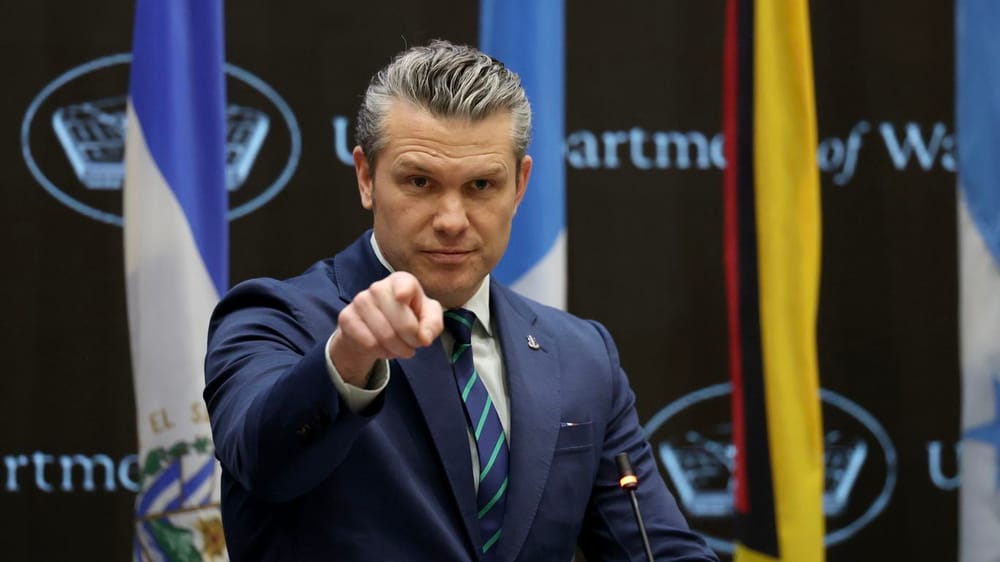
The precise number that legal scholars cite is 157 years. That's how long the United States military has explicitly banned commanders from declaring they will give "no quarter" to enemy forces—a prohibition dating to the 1863 Lieber Code that governed Union Army conduct during the Civil War. Defense Secretary Pete Hegseth violated that ban last week.
In a speech reported by Axios, Hegseth pledged "no quarter, no mercy for our enemies" in the context of escalating threats against Iran. International humanitarian law treats such declarations as war crimes—not rhetorical flourishes, not tough-guy posturing, but explicit violations of the laws of armed conflict on par with targeting wounded soldiers or executing prisoners attempting to surrender.
"The best thing Secretary Hegseth can do for the country and for the US military is to say he misspoke and to retract the statement," Ryan Goodman, a New York University law professor and co-editor-in-chief of the national security journal Just Security, told Axios. "The Pentagon's law of war manual states unequivocally that such statements are war crimes."
The phrase "no quarter" has a specific legal meaning. It signals an intent to take no prisoners—to kill enemy combatants who are attempting to surrender or who are incapacitated. The Hague Conventions of 1899 and 1907, the Geneva Conventions of 1949, and the Pentagon's own Law of War Manual all prohibit threatening or ordering such conduct. The United States prosecuted German military officials for precisely this crime after World War II.
What makes Hegseth's statement particularly dangerous is that it was not an off-the-cuff remark in a heated moment. It was a prepared declaration from the sitting defense secretary about a potential military confrontation with Iran—a country the Trump administration has threatened with strikes through official channels and presidential social media posts. President Trump has posted videos to Truth Social promising "certain death" to Islamic Revolutionary Guard Corps fighters who do not surrender, while urging Iranian civilians to "reclaim your country."
Senator Mark Kelly, a Democrat from Arizona and former Navy combat pilot, framed the stakes plainly in a post on X: "'No quarter' isn't some wanna be tough guy line - it means something. An order to give no quarter would mean to take no prisoners and kill them instead. That would violate the law of armed conflict. It would be an illegal order. It would also put American service members at greater risk."
That last point is critical and often overlooked in debates about the laws of war. These rules exist not as abstract humanitarian ideals but as reciprocal protections. When the United States signals it will not respect the prohibition on "no quarter," it invites adversaries to treat captured American troops the same way. The laws of war are fragile precisely because they depend on mutual restraint by parties who are trying to kill each other. A defense secretary who casually discards them does not project strength—he exposes his own forces to greater danger.
Goodman warned that Hegseth is "putting the American military on a track to lawlessness in which we will lose more and more allies." That assessment is not hyperbole. Allied nations that operate under the same Geneva Convention framework will face domestic and legal pressure to distance themselves from U.S. operations if American commanders are publicly threatening war crimes. Coalition warfare depends on shared legal standards. Hegseth's statement undermines that foundation.
The Pentagon did not respond to Axios' request for comment. That silence is itself notable. In previous administrations, such a statement would have triggered immediate clarification from the Defense Department's legal counsel or public affairs office. The absence of any walkback or correction suggests either that Hegseth's rhetoric reflects administration policy, or that the Defense Department no longer feels obligated to correct its own secretary when he threatens to violate international law.
This is not the first time Trump administration officials have tested the boundaries of lawful military conduct. During Trump's first term, he pardoned service members convicted of war crimes, publicly mused about targeting the families of terrorists, and suggested stealing Iraqi oil as compensation for military operations. What has changed is that those statements are now coming from the defense secretary himself, in the context of active military threats against a regional power.
Legal scholars have taken to social media to remind service members of their obligations. Under the Uniform Code of Military Justice, troops are required to refuse manifestly unlawful orders. An order to give no quarter would meet that threshold. But placing individual service members in the position of having to defy their chain of command is a failure of leadership at the highest levels. The defense secretary's job is to ensure that orders are lawful in the first place.
When Democratic lawmakers publicly reminded service members last year that they must refuse illegal orders, Trump called their remarks "SEDITIOUS BEHAVIOR, punishable by DEATH." That response reveals the deeper pattern: an administration that views legal constraints on executive power—including the laws of war—as obstacles to be denounced rather than rules to be followed. Hegseth's "no quarter" statement is not an isolated rhetorical misstep. It is part of a broader normalization of lawlessness in military policy.
The international legal architecture that governs armed conflict was built in the aftermath of wars that killed tens of millions of people. It exists because the alternative—total war without restraint—proved catastrophic for everyone involved. When the U.S. defense secretary casually discards that framework in a public speech, he is not demonstrating resolve. He is advertising that the United States no longer considers itself bound by the rules it once insisted the entire world follow. That shift will have consequences long after this administration leaves office, and American troops will bear the cost.