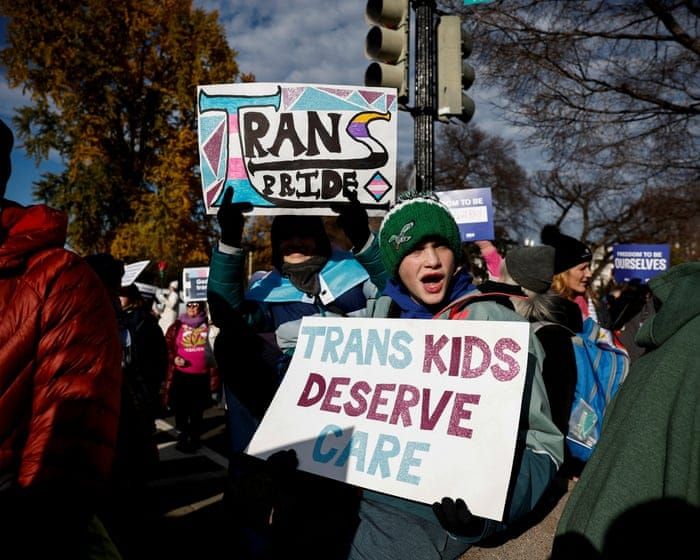
The U.S. Department of Health and Human Services has a new argument against gender-affirming care: supporting trans people is a sign of authoritarian political psychology, and authoritarian political psychology leads to violence. The report, described by The Guardian US as linking "gender ideology" to leftwing authoritarianism and political violence, was released as a scientific document by a cabinet-level health agency. Scientists say it is neither well-conducted nor politically neutral. What it is, in practice, is a policy instrument — one designed to make the elimination of trans healthcare look like a public safety measure.
This is how the administration has operated across multiple fronts: when the policy goal is predetermined, the scientific justification is built backward to fit it. The HHS report joins a pattern of regulatory and institutional action that has, piece by piece, made gender-affirming care inaccessible across the United States — not through a single legislative vote, but through investigations, funding threats, and now, a federally published study that reframes clinical medicine as a vector for political radicalization.
The practical effects were already accumulating before this report existed. The Guardian US noted that the Department of Justice reached an agreement with a New York hospital on the same Friday the report circulated — the hospital agreed to stop offering pediatric gender-affirming care. That agreement did not require a court ruling. It did not require Congress to pass a law. It required only that the federal government make the cost of continuing care high enough that an institution chose to stop. Dozens of hospitals have made the same calculation since the administration began investigating facilities for providing what medical associations describe as standard of care.
Gender-affirming care for minors — which can include puberty blockers, hormone therapy, and in some cases surgery — is endorsed as evidence-based by the American Academy of Pediatrics, the American Medical Association, the Endocrine Society, and the World Professional Association for Transgender Health. The HHS report does not engage with this clinical consensus. It reframes the political and social support for such care as a psychological pathology linked to authoritarian tendencies.
The core claim of the HHS report is not a scientific finding. It is a rhetorical move. By labeling support for trans people as a symptom of "leftwing authoritarianism," the document attempts to shift the terms of the debate: no longer are critics of gender-affirming care restricting access to medicine; they are protecting democratic society from a dangerous ideological movement. The people most harmed by this framing are trans adolescents and their families, who now exist in an environment where the federal health bureaucracy has officially characterized their doctors' recommendations as politically suspect.
Scientists quoted by The Guardian US described the study as "poorly conducted" and "nakedly political." Those are precise, damning terms from researchers whose professional lives involve evaluating methodology. "Poorly conducted" means the study does not meet the standards required to support its conclusions. "Nakedly political" means the conclusions appear to have preceded the research. When a government health agency publishes work that independent scientists describe in those terms, the question is not whether the science is flawed. The question is what the science was for.
The answer, in this case, is enforcement. The report gives institutional cover to a campaign that has been running for years through executive action rather than legislation. This matters because it is harder to challenge in court, harder to reverse with a single vote, and harder to cover as a coherent story when each individual action — an investigation here, a DOJ agreement there, a federal report somewhere else — can be presented as discrete and unrelated. They are not discrete and unrelated. They are the architecture of elimination.
The specific danger of deploying junk science through a government health agency — rather than through, say, a think tank or a political speech — is institutional legitimacy. HHS carries the weight of federal authority. Its publications are cited in court filings, referenced in state legislation, and treated by media as newsworthy precisely because they come from a government body charged with protecting public health. When that body publishes a document claiming that supporting trans people correlates with authoritarian psychology, the document does not need to be scientifically valid to do political work. It needs only to exist.
This is a tactic with precedent. The administration's approach to vaccine policy has drawn similar criticism — Tinsel News has reported on HHS making vaccine policy from a retracted study, with federal health guidance built on research that the publishing journal itself withdrew. The pattern is consistent: identify a policy goal, find or commission research that supports it, publish through channels that confer official credibility, and use the resulting document as justification for enforcement actions that would otherwise lack scientific grounding.
The people paying the most direct cost are trans youth and their families, particularly those who depend on hospital systems that have now stopped offering care under federal pressure. For a family in a state with hostile legislation and a hospital system that has withdrawn services, the federal report is not an abstraction. It is one more door that has been closed. The clinical literature on the mental health consequences of denying gender-affirming care to adolescents who need it is extensive and consistent. That literature does not appear to have informed the HHS report.
The report also carries consequences for science itself, as researchers quoted by The Guardian US noted. When a federal health agency publishes work that the scientific community regards as methodologically compromised and politically motivated, it contributes to a broader erosion of institutional credibility — one that makes it harder to build public trust in legitimate findings on vaccines, disease surveillance, or drug safety. The administration's relationship with scientific consensus has been consistently adversarial across multiple domains, from climate data to public health infrastructure. The HHS report on "gender ideology" is not an outlier. It is the method.
What makes this particular document worth examining closely is the specific rhetorical move it makes. Previous administration actions on trans healthcare have relied on arguments about parental rights, child protection, or the claimed inadequacy of the clinical evidence base. This report goes further: it attempts to pathologize the political identity of anyone who supports trans people, linking that support to authoritarianism and violence. That is not a healthcare argument. It is a political argument dressed in the language of psychology, published by an agency that is supposed to be in the business of protecting health — including, nominally, the health of trans people.
The administration has made clear, through the accumulation of these actions, that it does not regard trans people as a constituency whose health outcomes it is responsible for. What the HHS report adds to that posture is a theoretical framework: trans people and their supporters are not simply a group whose needs the administration deprioritizes, but a symptom of a dangerous political pathology. That framing, once embedded in federal documents, does not disappear when administrations change. It becomes a citation. It becomes precedent. It becomes the kind of institutional record that future actors — in courts, in statehouses, in federal agencies — can reach for when they need a government source to support a conclusion they have already reached.
That is the real function of junk science published by a legitimate government body. It is not meant to persuade scientists. It is meant to outlast them. As Tinsel News has covered in the context of the administration's broader strategy of using official designations to criminalize political identity, the power of a federal label is not in its accuracy. It is in its permanence.