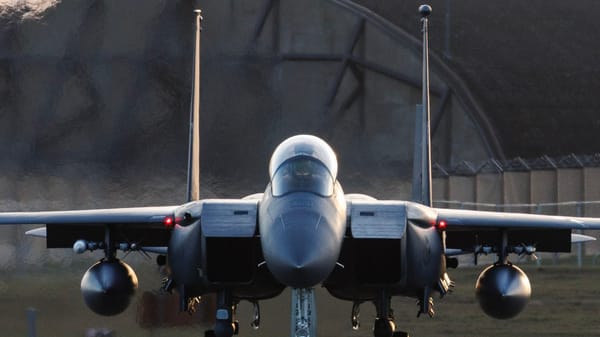
The United States has spent approximately $12 billion on military operations against Iran since the conflict began, according to Al Jazeera English, citing a top Trump administration adviser. That figure represents roughly $37 for every person in America — spent on a war that Congress never voted to authorize, with objectives the administration has yet to clearly define.
The $12 billion disclosure comes as pressure mounts on the White House to explain both the legal basis for the conflict and its strategic endgame. Al Jazeera English reported that the administration faces growing scrutiny over the war's escalating costs and unclear mission parameters. The Constitution grants Congress — not the executive branch — the power to declare war. Yet American forces have been conducting sustained military operations against a sovereign nation for weeks without explicit legislative authorization.
The financial cost is only part of the accountability gap. Trump has stated the U.S. will continue bombing Iran until it secures "better terms," but the administration has not defined what those terms are, what success looks like, or what would constitute an acceptable resolution. This is not strategy. This is open-ended military action funded by executive discretion, with American taxpayers footing a bill that grows by hundreds of millions of dollars each week — a conflict that could cost trillions over generations with no exit plan in sight.
The broader economic consequences extend far beyond the Pentagon's ledger. Gas prices have surged to $5.80 per gallon as the conflict disrupts global oil markets, with working families bearing the immediate cost of a war they never consented to. Meanwhile, Russia has benefited from elevated oil prices that cushion the economic impact of Western sanctions — an ironic outcome for an administration that campaigned on confronting Moscow.
Congressional oversight has been largely absent. Lawmakers who would scrutinize a $12 billion domestic infrastructure proposal have remained quiet as that same sum finances military operations without their approval. The War Powers Resolution of 1973 requires the president to notify Congress within 48 hours of committing armed forces and limits such deployments to 60 days without congressional authorization. That window has closed. The war continues.
The constitutional question is not abstract. If a president can unilaterally commit the United States to sustained military conflict against a regional power, spend billions in public funds, and reshape global energy markets without legislative approval, then the separation of powers exists only as a formality. The framers designed the war powers clause specifically to prevent exactly this scenario: executive military adventurism funded by public resources and justified by shifting rationales — a dynamic made explicit when the president publicly admitted the war's legal basis was never secured.
What the $12 billion figure reveals is not just a cost — it is a choice. That sum could have funded universal pre-K for 400,000 children for a year. It could have covered the average annual healthcare costs for roughly 1.5 million Americans. It could have rebuilt critical infrastructure in dozens of cities. Instead, it has been spent prosecuting a war whose legal authorization remains unaddressed, whose strategic objectives remain undefined, and whose endpoint remains unknown.
The administration's reluctance to seek congressional authorization suggests an awareness that such a vote might not succeed. That is precisely why the Constitution requires it. Wars that cannot secure democratic consent should not be waged with democratic resources. The $12 billion spent so far is not just a budget line — it is a measure of how far executive power has drifted from constitutional constraint, and how little accountability remains when that constraint is ignored.