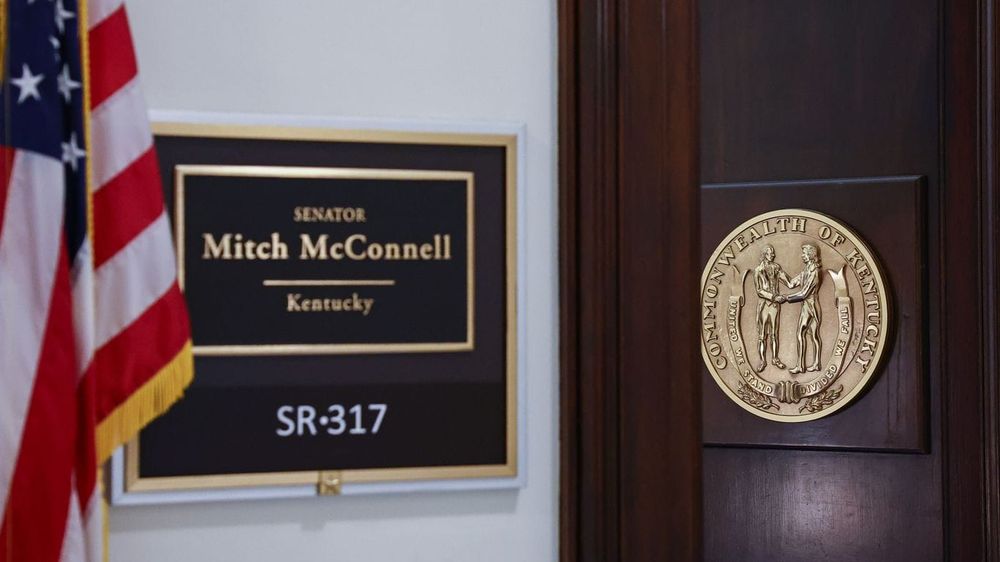
Forty days. That is how long Mitch McConnell, one of two U.S. senators representing Kentucky's 4.5 million residents, has gone without making a public appearance beyond photographs released by his own office. No floor votes. No town halls. No press availability. No verified, independent confirmation of his capacity to do the job he holds until January 2027.
On Monday, Kentucky Gov. Andy Beshear sent his second letter to McConnell's office demanding the senator either address constituents verbally — showing his ability to serve — or resign his seat. Axios reported the letter was also sent to Senate Majority Leader John Thune, whom Beshear urged to investigate McConnell's capacity to serve. The governor's language was unambiguous: "I understand anyone's desire for privacy, but when you run for office and serve as one of a state's two U.S. senators, you willingly abdicate much of your personal privacy. That's the deal, and we all know it when we run."
McConnell's office, alongside a statement from the congressional physician's office released the same day, offered a carefully managed response: the senator is still recovering from a June fall at his home, is undergoing "strenuous" physical therapy, and a childhood bout with polio plays a "significant factor in his mobility." The physician's statement did not address cognitive capacity. McConnell's own statement, reported by Axios, claimed he is "still working hard to get back to my full schedule of work in the Senate and in Kentucky." Neither Thune's nor McConnell's offices responded to Axios' request for additional comment.
Under Kentucky law, Senate vacancies — which can occur due to resignation, expulsion, or death — are filled by special election. McConnell is scheduled to retire when his term ends in January 2027. A resignation would trigger an election process, not a gubernatorial appointment — meaning Beshear could not simply install a Democratic replacement.
The framing of this story as a Democratic governor scoring political points against a Republican icon misses the more durable problem this situation exposes. Beshear cannot compel McConnell to speak. Thune cannot compel McConnell to submit to a capacity review. The Senate has no formal mechanism — none — to assess whether a sitting member is physically or cognitively able to perform the duties of office. The United States Constitution allows for expulsion by a two-thirds vote, a threshold so high it has never been used for health-related incapacity. There is no equivalent of the 25th Amendment for the legislative branch.
This is not a new problem. It is a recurring one that American political culture has chosen, repeatedly, to leave unresolved. McConnell himself froze at a press conference in 2023, standing silent for nearly 30 seconds before being led away by colleagues — an episode that generated significant media coverage and then, like the episodes before it, faded without institutional consequence. The Senate's response was not to examine its own rules. It was to wait.
The accountability gap here runs in two directions simultaneously. The first is the absence of any formal mechanism for constituents to obtain verified information about their senator's capacity to serve. McConnell's office controls what information is released, when it is released, and in what form. The congressional physician's statement, while more detailed than nothing, was released alongside a McConnell statement and a photograph — a coordinated communications exercise, not an independent medical assessment. Kentucky voters have no independent means to verify what their senator can and cannot do.
The second direction is the Senate's institutional incentive to look away. Incapacity reviews would set precedents that could apply to any senator. The chamber has members in their 70s and 80s across both parties. A formal process for assessing fitness to serve would be uncomfortable for the institution regardless of which party initiated it. The Senate's preference, historically, has been to manage these situations informally — through staff, through leadership, through quiet accommodation — rather than through rules that could one day apply to powerful members who do not wish to be examined.
Beshear's letter is not wrong on the merits. The accountability argument he makes — that elected office requires a baseline of public transparency about one's capacity to serve — is sound democratic theory. His framing is also notable for what it does not claim. He does not say McConnell is incapacitated. He says McConnell should prove that he is not. That is a different and more defensible position, and it is one the senator's office has so far declined to meet on its own terms.
The MAGA ecosystem has, predictably, filled the information vacuum with conspiracy theories. Beshear's letter acknowledges this directly, noting that "all of this speculation and even this letter could have been avoided with a minimal amount of transparency." This is the perverse outcome of institutional opacity: it does not suppress speculation. It licenses it. McConnell's office has chosen a communications strategy — managed statements, released photos, no independent verification — that creates the conditions for exactly the disinformation environment it is publicly complaining about.
What Beshear's letter cannot do, and what Thune's investigation, if it occurs, cannot produce, is structural change. Under Kentucky law, Senate vacancies are filled by special election, not gubernatorial appointment. Beshear has no political incentive to manufacture a vacancy he cannot fill with a Democrat. His power is moral and reputational, not structural. And Thune, as a Republican leading a Republican-majority Senate, has every institutional reason to manage this situation quietly rather than establish a precedent for reviewing the capacity of senior members.
This is the structural trap. The people with the formal power to act — Senate leadership — have the least political incentive to use it. The person with the political incentive to act — the Democratic governor — has no formal power. And the voters of Kentucky, the people whose representation is most directly at stake, have no mechanism beyond the ballot to force accountability, and the next ballot is more than a year away.
As Tinsel News has documented in other contexts, Congress has a consistent pattern of identifying its own accountability failures and declining to resolve them. The absence of a fitness-to-serve framework for senators is not an oversight. It is a choice — one that protects institutional incumbency at the cost of democratic representation. And the erosion of meaningful representation rarely announces itself with a single dramatic failure. It accumulates through exactly these moments: a senator absent for forty days, a governor without legal standing to demand answers, a Senate majority leader with every reason to look away, and a constituency that cannot compel any of them to act.
McConnell's term ends in January 2027. If he cannot perform his duties between now and then, Kentucky will have had, in effect, one senator. The Senate has no rule that treats that as a problem worth solving. Beshear's letter will not change that. What it does is put the failure in writing — and make clear that when the accountability mechanism breaks down, the only tool a democratic governor has left is a letter no one is obligated to answer.