The Republican Party has no consistent standard for evaluating the loyalties of candidates based on their religion — except when the candidate is Muslim. That is not a provocation. It is a pattern, and Ted Cruz just demonstrated it again.
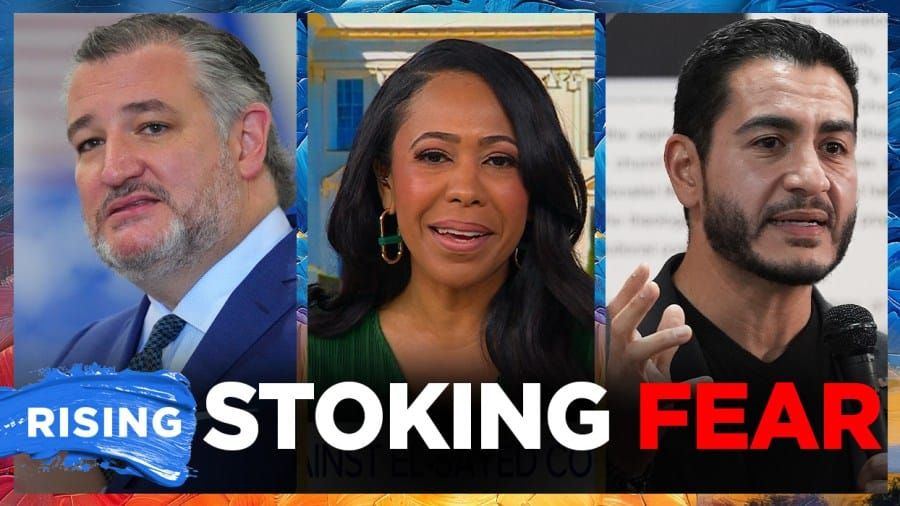
Cruz claimed, without evidence, that Abdul El-Sayed — a physician, former Detroit health director, and Democratic Senate candidate in Michigan — might share classified intelligence with terrorists if elected. The basis, as reported by The Hill, was an allegation linking El-Sayed to the Muslim Brotherhood — an allegation El-Sayed has repeatedly denied and that Cruz offered no documentation to support. The senator did not name a source. He did not cite a government finding. He made the claim as though it required no evidence, because for a certain audience, it doesn't.
Cruz's attack on El-Sayed is not about the Muslim Brotherhood. It is about establishing that Muslim Americans who seek federal office are presumptively dangerous — that their faith alone is sufficient grounds to question their fitness for access to classified information. No Republican senator has made this argument about Catholic candidates whose church is formally linked to organizations that have shielded abusers from law enforcement. No Republican senator has asked whether evangelical candidates might share intelligence with Christian nationalist networks that have advocated political violence. The asymmetry is not incidental. It is the point.
Abdul El-Sayed is a physician and public health official who served as Detroit's health director from 2015 to 2017. He ran for Michigan governor in 2018, narrowly losing the Democratic primary. He is now running for the U.S. Senate in Michigan. He has denied any ties to the Muslim Brotherhood. No law enforcement or intelligence agency has produced documentation linking him to the organization.
The accountability question is straightforward. Cruz made a claim that, if applied consistently, would require him to scrutinize every candidate whose religious community has any documented connection to any organization that has ever been accused of extremism. That standard would disqualify most of the Senate. Cruz does not apply it that way. He applies it specifically to Muslim candidates, which means the religion is doing the work — not the evidence.
Michigan is where this targeting lands with the most political calculation. The state has one of the largest Arab American and Muslim American populations in the country, concentrated in Wayne County and its surrounding communities. El-Sayed's candidacy is partly a direct expression of that community's political maturation — a generation that grew up after September 11 watching their families surveilled, their mosques monitored, their neighbors questioned, and that has now decided to run for office rather than simply absorb the scrutiny. Cruz's attack is an attempt to make that political participation carry a permanent asterisk: even if you win, you will be treated as a security risk.
AIPAC has already committed substantial resources to defeating El-Sayed in the Democratic primary, framing its opposition around his positions on Gaza. Cruz's intervention adds a second track: while one set of outside forces contests El-Sayed's policy positions, Cruz introduces the suggestion that El-Sayed's identity itself is the disqualification. The two tracks reinforce each other without requiring coordination. That is how normalized Islamophobia operates in American politics — not through a central conspiracy, but through a shared set of assumptions that different actors exploit for different purposes.
The pattern is clearer in historical context. Cruz's Muslim Brotherhood allegation belongs to a longer tradition of manufactured civilizational threat that Republican politicians have used against Muslim candidates and officials for two decades. Representative Keith Ellison was accused of secret loyalties when he sought to be sworn in on a Quran in 2007. Representative Ilhan Omar has been subjected to fabricated extradition claims amplified by major news outlets. Representative Rashida Tlaib has been called a terrorist sympathizer on the floor of Congress. The accusations are never substantiated. They do not need to be. Their function is not to inform — it is to signal that Muslim Americans in positions of power are inherently suspect, and that any Republican who raises the suspicion is performing a service.
What Cruz said about El-Sayed is not a fringe position that leaked into mainstream politics. It is a mainstreamed position that operates through the pretense of legitimate concern. The Muslim Brotherhood framing is specifically useful because the organization is real, has a complex global history, and has been designated as a terrorist organization by some governments — though not by the United States government. This creates just enough factual scaffolding to make the allegation sound like intelligence analysis rather than religious profiling. It is not intelligence analysis. No named source, no government document, no law enforcement referral has been cited. It is a senator telling a national audience that a Muslim man who wants to handle classified information should not be trusted.
Senator Tommy Tuberville demonstrated the same logic earlier this cycle when he linked a Muslim mayoral candidate to September 11 without evidence, then shrugged off criticism as political correctness. The pattern across Cruz and Tuberville is not coincidence — it is a shared understanding within the Republican Party that Islamophobic insinuation carries no political cost and may carry a political benefit. That understanding will persist until it stops being true.
The human cost of this pattern does not reside in the careers of the candidates targeted, though those careers are affected. It resides in what these accusations communicate to Muslim Americans who are not running for office — to the teenager in Dearborn who watches a senator suggest that people who look like her family cannot be trusted with the nation's secrets, to the doctor in Detroit who has served his community and is now told that his service is evidence of a hidden agenda. The accusations are aimed at candidates. The message lands on communities.
Cruz has not been asked to name his source. He has not been pressed to explain why the Muslim Brotherhood allegation applies to El-Sayed but not to the Catholic candidates whose church has paid over $3 billion in abuse settlements to victims whose abusers were protected by institutional cover-up — a form of institutional wrongdoing with more documented American victims than the Muslim Brotherhood has. The question answers itself: the standard is not applied consistently because consistency is not the goal. The goal is the targeting.
Michigan's Senate race will determine whether this strategy has a cost. If El-Sayed loses — in the primary or the general — the lesson Republican operatives will draw is that the Muslim Brotherhood smear worked. If he wins, the lesson will be different. The voters of Michigan, including its substantial Arab American and Muslim American electorate, are not abstractions in this calculation. They are the people Cruz's accusation was designed to either frighten into silence or provoke into backlash. Either outcome, from Cruz's perspective, is useful. The only outcome that is not useful to him is one in which the accusation is treated as what it is: a senator telling Americans that a Muslim man's religion makes him a security risk, with no evidence, no accountability, and no apology.