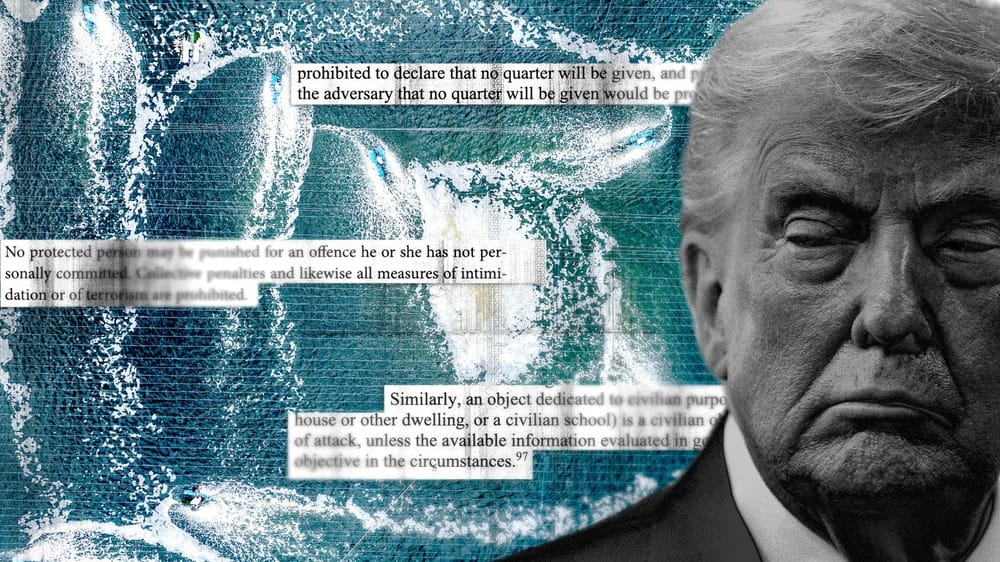
Destroying a civilian water supply is not a gray area in international law. Protocol I of the Geneva Conventions, adopted in 1977, explicitly prohibits attacks on "objects indispensable to the survival of the civilian population" and lists drinking water installations by name. When President Trump threatened Monday to obliterate Iran's desalination plants if a deal isn't reached, he wasn't describing a military option. He was describing a war crime, stated publicly, attributed to himself, and framed by his press secretary as consistent with acting "in the confines of the law."
That framing is worth sitting with. Because what Axios reported Monday is not simply another Trump escalation in a war that has already produced mass civilian casualties. It is the clearest evidence yet that this administration has made a deliberate, ideological decision to treat the laws of armed conflict as optional — and that the decision was made long before the first sortie of Operation Epic Fury.
Iran is one of the most water-stressed countries on earth. Decades of drought, groundwater depletion, and mismanagement have made desalinated water not a luxury but a lifeline for millions of Iranians, particularly in the south and along the Persian Gulf coast. Destroying that infrastructure does not pressure a government — it sentences a civilian population. The people who would lose water access are not the officials in Tehran who decide whether to negotiate. They are the families, the hospitals, the schools.
The administration knows this. A senior U.S. official told Axios the logic explicitly: "A couple of Israeli sorties, they will have no water. There is a lot to lose if there's no accommodation." The official framed civilian suffering as the mechanism of coercion — not a regrettable side effect of military pressure, but the instrument of it. That is the definition of collective punishment, which is prohibited under Article 33 of the Fourth Geneva Convention regardless of military objective.
This is not the first time the administration has approached this line. According to Axios, the White House has already signed off on Israeli assassinations of political leaders and threatened "no quarter" for enemy combatants — a phrase that, under the laws of war, means refusing to take prisoners and is itself a war crime when applied to combatants who are surrendering or incapacitated. The administration also initially rejected responsibility for a mass casualty strike on an elementary school before quietly walking back that position. Each incident has been treated as a discrete controversy. Taken together, they form a doctrine.
That doctrine has a paper trail. Defense Secretary Pete Hegseth, in his 2024 book, wrote that troops "should not fight by rules written by dignified men in mahogany rooms eighty years ago." During Trump's first term, Hegseth lobbied — both privately and on Fox News — for pardons for soldiers convicted of war crimes. Trump granted those pardons in 2019, citing Hegseth by name. Trump himself criticized the Geneva Conventions during his 2016 campaign, calling them an obstacle to soldiers who were "afraid to fight." The desalination threat is not an improvisation. It is a policy position held by the president and his defense secretary for nearly a decade, now being applied to an active war.
Press secretary Karoline Leavitt's statement — that the administration "will always act in the confines of the law" while simultaneously defending a threat that violates the law — is worth examining as a rhetorical object. It is not a contradiction in the usual political sense, where a politician says one thing and does another. It is something more specific: a claim that the law does not mean what it says, or that the United States is not bound by it when binding is inconvenient. This is how legal norms erode. Not through formal withdrawal from treaties, but through repeated assertions that the treaties don't apply to this case, this target, this president.
The accountability structure that might check this is largely absent. As Tinsel News has reported, the Iran war has no congressional authorization, no formal budget appropriation, and no legislatively mandated exit conditions. Congress has not been asked to weigh in on whether the United States should threaten to destroy civilian water infrastructure. The Pentagon declined to comment to Axios. The White House referred reporters to Secretary of State Marco Rubio, who said the operation was proceeding as planned and that Trump had "a number of options available."
That phrase — "a number of options" — is doing considerable work. It implies that destroying Iran's water supply is one item on a menu of proportionate responses, subject to deliberation and legal review. The senior official quoted by Axios suggested Trump "wants to make sure that things are proportionate in this war," citing his anger when Netanyahu struck an Iranian desalination plant weeks ago. But the distinction between Netanyahu striking a desalination plant and Trump threatening to strike desalination plants is not a moral one. It is a sequencing one. The administration's objection was apparently timing and optics, not principle.
The human cost of this war is already landing on Iranian civilians in ways that receive almost no coverage in American media. Tinsel News has documented the compounding humanitarian crisis inside Iran — a broken economy, infrastructure under sustained pressure, and a population that has no meaningful voice in whether their government negotiates. Threatening to remove their water access does not weaken the Iranian government. It strengthens the argument, used by authoritarian states in every era, that national survival requires closing ranks against an exterminatory enemy.
The systemic pattern here extends well beyond Iran. The U.S. government has now sanctioned a UN official for documenting war crimes, as Tinsel News reported earlier this month. It has pardoned soldiers convicted of those crimes. It has installed a defense secretary who wrote publicly that the laws of war are obsolete. And it is now threatening, in the open, to attack infrastructure whose destruction is explicitly prohibited by treaties the United States signed and ratified. The infrastructure of accountability — legal, legislative, journalistic — is being dismantled at the same pace as the infrastructure of restraint in warfare itself.
The Geneva Conventions were not written to constrain only America's enemies. They were written after the Second World War by people who had watched what happens when great powers decide the rules don't apply to them. The "dignified men in mahogany rooms" that Pete Hegseth dismissed were, in many cases, survivors and witnesses of industrial-scale atrocity. The rules they wrote were not naive idealism. They were the minimum agreed floor below which no state could descend without being named for what it was doing.
The United States is now publicly threatening to descend below that floor and calling it a negotiating tactic. If the threat is carried out, the legal term is not "escalation" or "controversial strike" or "pressure campaign." The legal term is a war crime. And the record of who authorized it, who defended it, and who stayed silent is already being written.