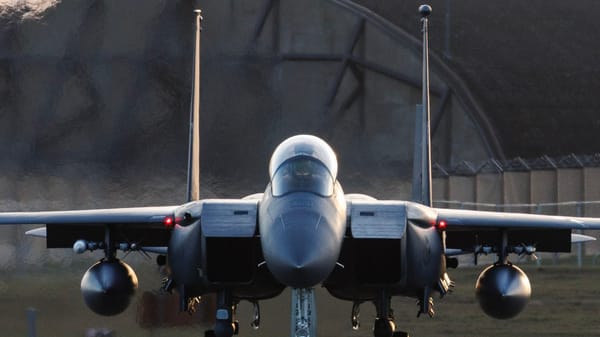
The United States has been bombing Iran for weeks now, and President Donald Trump made clear this week that he has no intention of stopping. Speaking to reporters, Trump told The Guardian US that while he believes Iran wants a ceasefire, the terms Tehran is offering are "not good enough yet." Translation: the U.S. will continue its joint military offensive with Israel until Iran capitulates to demands that remain publicly undefined.
This is not a strategy. This is the absence of one, dressed up in the language of negotiation. Trump's comments came as Iranian forces launched fresh waves of missile and drone strikes on Gulf states and Israel—predictable retaliation for the ongoing U.S.-Israeli bombardment. Israeli and American warplanes responded with new attacks inside Iran. The cycle continues, with no articulated endpoint, no clear objectives beyond "better terms," and no accounting for who is dying in the meantime.
What Trump is describing is not diplomacy. It is extortion under fire. The administration has offered no public framework for what a ceasefire would require, no timeline for negotiations, and no explanation of what "good enough" would actually look like. What it has offered is an open-ended military campaign against a country of 89 million people, conducted in partnership with a regional ally whose own government has spent decades seeking regime change in Tehran.
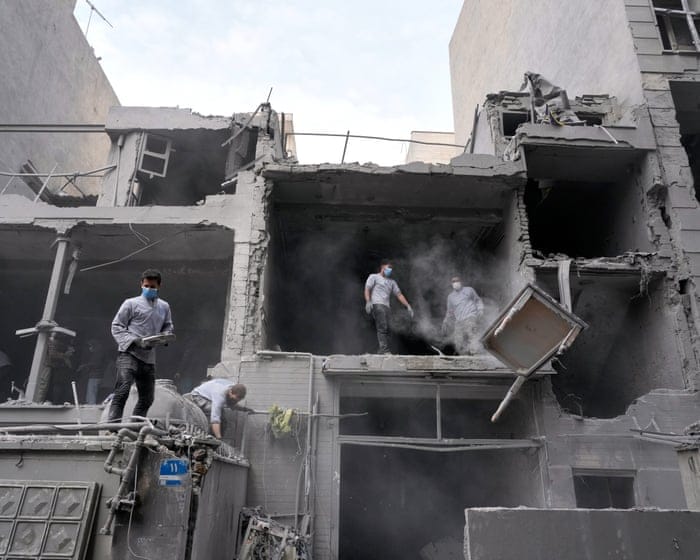
The human cost of this ambiguity is not hypothetical. Iran's civilian infrastructure—power grids, water treatment facilities, transportation networks—has been hit repeatedly in recent strikes. Independent monitoring groups have documented significant civilian casualties, though verifying exact numbers is nearly impossible given the communications blackout in affected regions and the Iranian government's own restrictions on information. What is clear is that ordinary Iranians, not the clerical leadership Trump claims to be pressuring, are bearing the immediate consequences of this campaign.
The regional fallout is equally destabilizing. Gulf states, including U.S. allies Saudi Arabia and the United Arab Emirates, have absorbed Iranian missile strikes in retaliation for allowing American forces to use their airspace and military bases. Oil prices have spiked 18% since the offensive began, threatening global economic stability and hitting American consumers at the pump. European allies have publicly urged restraint. China and Russia have condemned the strikes and called for immediate de-escalation. The U.S. is isolated diplomatically, even as it escalates militarily.
This is what happens when a U.S. administration outsources its Middle East policy to Benjamin Netanyahu's government, which has long sought to destroy Iran's nuclear program and regional influence through military force. The current offensive is the realization of a decades-old Israeli strategic goal, now executed with full American military participation. Trump is not leading this policy—he is ratifying it, providing the airpower and the diplomatic cover for an operation that serves Israeli objectives more clearly than American ones.
The administration's justification for the campaign has been inconsistent. Initially, officials cited Iran's nuclear program and its support for proxy forces in Iraq, Syria, Yemen, and Lebanon. But the strikes have targeted far more than nuclear or military sites—they have hit dual-use infrastructure that affects millions of civilians. When pressed on civilian casualties, U.S. officials have repeated the phrase "precision strikes" without providing damage assessments or casualty figures. The pattern is familiar: destroy first, assess later, deny responsibility always.
What Trump is effectively saying is that the U.S. will continue bombing until Iran agrees to terms it finds humiliating enough to accept. This is not a peace process. It is a coercion process, and history suggests it will not produce the outcome Trump expects. Sanctions and military pressure did not force Iran to abandon its nuclear program in the past—they pushed Tehran closer to building one. The 2015 nuclear deal, which Trump abandoned in his first term, was the most effective constraint on Iran's nuclear ambitions in decades. That deal is now irrelevant. Iran has since advanced its enrichment capabilities and hardened its defenses. The current bombing campaign may set back some facilities, but it will not eliminate the knowledge, the infrastructure, or the political will that drives Iran's nuclear program.
Meanwhile, the domestic political logic is transparent. Trump is selling this war as strength, as a president who does not back down, who makes demands and waits for the other side to cave. It is a posture that plays well with his base and allows him to contrast himself with his predecessor's diplomatic approach. But posture is not policy. Strength is not strategy. And demanding "better terms" without defining them or offering a path to achieve them is not negotiation—it is stalling while people die.
The question the administration will not answer is the most important one: what happens if Iran does not offer better terms? What happens if Tehran calculates, correctly, that it has more to lose by surrendering to undefined American demands than by enduring continued strikes? What happens if the bombing continues for months, if civilian casualties mount, if oil prices surge further, if regional allies grow exhausted, if a missile strikes a U.S. base and kills American troops? Trump has no public answer to any of these scenarios. He has only the assertion that Iran will eventually break.
This is the same assumption that has guided failed U.S. military interventions for decades—that sufficient violence will force adversaries to accept American terms. It did not work in Vietnam. It did not work in Iraq. It did not work in Afghanistan. It has not worked in Yemen, where a Saudi-led bombing campaign backed by the U.S. has produced one of the world's worst humanitarian catastrophes without achieving its stated objectives. The belief that bombing a country into submission is a viable strategy is not supported by evidence. It is supported by ideology, by the conviction that American military power can reshape the world if only it is applied with enough force.
What Trump is offering is not a path to peace. It is a path to an open-ended conflict with no exit strategy, no defined victory conditions, and no accountability for the human cost. He is telling the American public—and the world—that the U.S. will keep bombing Iran until it gets what it wants, without specifying what that is or how long it will take. That is not leadership. That is recklessness, and the people of Iran, the region, and ultimately the United States will pay for it.