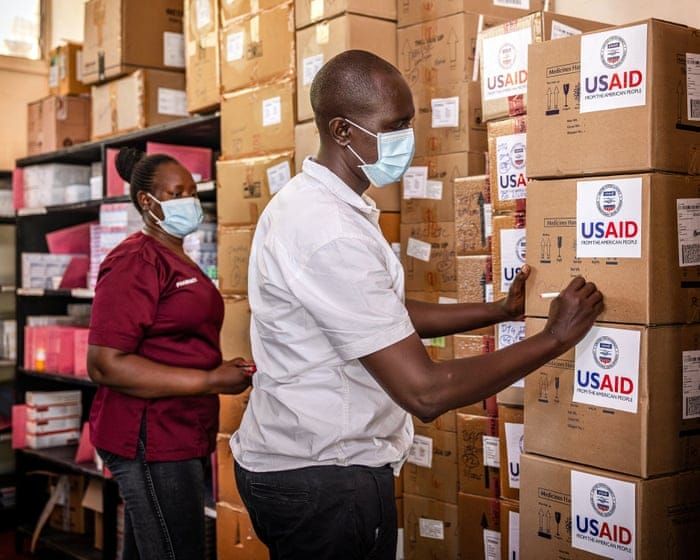
Nicholas Enrich was in Kenya in 2003 when President George W. Bush signed a $15 billion, five-year commitment to fight HIV — the largest international health investment any government had ever made against a single disease. Enrich was a young American aid worker at the time, and he later told The Guardian US that the moment crystallized something for him: his government had decided to show up. He spent the next two decades building on that commitment, working inside the foreign aid architecture that made it real.
Then he watched it get taken apart.
What Enrich witnessed — and what his account to The Guardian documents — is not the story the Trump administration and DOGE have been telling about foreign aid. The official version is simple: bloated bureaucracy, wasted taxpayer money, programs that serve no American interest. The reality Enrich describes is something else entirely. The cuts did not find inefficiency and eliminate it. They found functioning infrastructure and broke it.
USAID administered the President's Emergency Plan for AIDS Relief (PEPFAR), which by 2024 was credited with saving more than 25 million lives across sub-Saharan Africa, according to the agency's own program data. It also funded tuberculosis treatment, maternal health, famine response, and disease surveillance programs in more than 100 countries. The agency's annual budget was approximately $40 billion — roughly 1 percent of the federal budget.
This is the argument Enrich's account makes possible, even if he does not state it in those terms: DOGE did not audit USAID. It executed it. There is a meaningful difference, and the people bearing the cost of that difference are not in Washington.
The Global Perspective Test, applied here, is brutal. Every domestic political debate about USAID — about government spending, about the role of foreign aid, about whether American taxpayers should fund programs abroad — has been conducted almost entirely without the voices of the people those programs serve. In Kenya, in Zambia, in Mozambique, in the communities where PEPFAR built clinics and trained health workers and funded antiretroviral supply chains, no one was asked. No one's perspective was solicited by the officials who ordered the cuts. No cost-benefit analysis weighed their lives.
That is not an accident. It is a feature of how foreign aid gets eliminated. The people who depend on it have no vote, no lobby, no seat at the table where American budget decisions get made. They are, in the political calculus that produced DOGE's actions, not a constituency. They are a line item.
Enrich's phrase — "ignorance and cruelty" — is precise in a way that the political debate around USAID has not been. "Ignorance" because the people ordering the cuts demonstrably did not understand what they were cutting. USAID programs are not interchangeable budget lines. They are supply chains, trained workforces, laboratory networks, cold storage facilities, referral systems. You cannot pause an antiretroviral distribution network for six months and then restart it as if nothing happened. The patients who missed treatment windows do not get those windows back. The health workers who lost positions and found other work do not automatically return. The supply chains that collapsed do not reassemble on command.
"Cruelty" because, once the ignorance is corrected — once you are told what the programs do and who depends on them — continuing the cuts becomes a choice. That is what Enrich's eyewitness account documents: officials who were told, who understood, and who proceeded anyway. This pattern connects directly to what Tinsel News has documented in the State Department, where the same logic — cut the workforce, accept the consequences later — has left Americans stranded in conflict zones because the people who would have managed their evacuation were fired.
The accountability question here runs deeper than DOGE. The Trump administration did not invent the political vulnerability of foreign aid. Foreign aid has always been structurally exposed in American politics precisely because its beneficiaries cannot vote in American elections. What DOGE did was exploit that structural vulnerability at speed and scale, using a mandate for "efficiency" to do something that is better described as policy elimination. The distinction matters because efficiency cuts are reversible. Destroyed infrastructure is not.
There is also a power and money dimension that the domestic debate consistently skips. USAID's programs generated real diplomatic, strategic, and epidemiological value — advantages that took deliberate effort to build. PEPFAR gave the United States relationships and credibility in sub-Saharan Africa that took decades to build. Health surveillance programs funded through USAID were part of the early warning architecture for pandemic detection. These are not sentimental considerations. They are strategic assets that cost real money to build and, once gone, cannot be replaced quickly or cheaply. The countries that have been watching — China foremost among them — are not unaware of what the cuts signal about American reliability as a partner.
Enrich's account lands at a specific moment. The DOGE-driven cuts to USAID have been framed, by the administration and by sympathetic media, as a correction of progressive excess — a rollback of ideological programs funded by a government that lost its way. What Enrich describes does not fit that frame. He describes the dismantling of PEPFAR infrastructure. He describes programs that a Republican president created, that bipartisan coalitions funded for two decades, that epidemiologists and public health researchers have documented saving millions of lives. These are not contested programs in any serious empirical sense. They are contested only in the political sense — which is to say, they have been made contestable by an administration that needed a target.
This connects to a broader pattern in how the current administration has approached institutions: the collapse of institutional accountability mechanisms across the federal government has made it possible to eliminate programs without the normal friction of oversight, public testimony, or documented justification. USAID was not defunded through a congressional debate about foreign aid priorities. It was dismantled through executive action and DOGE-directed personnel cuts that moved faster than oversight could respond.
The people bearing the cost of that speed are in Nairobi and Lusaka and Maputo. They are the patients who showed up to clinics that had closed. The health workers who had no paycheck and no program left to run. The supply chains that exist now only in the past tense. Nicholas Enrich saw it happen. His account is one of the few public records of what was actually lost — told not by a politician or an advocate but by a man who was there when the commitment was made and there when it was broken.
The infrastructure Enrich helped build took twenty years and billions of dollars to construct. It took DOGE a few months to dismantle. Rebuilding it — if any future administration chooses to — will not be a matter of restoring a budget line. It will require rebuilding trust, rehiring trained workforces, reestablishing supply chains, and persuading partner governments that the United States is a reliable actor. That case will be significantly harder to make after this. The countries that watched what happened to USAID now have data points about what American commitments are worth when the political wind shifts. So do the countries that were waiting to see whether China or the United States was the more durable partner. That question, for many of them, has now been answered.