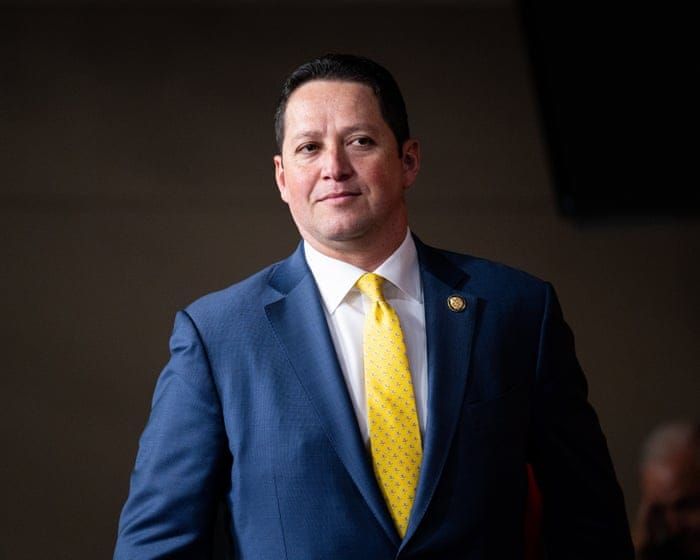
Tony Gonzales, a Republican congressman from Texas, announced Monday he will file for retirement from office after admitting to an extramarital affair with a congressional aide who later died by suicide. According to The Guardian US, Gonzales was facing a growing threat of expulsion by his colleagues when he made the announcement — not a formal vote, not a sanction, but the threat of one. On the same day, Democratic Representative Eric Swalwell announced he would not seek re-election following years of ethics scrutiny over his conduct toward a congressional staffer. Two members. Two parties. One day. Zero formal accountability.
The simultaneity is not a coincidence to be explained away. It is a data point about how Congress handles misconduct: with enough private pressure to force exits, but never enough institutional courage to force accountability. The House Ethics Committee, the body theoretically designed to enforce standards of conduct, spent years in both cases doing what it does most consistently — very little, very slowly, until the political cost of inaction finally exceeded the institutional preference for discretion.
The House Ethics Committee is an evenly divided bipartisan panel with subpoena power and the authority to recommend sanctions ranging from reprimand to expulsion. In practice, investigations routinely take years, findings are often sealed, and formal sanctions are exceptionally rare. The committee's design prioritizes institutional harmony over enforcement — a feature, critics argue, not a bug.
The Gonzales case is the more acute one. His affair was with a member of his own staff — a person over whom he held direct professional power. That aide later died by suicide. Gonzales acknowledged the relationship last month. The sequence of events — the admission, the expulsion threat, the resignation — unfolded over weeks, not the years a formal ethics process would have consumed. What ultimately moved Gonzales toward the door was not an institutional finding of wrongdoing. It was the political arithmetic of his own caucus. When enough colleagues signaled they might vote to expel him, he chose to leave on his own terms.
That is not accountability. That is managed exit. The distinction matters enormously, because managed exits leave no institutional record, no formal finding, no precedent. The next member of Congress who exploits a subordinate staffer will face the same absent deterrent. The Ethics Committee will open a file. The file will sit. The member will calculate whether their caucus has the votes and the will. Usually, the answer is no.
Swalwell's situation operates in a different register but through the same mechanism. The California Democrat has faced scrutiny over his conduct for years, with the Ethics Committee's investigation stretching across multiple congressional terms. The details of the probe have been largely shielded from public view — a feature of the Ethics Committee process that serves members far more than it serves the public. Swalwell's announcement that he will not return to Congress arrives without a completed investigation, without a public finding, without any formal accounting of what the committee spent years examining.
Congress has expelled five members in its history. Four were expelled during the Civil War for supporting the Confederacy. The fifth was James Traficant, removed in 2002 after a federal bribery conviction. The institution has never expelled a member for sexual misconduct. It has censured members. It has reprimanded them. It has, most frequently, waited for them to leave. The threat of expulsion that drove Gonzales out is itself a historical rarity — and even that threat never materialized into a vote.
This is worth sitting with: the most powerful legislative body in the world has developed, over more than two centuries, an enforcement mechanism for member misconduct that functions primarily as a reputational pressure valve. When the pressure gets high enough, members exit. The valve releases. The institution continues. No finding. No record. No change to the conditions that made the misconduct possible in the first place.
Congressional staffers — the people most directly affected by member misconduct — have been organizing for years to change this. The Congressional Accountability Act of 1995 created a formal process for staff to report harassment and discrimination, but critics have long argued that the process is structured to protect members rather than the people who work for them. Settlements were for years paid from a Treasury fund, shielding members from personal financial consequence. A 2018 reform required members to personally pay a portion of settlements, but advocates noted at the time that the changes fell short of what survivors had demanded. The Gonzales case — involving an aide who later died by suicide — is the kind of outcome that reform advocates have spent years warning about.
The bipartisan framing of Monday's dual resignations deserves scrutiny too. Both parties will be tempted to use the other's case as a cudgel. Republicans will cite Swalwell. Democrats will cite Gonzales. The symmetry will be weaponized as evidence of universal venality, which will then be used to justify doing nothing structural, because if both sides do it, reform becomes a partisan attack rather than an institutional obligation. This is how Congress has escaped accountability reform for decades — by converting every specific failure into a generalized equivalence that exhausts rather than motivates.
The staffers who work in these offices — young, often early in their careers, economically dependent on references and relationships that flow through the very members who hold power over them — are the people the Ethics Committee was nominally designed to protect. They are also the people least represented in how the committee operates. They cannot vote on whether to expel a member. They cannot compel a public finding. They can file a complaint and wait, often for years, for a process that may conclude with a sealed report and a member who chose to retire rather than face a vote that was never quite certain to happen anyway.
There is a version of Monday's news that gets written as a victory — two members with serious misconduct allegations are leaving Congress, and the institution's informal pressure mechanisms worked. That version is not wrong, exactly. But it omits the cost. It omits the aide who died. It omits the staffers whose complaints sat in committee files. It omits the years that passed. And it omits the fact that the next member in a similar situation faces exactly the same weak deterrent, the same slow process, and the same calculation: if you can hold your caucus, you can hold your seat.
As Tinsel News has reported, Congress has shown a consistent pattern of failing to regulate its own members' conduct — whether on financial conflicts or personal behavior. The Ethics Committee is a body that functions on the same logic as the broader institution: self-governance, bipartisan consensus, and an abiding preference for the least disruptive outcome. When that logic produces two resignations on the same day without a single formal finding between them, it is not accountability. It is the system working exactly as designed — and that design is the problem.
The House could respond to this moment by strengthening the Ethics Committee's independence, accelerating its timelines, requiring public disclosure of findings, and removing the informal off-ramp that lets members choose resignation over accountability. It has had every previous version of this moment to do so. The staffers who work in congressional offices will be watching to see whether this one is different — or whether it, too, becomes a managed exit with no institutional memory and no change to what comes next.