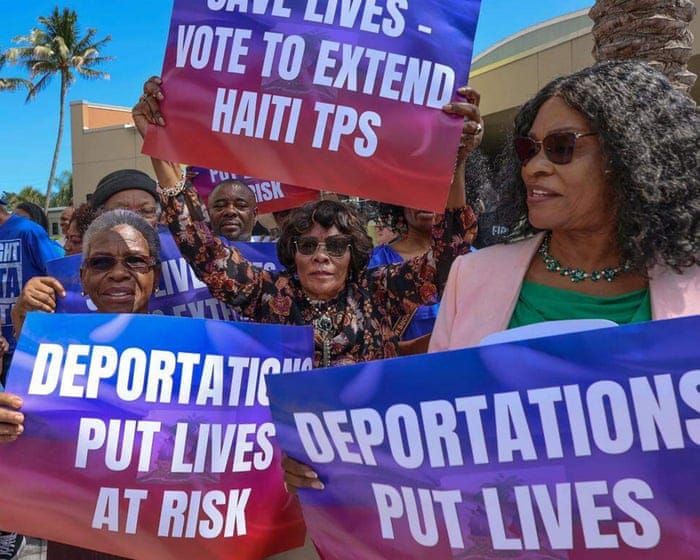
The case before the Supreme Court on Wednesday was framed, as these cases always are, in the neutral language of administrative authority: does the executive branch have the power to rescind Temporary Protected Status designations? But the people whose lives hang on the answer are not abstractions. Roughly 400,000 Haitian and Syrian nationals living in the United States — many of whom have been here for years, some for decades, nearly all with U.S.-citizen children — would be rendered deportable if the administration prevails. The Court's conservative majority, as reported by The Guardian US, appeared sympathetic to the government's position.
That sympathy is the story. Not the legal mechanics of TPS, not the procedural posture of the appeal, but the fact that a Court reshaped over the past decade by a deliberate, funded, ideologically coordinated project of judicial appointment is now positioned to ratify a mass deportation agenda that could not have passed Congress on its own merits. The bench is doing what the ballot box would not.
TPS — Temporary Protected Status — is a humanitarian designation that allows nationals of countries experiencing armed conflict, natural disaster, or other extraordinary conditions to remain in the United States without fear of removal. Haiti has held TPS designation continuously since the 2010 earthquake. Syria's designation reflects a civil war that has killed hundreds of thousands and displaced millions. These are not edge cases for the program. They are exactly what it was designed for.
The Trump administration's argument is that previous administrations improperly extended these designations — that TPS was never meant to function as a long-term residency status, and that the executive branch has both the right and the obligation to terminate protections it considers overbroad. This is a coherent legal position. It is also one that, if accepted, would send hundreds of thousands of people back to countries that remain dangerous, destabilized, and in some cases actively at war. The administration's argument does not dispute this. It simply argues that the humanitarian calculus is the executive's to make.
TPS is a congressionally created humanitarian program that shields nationals of designated countries from deportation when conditions in those countries — war, environmental disaster, epidemic — make safe return impossible. It does not provide a path to permanent residency, but it grants work authorization and protection from removal. Designations are made and renewed by the executive branch. The question before the Supreme Court is whether an incoming administration can terminate a prior administration's designation without meeting a specific legal standard for doing so.
What the oral arguments appear to have exposed is something more structural than a single policy dispute. This Court — six of whose nine justices were appointed by Republican presidents, three of them by the current administration — has consistently expanded executive authority when that authority is wielded by this administration, and contracted it when wielded by others. The pattern holds across immigration, environmental regulation, and administrative law broadly. The TPS case fits the template precisely: a challenge to an executive action that strips a protection, brought by people with no political constituency, heard by a bench that has already signaled its deference to executive immigration power in case after case.
The communities most affected by Wednesday's arguments are not Washington stakeholders with lobbying budgets and access to the justices' social circles. Haitian TPS holders are disproportionately working-class, concentrated in states like Florida, New York, and Massachusetts, employed in healthcare, construction, and domestic work. Many arrived after the 2010 earthquake that killed more than 100,000 people and left more than a million homeless. Haiti has since endured a presidential assassination, a second catastrophic earthquake in 2021, and a collapse of state authority so severe that armed gangs now control significant portions of the capital, Port-au-Prince. The State Department's own travel advisory for Haiti is currently Level 4: Do Not Travel — the same designation applied to active war zones.
Syria's situation requires no elaboration for anyone who has followed the past fifteen years of that country's history. The civil war that prompted its TPS designation displaced more than 6 million people abroad and killed an estimated 500,000. The conditions that made safe return impossible in 2012 have not been resolved. They have been managed into a frozen catastrophe.
The Court's apparent willingness to defer to the administration on these facts — not to dispute them, but to hold that the executive branch's authority to make this call supersedes any judicial check — is the legal argument that deserves scrutiny. Immigration law has always granted the executive broad discretion. But discretion is not the same as unchecked power, and the question of whether a TPS termination must meet any substantive standard — whether "conditions have improved" must actually be true and documented — is precisely what this case should turn on. The signals from oral argument suggest the conservative majority may not require that standard to be met.
This is where the Systemic Pattern Lens becomes essential. The TPS case is one piece of a larger architecture of immigration enforcement that has been constructed not through legislation — Congress has not passed comprehensive immigration reform in decades — but through executive action, agency rulemaking, and judicial deference. As we've documented in our coverage of ICE's family separation violations and the deportation of 174 DACA recipients while their applications were pending, the enforcement apparatus has repeatedly acted ahead of legal authority, betting that the courts — and this Court in particular — will ratify the action after the fact. TPS is the same logic at scale.
The accountability question is direct: who bears responsibility for what happens next? If the Court rules for the administration, the legal responsibility for the consequences rests with the six justices who form the majority. But the political responsibility traces further. Three of those justices — Neil Gorsuch, Brett Kavanaugh, and Amy Coney Barrett — were confirmed through a process shaped in no small part by the Federalist Society and the judicial appointment infrastructure built over decades, a project whose downstream effects are now visible in ruling after ruling. The bench that may strip TPS from 400,000 people was not assembled by accident.
There is also a global dimension that domestic coverage of this case has mostly ignored. Haiti and Syria are not abstractions on a map. Haiti is the poorest country in the Western Hemisphere, currently unable to provide basic security for its own citizens, where the U.S. government itself advises Americans not to travel. Syria is a country whose reconstruction has barely begun, where millions remain displaced and where returning nationals face documented risks of detention and persecution. The decision to send people back to these places is not a neutral exercise of administrative discretion. It is a choice about who bears the cost of geopolitical failures that the United States had a hand in creating — in Haiti through decades of economic intervention and political interference, in Syria through a proxy conflict that Washington funded and then abandoned.
The ruling, expected before the Court's term ends in June, will be written in the language of statutory interpretation and administrative authority. The people it affects will experience it in a different language entirely — the language of plane tickets and border crossings and children left behind. If the conservative majority rules as oral argument suggests it may, roughly 400,000 people will lose the legal status that has let them build lives here, and will face removal to countries the U.S. government itself classifies as too dangerous to visit. The Court will have done what the administration could not accomplish through Congress. That is not a coincidence. It is the strategy.