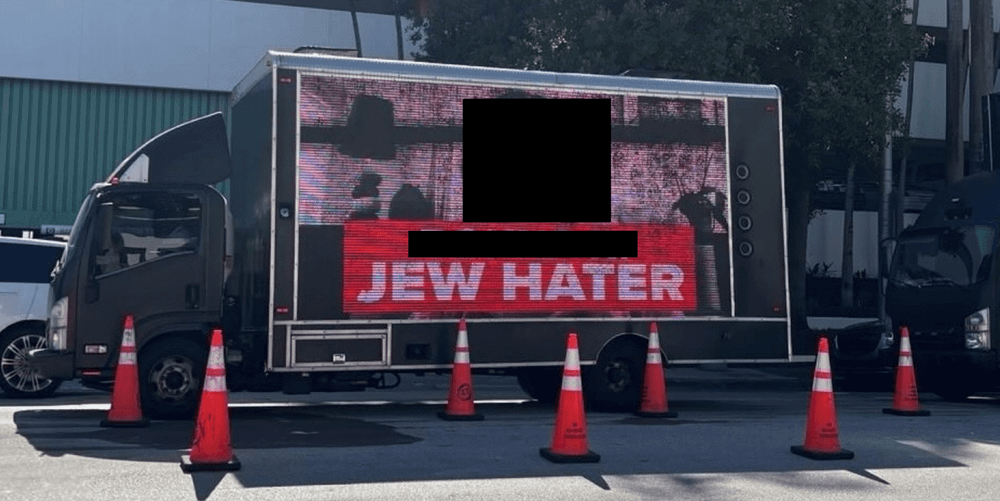
Jewish Voice for Peace is a Jewish organization. Its members are Jewish. The billboard trucks that allegedly followed them through Miami Beach called them "Jew haters." The man accused of ordering those trucks is a sitting city commissioner. This is not a story about a political dispute. It is a story about an elected official allegedly using institutional resources to run a targeted harassment campaign against constituents whose politics he dislikes — and dressing that harassment in the language of fighting antisemitism.
According to a lawsuit reviewed by The Intercept, Miami Beach City Commissioner David Suarez is accused of hiring mobile billboard trucks to single out individual members of the activist group Jewish Voice for Peace, displaying their names and photographs alongside the label "Jew hater." The trucks, according to the lawsuit, were not parked in front of city hall or deployed at a political rally. They were directed at specific people — targeted by name, targeted in their community, targeted for their political beliefs about Gaza.
Jewish Voice for Peace (JVP) is one of the largest Jewish-led organizations in the United States that advocates for Palestinian rights. Its membership is predominantly Jewish. The group opposes the Israeli military campaign in Gaza and supports boycott, divestment, and sanctions (BDS) measures. Calling its members "Jew haters" is not a political disagreement — it is a factual inversion designed to delegitimize Jewish dissent.
The lawsuit's central allegation is not merely that Suarez holds views hostile to Palestinian solidarity activism. Elected officials hold all manner of views. The allegation is that he translated those views into a directed, personalized campaign against named private citizens — using resources, coordination, and the implicit authority of his office to make their public lives more dangerous. That is a different category of act entirely.
The accountability question here is precise: did a sitting commissioner deploy what amounts to a government-backed intimidation apparatus against constituents exercising First Amendment rights? And if so, what oversight exists to stop it?
The answer to the second question is uncomfortable. Very little. A city commissioner in Florida does not need to file paperwork to hire a billboard truck. The expenditure may not appear in any public record that would trigger automatic scrutiny. The First Amendment constrains government speech in some circumstances, but the legal doctrine around elected officials funding private political activity — particularly when they use personal or PAC funds rather than city accounts — is murky enough that cases like this routinely survive on technicalities long after the damage is done. The lawsuit itself is the accountability mechanism. That is a thin reed.
The pattern this case belongs to is not new, and it is not local. Across the country, pro-Palestine activists — and specifically Jewish pro-Palestine activists — have been subjected to doxxing campaigns, employer pressure, and public shaming operations that treat political dissent as a form of ethnic betrayal. The specific targeting of Jewish members of JVP carries a particular charge: it attempts to weaponize Jewish identity against Jewish people, to define who counts as authentically Jewish by whether they support Israeli government policy. That is not a defense of Jewish people. It is a political maneuver that uses the language of protection to silence.
This dynamic has a recent and well-documented federal analog. The FBI cleared Mahmoud Khalil two days before his arrest, yet the administration kept applying the "threat" label anyway — demonstrating how official designations can be manufactured and deployed against people whose primary offense is political speech. The Miami Beach case operates at a municipal scale, but the logic is identical: attach a stigmatizing label to a person, circulate it publicly, and let the social consequences do what direct legal action cannot.
The human impact is not abstract. Being named on a mobile billboard as a "Jew hater" in a city with a large Jewish population is not a neutral experience. It exposes individuals to harassment, threatens their professional reputations, and signals to others in their community that visible political dissent carries a personal cost. That signal is, in many respects, the point. The goal of a targeted shaming campaign is not to change the named person's mind. It is to deter the next person from speaking at all.
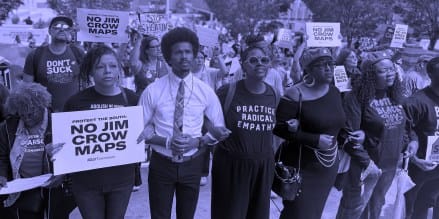
That deterrence effect is what makes the alleged conduct more serious than a commissioner simply voicing strong disagreement. Speech from power aimed at silencing speech from below is not a symmetrical exchange of views. It is the exercise of authority — the implicit weight of an elected position — deployed to narrow the space in which ordinary people feel safe to participate in political life. Florida has moved aggressively since 2023 to restrict campus speech about Palestine, to expand the government's power to designate student groups, and to insulate those designations from judicial review. Florida recently gave a single official the power to label student groups as terrorists with no court review required. The Miami Beach case does not exist in a vacuum. It exists in a state that has been systematically expanding the toolkit available to officials who want to suppress Palestine solidarity activism.
The Power & Money lens is also relevant here, though the source material does not yet establish direct financial documentation. The question any serious accountability investigation would ask — and the one that matters most for understanding the scope of this operation — is where the money to hire those trucks came from. Was it personal funds? A political committee? A donor network with interests in suppressing Gaza-related activism? The answer matters because it determines whether this is one commissioner acting alone or whether it reflects a coordinated effort with institutional backing. The lawsuit may produce that documentation. Until it does, the financial trail is an open question that should be on the record as such.
What the lawsuit has already established — at the level of allegation — is a template that deserves scrutiny wherever it appears: an elected official, the apparatus of targeted public shaming, and a Jewish organization whose Jewishness is being used against it. The framing of Jewish pro-Palestine activists as self-hating or treasonous to their own community is not a novel rhetorical move. It has been deployed consistently to fracture the coalition of people who object to the conduct of the war in Gaza, and it has been deployed with particular venom against organizations like JVP precisely because their existence complicates the claim that opposition to Israeli government policy is inherently antisemitic. The administration has shown a willingness to share data across agencies with no public notice to build cases against people whose primary offense is political speech — a pattern that makes the question of institutional coordination in cases like this one harder to dismiss.
That claim is the load-bearing wall of the suppression strategy. If you can establish that criticizing Israeli military conduct equals antisemitism, then Jewish critics become the most threatening category — because they disprove the premise by existing. The billboard trucks, if the lawsuit's allegations are accurate, were not just harassment. They were an attempt to enforce a definition of Jewish identity that excludes dissent. A sitting city commissioner allegedly paid for that enforcement. The courts will determine liability. But the political question — whether officials who use the machinery of public life to intimidate constituents face any consequence short of a lawsuit — does not wait for a verdict.