The official story about Amazon is a story about efficiency. The company built better warehouses, wrote better software, offered better prices, and won. Competitors failed because they were slower, less innovative, less customer-obsessed. The market spoke. Amazon won fair and square.
The evidence tells a different story. Amazon's dominance over Western retail — it now controls roughly 38 percent of all U.S. e-commerce, according to data tracked by eMarketer, with its nearest competitor Walmart sitting at less than 7 percent — was not simply earned through superior service. It was constructed through two decades of pricing strategies that antitrust economists classify as predatory, a systematic campaign to co-opt the regulatory bodies meant to constrain it, and a political environment in which the enforcers responsible for preserving competition decided, repeatedly, that the company was too useful to stop. BBC News examined why Amazon dwarfs every other online retailer on both sides of the Atlantic. The more urgent question is why no one stopped it from getting there.
Amazon was founded in 1994 as an online bookstore. By 2000, it was selling everything. By 2010, it was the infrastructure on which millions of other businesses ran. By 2025, it is simultaneously the store, the marketplace, the shipping network, the cloud computing platform, the advertising network, the logistics provider, and the data collector — for the very competitors who depend on its platform to reach customers. No company in American history has occupied this many positions in a single supply chain at the same time. That is not an accident of innovation. It is the result of a specific strategy, executed over decades, in an environment where the people responsible for preventing it were either unable or unwilling to act.
The predatory pricing story begins early. In the late 1990s and 2000s, Amazon sold books, diapers, electronics, and eventually cloud computing services below cost — sometimes dramatically below cost — to establish market position and drive competitors out. The logic was explicit internally: accept losses now, own the market later, raise prices when rivals are gone. This is the textbook definition of predatory pricing under antitrust law. It is also, in practice, nearly impossible to prosecute under the consumer welfare standard that has dominated U.S. antitrust enforcement since the 1980s — a standard that asks only whether consumers are paying lower prices right now, not whether the destruction of competition will cost them more later. Amazon's lawyers understood this framework. They used it deliberately.
The consumer welfare standard — sometimes called the Chicago School framework — was not inevitable. It was a political choice, championed by economist Robert Bork in his 1978 book The Antitrust Paradox, which argued that antitrust law should concern itself only with consumer prices, not with market concentration, competitive structure, or the long-term distribution of economic power. Regulators and courts adopted this framework gradually through the 1980s and 1990s. By the time Amazon was scaling, it was the operating system of American competition law. A company could eliminate every rival in a sector, as long as it could argue that prices were lower in the short term. Amazon made that argument every year. Regulators accepted it every year.
Since the 1980s, U.S. antitrust enforcement has used a framework that evaluates market harm almost exclusively through short-term consumer prices. Under this standard, a company can eliminate competitors, acquire potential rivals, and dominate an entire sector — so long as it can demonstrate that consumers are paying less than they would otherwise. Amazon's strategy of sustained below-cost pricing was designed to satisfy exactly this test. Critics argue the standard ignores long-term harms: once competition is eliminated, prices rise, workers lose bargaining power, and suppliers lose their negotiating power. The Biden-era FTC attempted to shift this framework. The Trump administration's FTC has shown no interest in continuing that effort.
The European experience makes the American failure visible. The European Commission has pursued Amazon through multiple antitrust investigations over the past decade — examining how Amazon uses data from third-party sellers on its platform to advantage its own private-label products, how its Prime membership bundles services in ways that lock out rivals, and how its logistics network creates dependencies that smaller competitors cannot escape. In 2022, the EU reached a settlement with Amazon that imposed behavioral remedies. In 2024, the Digital Markets Act designated Amazon as a "gatekeeper" under new rules designed specifically for platform dominance. Neither enforcement action broke Amazon's European market position. But they represent a governing philosophy that at least acknowledges the problem exists. The United States spent the same period doing almost nothing.
The domestic record is damning. The Federal Trade Commission did not open a major investigation into Amazon's retail dominance until 2019 — a full decade after the company had established effective control over online commerce. The resulting lawsuit, filed in September 2023 under FTC Chair Lina Khan, accused Amazon of illegally maintaining monopoly power by charging sellers inflated fees, degrading search results to extract more advertising revenue, and using its logistics dominance to coerce sellers into programs that benefit Amazon at sellers' expense. The suit cited internal documents, including emails in which Amazon executives discussed pricing strategies with explicit awareness of their anticompetitive effect. As Tinsel News has previously reported, California's antitrust lawsuit against Amazon produced unsealed emails showing the company's marketplace operated as a price-fixing mechanism — with Amazon using contractual terms to prevent sellers from offering lower prices elsewhere, effectively setting a price floor across the entire internet.
The FTC lawsuit is now in legal jeopardy. The Trump administration's FTC, led by Andrew Ferguson, has signaled a dramatically narrower approach to tech antitrust — one focused on content moderation and alleged anti-conservative bias rather than market structure. Legal observers note that the Amazon case, which was brought by the previous administration and requires sustained institutional commitment to litigate, faces an uncertain future under leadership that has shown little interest in structural remedies against large platforms. The regulatory window that briefly opened under Khan is closing. Amazon's lawyers know it.
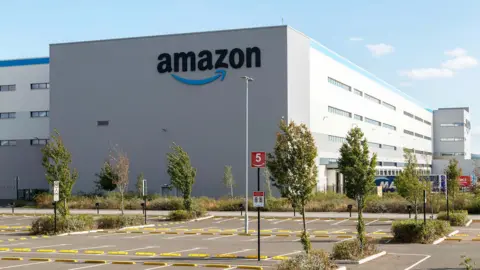
The third-party seller story is where Amazon's dominance becomes most concrete. Approximately 60 percent of products sold on Amazon come from third-party sellers — independent businesses that pay Amazon fees to access its customer base. Those fees have grown substantially. Amazon charges sellers a referral fee of 8 to 15 percent depending on category, plus fulfillment fees if they use Amazon's logistics network, plus advertising fees if they want their products to appear prominently in search results, plus subscription fees for seller accounts. An Institute for Local Self-Reliance analysis found that Amazon takes, on average, 45 cents of every dollar a third-party seller makes. Sellers cannot easily leave. Amazon controls access to roughly 38 percent of American online retail. Walking away from Amazon means walking away from the majority of the addressable market. So sellers pay. And Amazon's advertising revenue — now its fastest-growing business segment — is essentially a tax on the sellers who have no alternative venue.
This is the structural position that no amount of competition can easily dislodge. Amazon is not just a retailer. It is the platform on which retail happens. When a company controls both the marketplace and the rules of the marketplace, and when it also competes as a seller within that marketplace, the conflict of interest is not incidental — it is the business model. Amazon's private-label products, which compete directly with third-party sellers, benefit from access to aggregated seller data that no outside competitor can see. Amazon knows exactly which products are selling, at what price, with what margins, before it decides which categories to enter with its own brands. The FTC's 2023 complaint described this as a systematic use of non-public seller data to undercut the merchants who depend on the platform. Amazon disputed this characterization. The emails suggested otherwise.
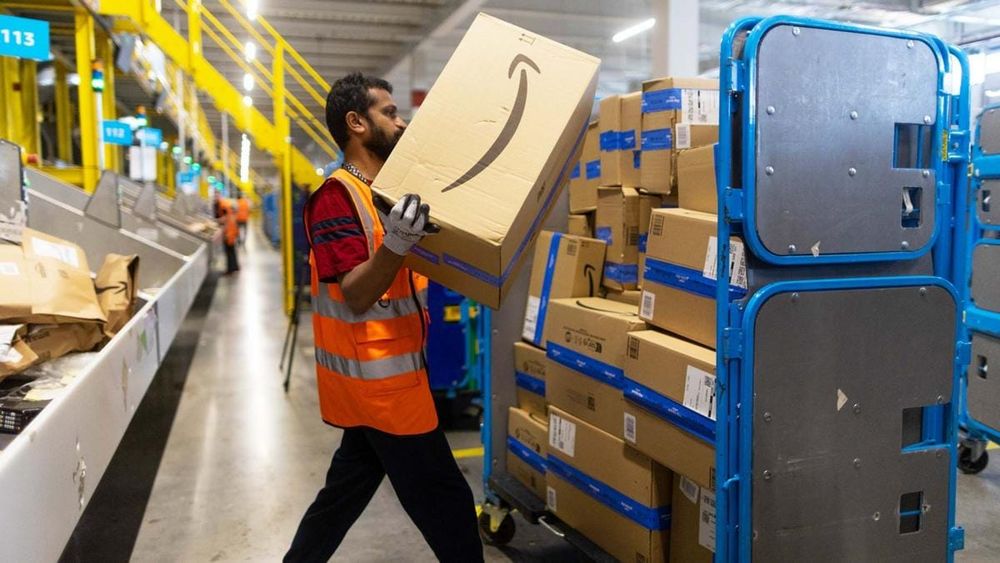
The workers at the base of this system pay the most direct cost. Amazon employs approximately 1.5 million people globally, making it one of the largest private employers on earth. Warehouse workers — the people who make two-day delivery possible — face documented injury rates substantially higher than industry averages. A 2021 Strategic Organizing Center report found that Amazon warehouse workers sustained serious injuries at nearly twice the rate of workers at comparable non-Amazon warehouses. The speed targets that drive those injury rates are enforced algorithmically: workers are tracked by the second, their productivity measured against rates that former workers and labor researchers describe as physically unsustainable over time. Amazon has contested these characterizations. The injury data is from Amazon's own OSHA filings.
The labor picture is international and worsening. In the UK, Amazon is one of the country's largest employers, with fulfillment centers concentrated in areas of post-industrial economic decline where alternative employment is scarce. Workers there have reported similar productivity surveillance and injury rates. In Germany, Amazon has faced repeated strikes organized by the ver.di union over pay and working conditions. In France, courts have intervened over workplace surveillance practices. The pattern is consistent across jurisdictions: Amazon's logistics model requires a workforce that can be pushed to its physical limits, in places where those workers have limited alternatives, monitored at a granularity that would have been technologically impossible a generation ago. The efficiency that consumers experience as fast, cheap delivery is produced at a human cost that the price of a Prime membership does not reflect.
The question of why no Western rival exists has a structural answer and a political one. The structural answer is that Amazon's control of cloud infrastructure — Amazon Web Services supplies roughly 31 percent of global cloud computing capacity, according to Synergy Research Group — means that the companies best positioned to challenge Amazon's retail dominance are also dependent on Amazon's cloud services to run their own operations. This is not a coincidence. It is the consequence of allowing one company to become essential infrastructure across multiple sectors simultaneously. A potential retail competitor cannot easily build at scale without using cloud services — and the dominant cloud provider is the competitor they are trying to challenge. The barrier to entry is not just capital. It is structural dependency.
The political answer is about who benefits from the status quo. Amazon spent $21 million on federal lobbying in 2023, according to OpenSecrets. Its lobbyists include former congressional staffers, former FTC officials, and former White House advisers — the revolving door between regulatory agencies and the companies they oversee that defines what regulatory capture looks like in practice. Amazon has donated to politicians on both sides of the aisle. It has funded think tanks that produce research supporting its preferred regulatory frameworks. It has built fulfillment centers in the districts of key legislators, creating employment dependencies that make those legislators reluctant to support enforcement actions. The lobbying infrastructure is not secret. It is reported annually. It works because the system allows it to work.
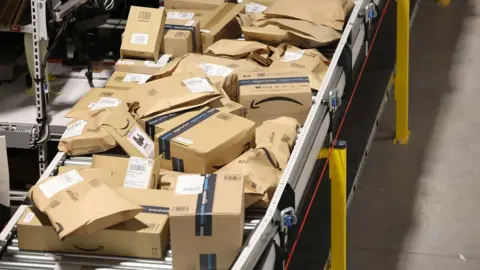
The European gap matters here. The EU's willingness to pursue Amazon through the Digital Markets Act reflects a governing philosophy that treats market concentration as a public problem, not just a consumer price problem. European competition law asks whether a company's dominance is harmful to the structure of markets — to the existence of alternatives, to the bargaining power of suppliers, to the viability of independent businesses. That framework produces different enforcement outcomes. It does not produce a different Amazon. Amazon's European market share, while lower than in the United States, has grown steadily despite regulatory pressure. Behavioral remedies — telling Amazon to stop doing specific things — have not altered the fundamental power asymmetry between the platform and everyone who depends on it. The EU's framework is better than the American one. It is not sufficient to reverse what twenty years of inaction produced.
The structural remedy that antitrust scholars have proposed — separating Amazon's marketplace from its logistics arm, or prohibiting Amazon from competing as a seller on a platform it controls as an operator — has never been seriously pursued by American regulators. The Biden-era FTC came closer than any previous administration to articulating a structural theory of harm. That work is now stalled. The companies that might have competed with Amazon — Sears, Toys R Us, Bed Bath & Beyond, countless independent retailers — are gone. The small businesses that sell on Amazon's platform are not competitors. They are tenants, paying rent to the landlord who also runs the grocery store, the bank, and the post office.
The reason Amazon has no Western rivals is not that no one tried to compete. It is that the rules were written — and then not written, and then not enforced — in ways that made the outcome close to inevitable. The consumer welfare standard said low prices were enough. Amazon offered low prices. The enforcers accepted the argument. By the time the argument was recognized as insufficient, the competition was already gone. What remains is a company so large that the question is no longer whether it can be challenged by a rival, but whether it can be constrained by a government — and whether any government currently in power has the will to try.