The United States government is currently being sued by the president of the United States. The agency being sued is run by officials appointed by the president. The settlement now being negotiated — according to reporting by The Guardian US, citing ABC News and the New York Times — would transfer up to $1.7 billion in taxpayer money to a fund compensating people the president says were wronged. Those people include the president himself and his political allies.
There is no polite way to describe what this is. A president who controls the executive branch, including the Justice Department lawyers who would negotiate any settlement, is positioned to personally benefit from a legal resolution he has the power to dictate. The conflict of interest is not a matter of interpretation. It is the structure of the arrangement.
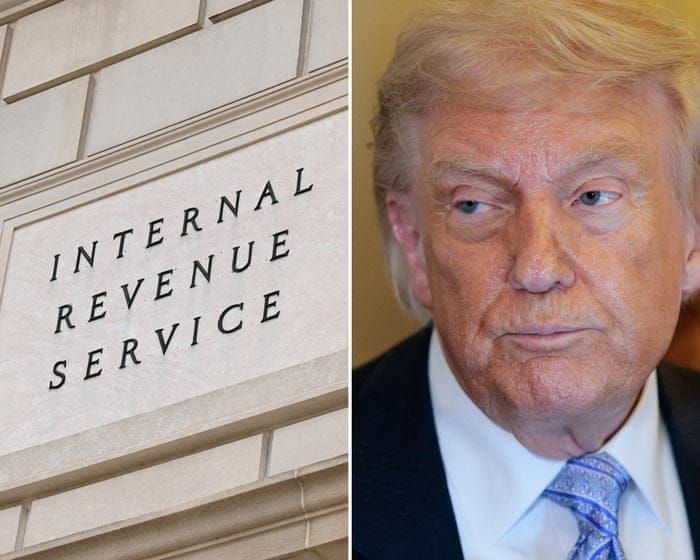
To understand how we arrived here, the background matters. Trump has long claimed that the IRS, under the Biden administration, unlawfully targeted him and political allies for audits and scrutiny. That allegation — contested, and not independently verified by any court — formed the basis of a $10 billion lawsuit. Now, rather than that lawsuit proceeding through the courts to a judgment, The Guardian US reports that Trump's own administration may settle the case by creating a $1.7 billion compensation fund. The administration would, in effect, be paying itself.
The legal mechanism for this matters. When the federal government settles a lawsuit, it is the Justice Department — a branch of the executive, reporting to the president — that negotiates the terms and authorizes the payment. In every normal case, the government is defending against a claim made by a party outside of it. Here, the claimant and the defendant are both, in functional terms, the same person. The president filed the suit. The president controls the agency that would pay it. The president would benefit from the settlement. This is not a gray area in ethics law. It is a textbook definition of self-dealing.
Self-dealing occurs when a public official uses their official position to benefit themselves financially. Federal ethics laws prohibit executive branch employees from participating in matters in which they have a personal financial interest. Legal scholars and ethics watchdogs have noted that no previous U.S. president has been in a position to simultaneously control both sides of a federal lawsuit in which they stood to receive payment.
What is at stake here is not abstract. The $1.7 billion proposed fund would come from the U.S. Treasury — from tax revenue collected from American workers, retirees, and businesses. That money would then flow to a compensation pool whose beneficiaries are, according to the reports, Trump and people described as his political allies. The public has not been told who those allies are, how the fund would be administered, what evidentiary standard would determine who qualifies for compensation, or who would oversee disbursements.
The absence of those details is not an oversight. It is the point. Vague compensation funds, administered without independent oversight, in the wake of politically convenient legal settlements, are a well-documented vehicle for transferring public money to private interests. The structure being described here — a fund created through an executive-branch settlement, paid from the Treasury, compensating a list of people defined by the president — contains every element of that pattern.
The historical record offers no real comparison. Legal scholars and government ethics experts have noted, as reported by The Guardian US, that this arrangement would be unprecedented for a U.S. president. That word is used carelessly in political coverage, but its precision here is important. No previous American president has filed a lawsuit against a federal agency, assumed control of that agency through appointment, and then negotiated a settlement from which they personally benefited. The reason this has never happened before is not that no president thought of it. It is that the conflict was considered disqualifying on its face.
The IRS is not a peripheral agency. It is the institution through which the federal government funds itself — and through which the law requires every American, including the very wealthy, to pay their legal share. The credibility of that institution depends entirely on the perception that it operates independently of political pressure. An IRS that can be sued by a president, settled by that president's Justice Department, and made to pay that president's allies does not function as a tax authority. It functions as a political instrument.
This concern is not hypothetical. The IRS has already seen significant institutional disruption during this administration. Separately, as Tinsel News has reported, the agency lost roughly a quarter of its staff to DOGE cuts, and an IRS database error caused $51 million in political donation records to go missing. An agency that has been hollowed out through staff reductions and subjected to a $10 billion lawsuit by the sitting president is not in a position to operate as an independent check on anyone — least of all the person suing it.
The people bearing the cost of this arrangement are not politicians or political operatives. They are the roughly 150 million Americans who file federal tax returns each year, whose payments fund the Treasury that would write the settlement check. They have no say in whether this settlement proceeds, no visibility into who receives the compensation, and no recourse if the fund is administered corruptly. Their money is the mechanism through which the president would compensate himself.
The question of congressional oversight is not incidental here. Congress has the power to investigate executive branch settlements, subpoena records, and withhold appropriations. Whether it will exercise any of those powers in this case is a separate question — one that depends on political will that has been conspicuously absent on related matters. As Tinsel News has documented, the pattern of Congress failing to assert its constitutional authority over executive branch actions has been consistent and costly in ways that extend far beyond this case.
There is also a systemic dimension here that the narrow framing of "IRS lawsuit" obscures. This proposed settlement is one instance of a broader pattern in which the executive branch under this administration has treated the instruments of government — regulatory agencies, law enforcement, the courts — as tools available for the personal and political use of the president. The DOJ's interventions in cases involving the president's allies, the selective enforcement of federal law, the use of agency power to reward friends and punish opponents: these are not unrelated phenomena. They are expressions of the same logic. The IRS settlement, if it proceeds as described, would be the most financially direct expression of that logic yet.
Consider what would have to be true for this arrangement to be legitimate. The IRS would have to have genuinely and unlawfully targeted Trump and his allies — a claim that has not been proven in court. The $1.7 billion figure would have to represent a fair and proportionate remedy — a determination made by no independent body. The fund's beneficiaries would have to be identified through a process untainted by the president's personal interest in the outcome — a standard that cannot be met when the president controls the process. And the settlement would have to be negotiated by Justice Department officials who are genuinely independent of political direction — officials who serve at the pleasure of the president who benefits from the deal. None of these conditions can be verified. Most of them are structurally impossible to satisfy.
The accountability question here is not complicated, though the political will to ask it may be. Who authorized the settlement negotiations? Which Justice Department officials are conducting them? What criteria determine who qualifies for compensation from the fund? Will the list of beneficiaries be made public before any money is disbursed? Will Congress hold hearings before any settlement is finalized? These are not rhetorical questions. They are the minimum threshold of oversight that the public is owed before $1.7 billion of its money changes hands.
The deeper issue is what this moment reveals about the state of institutional constraint in American government. The norms that prevented previous presidents from doing what Trump is reportedly doing were never codified into enforceable law. They were conventions — shared understandings about what was disqualifying behavior for someone holding the public trust. Those conventions have been eroding for years. What is being described here is not their erosion. It is their elimination. If a sitting president can sue a federal agency he controls and collect a taxpayer-funded settlement, the principle that public office cannot be used for personal enrichment has not merely been weakened. It has been abandoned as a working constraint on executive power.
The people who will pay for that abandonment are not the ones who will receive the settlement check. They are the ones whose taxes fund the Treasury that writes it — and who will be left with an IRS whose independence, already damaged, has been further compromised by being made a vehicle for presidential self-enrichment. That is not a theoretical harm. It is a direct and measurable cost, distributed across every American who has ever paid federal taxes, with no mechanism for recovery.
If Congress does not act — through hearings, subpoenas, or legislation requiring independent oversight of any settlement — then the $1.7 billion will move. The precedent it sets will be permanent. Future presidents will have been shown that the structure exists, that it works, and that no one stopped it.