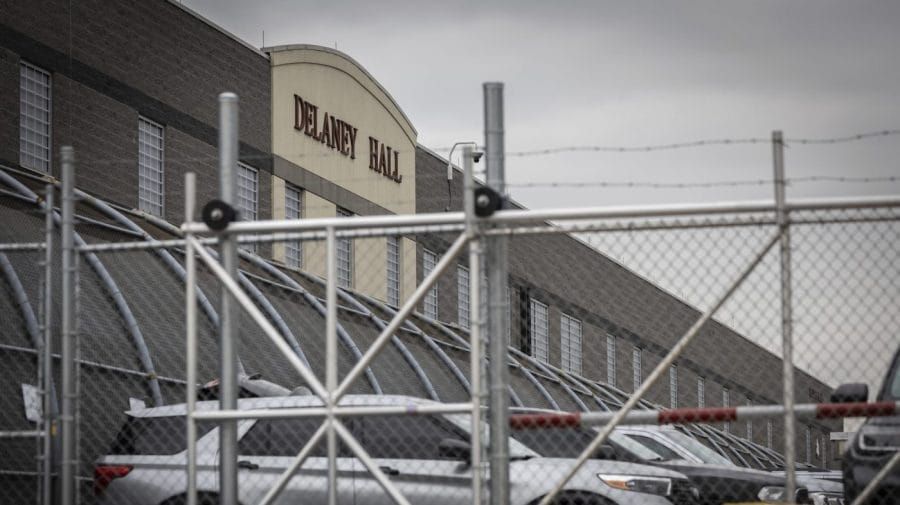
GEO Group, the publicly traded prison corporation that operates Delaney Hall in Newark, reported $2.4 billion in revenue in 2023. The people held inside Delaney Hall reported being beaten when they went on hunger strike. New Jersey has now issued subpoenas to find out which version of events is truer to the facility's daily reality — and whether the company's staff violated the civil rights of the people in their custody.
The New Jersey Division on Civil Rights announced Friday it is opening a formal civil rights investigation into Delaney Hall, the state's largest immigration detention facility, according to reporting by The Hill. The investigation follows documented deaths inside the facility and accounts of dangerous conditions that detainees and advocates have been raising for months. The subpoenas compel GEO Group to produce records that the company has not voluntarily disclosed.
GEO Group is one of the two largest private prison and detention corporations in the United States. It operates immigration detention facilities under contracts with ICE, earning revenue on a per-bed, per-day basis — meaning the company profits directly from keeping more people detained for longer. As Tinsel News has previously reported, GEO Group's political spending connects directly to the congressional figures who control ICE detention funding.
The investigation does not emerge from a vacuum. Detainees at Delaney Hall have been sounding alarms for months. Earlier this year, detainees launched hunger strikes to protest conditions inside the facility, with families describing a communications blackout that made it nearly impossible to reach their relatives. Those strikes, according to accounts gathered by advocates and members of Congress, were met with force. A congressional delegation that visited the facility heard directly from detainees who described being pepper-sprayed and beaten in retaliation for striking. Newark's mayor subsequently imposed a curfew around the facility as protests outside its gates intensified.
What the state investigation now formally places on the table is accountability — not as a political statement, but as a legal process with compulsory teeth. A subpoena is not a press release. GEO Group must produce documents. Staff conduct becomes subject to scrutiny. The gap between what the company told federal contractors and what actually happened inside the facility may become, for the first time, a matter of legal record.
The structure of private immigration detention makes that gap almost inevitable. GEO Group and its primary competitor, CoreCivic, earn money on occupancy. The financial incentive runs directly against adequate staffing, medical care, and the conditions that keep people alive and unharmed. Federal oversight of these facilities has been documented as inadequate across multiple administrations — inspections that are scheduled in advance, deficiencies that are noted and not corrected, deaths that are investigated internally by the same contractors responsible for the conditions that caused them. The Department of Homeland Security's own inspector general has repeatedly flagged these failures. The pattern has not changed.
New Jersey's action is notable precisely because it comes from the state level. Federal civil rights enforcement of ICE detention facilities has effectively collapsed — the current administration has shown no interest in scrutinizing the contractors it relies on to expand detention capacity. That leaves state attorneys general and civil rights divisions as the only functioning oversight mechanism for what happens inside these walls. New Jersey is using the tools it has. Whether those tools can reach inside a federally contracted facility without triggering a jurisdictional fight with the Department of Justice remains an open question — one the state appears prepared to test.
The timing also matters. Forty-two people have died in immigration custody since the administration took office, with families routinely denied basic information about the circumstances. ICE's own detainee tracking system has been documented as unreliable, making it difficult even to locate where a person is being held. The federal infrastructure that should catch these failures — oversight, transparency, accountability — has been systematically weakened. New Jersey is stepping into that void because someone has to.
GEO Group's contract to operate Delaney Hall exists because the federal government decided that outsourcing detention to a profit-seeking corporation was an acceptable way to hold human beings. The subpoenas issued Friday are a direct challenge to the premise that this arrangement can police itself. If the investigation produces evidence of civil rights violations — and the documented deaths and detainee accounts suggest the bar for that finding is not high — the question becomes what consequence a state can actually impose on a federally contracted corporation running a federally authorized facility. That is the legal and political fight New Jersey just chose to pick. The people who died inside Delaney Hall did not get to choose anything.