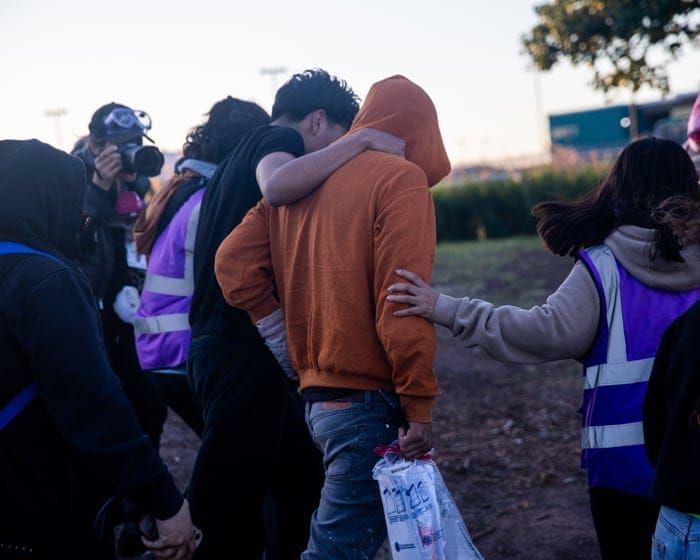
Elder Guerra slipped in the shower at Delaney Hall in mid-May. The Guatemalan immigrant had been locked inside the Newark, New Jersey detention facility for nearly five months at that point — arrested in January, according to a relative who spoke with The Guardian US, while helping a friend move a car stuck in the snow. ICE officers approached, asked a few questions, and took him. What happened after the shower fall — whether he received medical attention, whether anyone at the facility documented the injury, whether his family was told — is exactly the kind of information Delaney Hall does not provide.
That opacity is not incidental. It is the facility's operating logic.
Delaney Hall is a privately operated immigration detention center, contracted by ICE and run by the GEO Group, one of the country's largest private prison corporations. Families of detainees have described an institution that functions less like a detention facility with legal obligations and more like a sealed box — one where information flows out only when it serves the facility's interests, where injuries go unacknowledged, and where the primary tool available to detainees who want to be heard is refusing to eat. As detainees at Delaney Hall have gone on hunger strike over conditions, their relatives are using a word that ICE and GEO Group will not use: kidnapping.
Delaney Hall is an immigration detention facility in Newark, New Jersey, operated by the GEO Group under contract with ICE. It has faced sustained criticism over medical care, communication access, and conditions. Newark's mayor imposed a curfew around the facility earlier this year after detainees reported beatings during a hunger strike action.
The hunger strike at Delaney Hall did not emerge from nowhere. Detainees staging collective action inside immigration detention facilities have a documented history — and a documented pattern of consequences. When detainees at Delaney Hall previously went on hunger strike, ICE reportedly responded with pepper spray and physical force, with a member of Congress present to hear detainees describe the retaliation firsthand. Newark's mayor subsequently imposed a curfew around the facility — a measure that effectively criminalized the public solidarity that had gathered outside its walls. The pattern is consistent: detainees protest, the facility responds with force, and the legal architecture around it ensures accountability is nearly impossible to obtain.
The word "kidnapping" carries legal weight that families are deploying with precision. It describes a situation where a person is held against their will, cut off from communication, and their whereabouts are either unknown or unverifiable. For families of Delaney Hall detainees, that description is functionally accurate. ICE's own detainee locator system has documented failures — families have reported being unable to find detained relatives through official channels — and the experience of trying to reach someone inside Delaney Hall, according to relatives who spoke with The Guardian, involves phone calls that terminate without explanation and facility staff who provide no information about medical incidents or daily conditions.
Elder Guerra's shower fall is a small story inside a larger one. But it concentrates the problem. A man detained for five months after a sidewalk encounter with ICE agents — not a court order, not a criminal warrant, but a street-level interaction while helping someone dig out a car — sustained an injury inside a facility where his family cannot confirm what treatment, if any, he received. The facility is under no apparent legal obligation to tell them. ICE has not publicly addressed the incident. GEO Group, which collects government revenue for each detained person per day, has financial incentives to keep the facility full and operational, and limited incentives to make conditions visible.
The accountability gap here is structural, not accidental. Private detention facilities operate under ICE contracts that set minimum standards — standards that critics and legal advocates have long argued are both inadequate and unenforced. GEO Group and its competitors in the private detention industry have lobbied extensively for expanded immigration enforcement, because enforcement produces detainees, and detainees produce revenue. The incentive structure does not reward humane conditions. It rewards capacity.
What the hunger strike makes visible is what the facility's design is meant to keep invisible. When detainees stop eating, they force a response — from the facility, from ICE, from courts if legal advocates can get involved, and from the public if journalists can get access. The hunger strike is not a negotiating tactic in the conventional sense. It is an act of last resort by people who have exhausted every other mechanism for being heard. ICE does not hold press briefings about conditions at Delaney Hall. GEO Group does not publish incident reports. The families outside have no legal right to information about what is happening to the people they love. The hunger strike is the only signal that gets out.
The legal context matters here. Immigration detention is civil, not criminal — detainees are not serving sentences, they are being held pending civil proceedings. That distinction has enormous implications for due process, for access to counsel, and for the conditions under which people can be held. Civil detention is supposed to be non-punitive. The conditions families are describing at Delaney Hall — unremediated injuries, communication blackouts, retaliation for collective protest — are not consistent with non-punitive detention. They are consistent with punishment. ICE and GEO Group have not, in public statements or court filings reviewed by this publication, offered a substantive defense of conditions at Delaney Hall. They have offered denials.
That silence is itself a data point. When a facility's conditions can be defended, its operators defend them. The pattern of non-response from ICE and GEO Group on Delaney Hall — across multiple rounds of protest, multiple congressional inquiries, multiple news cycles — is not a communications failure. It is a legal strategy. Engaging with specific allegations creates a record. Silence does not. Forty-two people have died in immigration custody since the current administration took office, and in many cases their families still have not received adequate explanations. The pattern of non-disclosure is not limited to Delaney Hall.
The families speaking to journalists are doing something that carries real risk. Publicly identifying a detained relative draws attention to a case that ICE could choose to accelerate toward deportation. Describing conditions at a facility can result in a detainee being transferred — moved to a different facility, farther from legal counsel, farther from family, with the clock on any pending legal proceedings reset. The decision to speak is not made lightly. When families describe Delaney Hall as a kidnapping operation, they are not speaking hyperbolically. They are describing a system in which the people they love have been taken, cannot communicate freely, cannot access consistent medical care, and cannot be reached through official channels. That description fits the facility's documented operations.
The hunger strike will end — either because conditions change, because detainees are too weakened to continue, or because the facility intervenes in ways that are not publicly disclosed. What will not end, absent legal or legislative intervention, is the system that produced it. Delaney Hall is one facility. ICE operates or contracts with dozens of others. GEO Group and its competitors hold contracts worth billions of dollars annually. The detainees currently refusing food at Delaney Hall are not anomalies. They are the population that this system was designed to hold — and hold invisibly. The hunger strike is the one mechanism that briefly makes them visible. When it ends, the invisibility returns.
Elder Guerra's family is still waiting to find out what happened after he fell in the shower. That wait — indefinite, unacknowledged, with no legal right to an answer — is the condition the system has created. It is not a bug. It is the product.