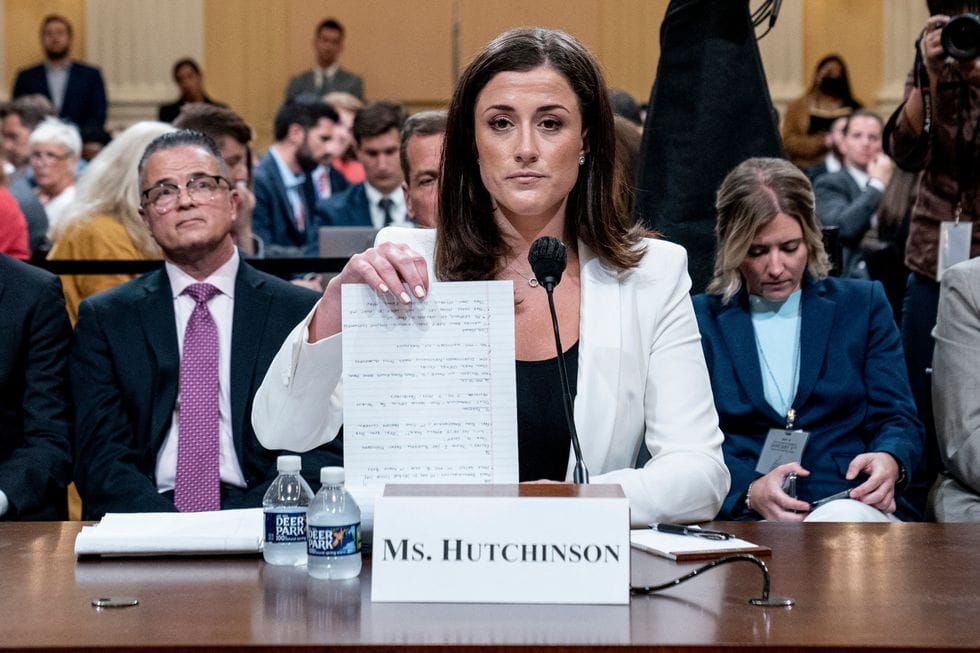
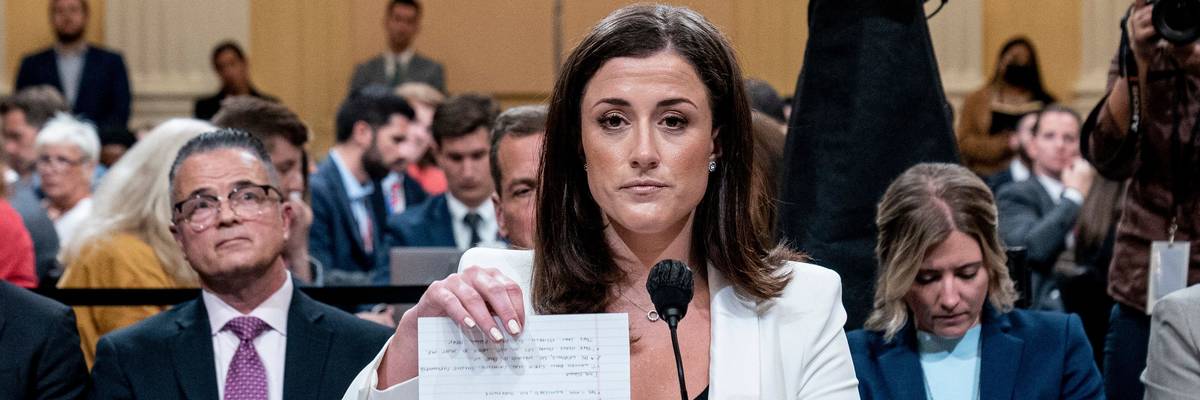
The Department of Justice is pursuing federal criminal charges against Cassidy Hutchinson, the former White House aide whose June 2022 congressional testimony placed Donald Trump at the center of the January 6 Capitol attack. The charges, first reported by Common Dreams citing Punchbowl News, allege that Hutchinson made false statements — a claim the DOJ has not publicly confirmed, but has not denied.
The procedural anomaly here is not subtle. As The New York Times reported when the investigation became public in April, the probe is being run by the Civil Rights Division — a unit whose mandate is discrimination law, not perjury or false statements investigations, which typically fall to the U.S. Attorney for the District of Columbia. That routing decision was not bureaucratic accident. It was a choice. And choices about which division investigates which person, at this DOJ, carry political weight.
Hutchinson told the House January 6 Committee that Trump demanded metal detectors be removed at his rally despite knowing attendees were armed, saying "They're not here to hurt me." She also relayed that Anthony Ornato told her Trump tried to grab the steering wheel of his SUV to join supporters at the Capitol. Ornato later said he did not recall this conversation. Hutchinson also testified that Mark Meadows told her Trump believed Mike Pence "deserved" the threats from rioters who had erected a gallows outside the building.
The Hutchinson case is not primarily about false statements. The DOJ has not spelled that out, and the press has not fully named it. The case is about establishing a legal cost for cooperating with congressional oversight of the executive branch. Every person who testified against Trump in the January 6 investigation now watches a federal agency decide whether their testimony was criminal. That is not accountability. That is deterrence.
Consider the evidentiary landscape. Hutchinson's testimony divided into two distinct categories. The first was direct: she heard Trump say that armed rally attendees were "not here to hurt me," and she was present for conversations with Meadows about Pence's safety. The second was relayed: Anthony Ornato, she testified, told her that Trump lunged for the steering wheel of his presidential SUV. Ornato has since said he does not recall that conversation. The Secret Service agents in the vehicle denied the incident. A subsequent Republican-led House investigation reached the same conclusion.
That secondhand claim — the steering wheel account — is almost certainly the centerpiece of the DOJ's false statements theory. But the legal standard for criminal false statements requires that the statement be knowingly false at the time it was made. Hutchinson testified that she was telling Congress what Ornato told her. If Ornato told her something different than what he now recalls, the question of who misremembered, who mischaracterized, and who is now revising their account under different political pressures is not a simple one. It is precisely the kind of disputed recollection that federal prosecutors routinely decline to charge — unless the political value of charging it outweighs the legal weakness of the case.
None of this means Hutchinson's testimony was without error. Secondhand accounts of chaotic events, relayed months later under oath, carry real risks of distortion. But other witnesses, including those with no apparent motive to protect Hutchinson, testified more broadly that Trump was furious he could not join his supporters at the Capitol that day. The disputed detail — the steering wheel — exists within a larger corroborated picture of a president who wanted to be at the siege. Prosecuting the detail while the broader picture stands is a selective reading of the evidentiary record.
The Hutchinson prosecution sits inside a broader pattern this DOJ has been building since January 20, 2025. The department has opened or expanded investigations into figures who crossed Trump during his first term or the transition between administrations. As Tinsel News has documented, the DOJ is building a case against former CIA Director John Brennan, whose public criticism of Trump predates the January 6 committee by years. The pattern is not one of prosecutorial independence. It is one of prosecutorial alignment.
What makes the Hutchinson case distinctive is its target: a witness who cooperated with a legitimate congressional investigation. The January 6 committee was duly constituted, subpoena-empowered, and operating within Congress's core constitutional function of oversight. Hutchinson did not leak classified information. She did not obstruct justice. She testified — under oath, with counsel, about events she witnessed or was told about. If the DOJ can criminalize that testimony based on disputed secondhand accounts, the message to every future congressional witness is clear: cooperation carries legal risk that silence does not.
That chilling effect is not hypothetical. It is the mechanism. The DOJ's loyalty architecture under this administration has already demonstrated that institutional positioning matters more than legal merit in determining who gets investigated. The Civil Rights Division does not typically handle perjury cases. Its assignment to the Hutchinson investigation either means someone in DOJ leadership made an unusual routing decision for reasons they have not explained, or it means the investigation is being structured in a way that keeps it away from the prosecutors who would normally assess its merits — and who might find them insufficient.
Trump, for his part, has already made his position on January 6 accountability explicit. He pardoned all 1,500-plus people convicted of offenses related to the Capitol attack — including those who committed violent felonies, including those who assaulted police officers. The pardon power was used not to correct injustice but to erase accountability wholesale. The same administration that pardoned men who built a gallows outside the Capitol is now pursuing criminal charges against the woman who told Congress what happened inside the White House while they did it.
That contrast is the accountability gap this prosecution depends on. If Hutchinson is charged, the story becomes about her credibility — the steering wheel, Ornato's memory, the disputed secondhand account. The larger question, the one the January 6 committee was trying to answer, recedes. A trial about what Cassidy Hutchinson said to Congress in 2022 is not a trial about what Donald Trump did on January 6, 2021. It is a replacement for that trial — one the administration controls, one it initiated, one whose outcome it can shape.
The DOJ has not confirmed the charges. It has not denied the investigation. It has offered the standard non-answer: the department neither confirms nor denies the existence of investigations. But the investigation has been public knowledge since April, and the decision to pursue it — routed through the wrong division, targeting the right political enemy — tells you more than any press release would. When institutions are used as weapons rather than instruments of law, the silence around them is not neutrality. It is cover.
Congress built a record of what happened on January 6. Hutchinson was part of that record. The administration that January 6 was about is now deciding which parts of that record become criminal liabilities for the people who built it. If that prosecution moves forward, the precedent it sets will outlast this case, this witness, and this administration — and every future congressional witness will know it.