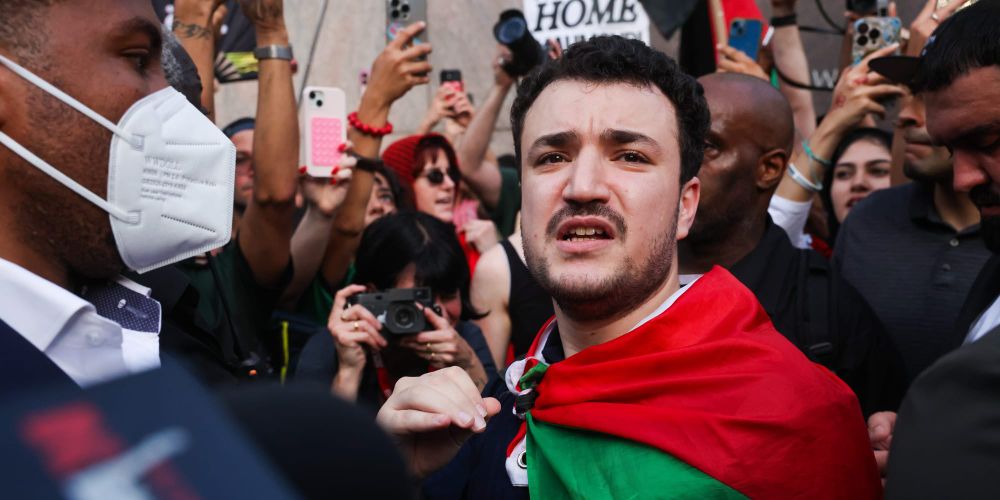
The federal government's own investigators determined that Mahmoud Khalil was not a threat. That finding did not stop his arrest. It did not stop his detention. And it did not stop administration officials from continuing to describe him as dangerous — even after the agency responsible for assessing that danger had quietly concluded otherwise.
According to reporting by The Intercept, two days before ICE agents arrested Khalil in March 2025, an anonymous tip accused him of calling for violence. The FBI opened a review. Within days, agents determined the tip did not "warrant further investigation" and closed the probe. Then the arrest happened anyway — and the public justification from the Trump administration leaned on the same category of threat the FBI had just rejected.
This is not a story about a tip that turned out to be wrong, or about bureaucratic miscommunication between agencies. It is a story about how the label "threat" functions in the current immigration enforcement system — not as a conclusion reached through evidence, but as a tool applied before investigation, maintained after investigation, and never retracted regardless of what investigation finds. The FBI's closure of the probe was not disclosed publicly. The threat framing continued without it.
Khalil, a Palestinian activist and Columbia University graduate student, became one of the most prominent targets of the administration's campaign to use immigration law against campus protesters. His case drew widespread attention in part because he is a legal permanent resident — a green card holder — and in part because the government's stated justification for his removal shifted repeatedly. First it was his activism. Then his alleged associations. Then the anonymous tip, which was apparently circulating in the background of a public posture that treated his dangerousness as settled fact.
The mechanics here matter. An anonymous accusation — one the FBI itself could not substantiate — became part of the architecture of a detention that has now lasted months. The accusation's failure to survive scrutiny was never made public. The threat label was never revised. This is the gap between what law enforcement actually found and what the administration told the public: not a gap caused by ongoing investigation, but one maintained deliberately, after the investigation concluded.
The pattern fits a documented practice that Tinsel News has tracked across multiple cases: the post-hoc threat label. In a separate case involving Carlos Mendoza-Hernandez, ICE applied a gang designation after shooting him — not before. The label came after the bullets. In Khalil's case, the label came before the arrest, but survived after the evidentiary basis for it was discarded. The function is the same: the designation provides public legitimacy for an enforcement action that the evidence does not support.
What makes the Khalil case structurally significant is that it exposes the seam between the FBI and ICE in this enforcement framework. The FBI's mandate is to assess actual threats — criminal violations, credible violence, material harm. When agents reviewed the tip about Khalil, they applied that standard and found nothing. ICE's mandate, as currently deployed, is immigration enforcement — and the threshold for detention and removal under immigration law is far lower than the threshold for criminal prosecution. The administration exploited that gap. The FBI's finding never needed to be disclosed, because it operated in a different legal lane than the one being used to hold him.
This is not an edge case. It is the system working as designed — or rather, working as it has been redesigned. The Trump administration has consistently used immigration detention as a tool against political targets where criminal prosecution is unavailable or would require a public evidentiary standard the government cannot meet. Khalil's case follows a line that includes hundreds of detentions where families cannot locate their relatives and where the stated justification shifts or evaporates under scrutiny — but where the detention continues regardless.
The DOJ's broader posture during this period has been to treat legal process as an obstacle rather than a constraint. In a separate matter, the administration's DOJ sided with Elon Musk's business interests against a state law — a pattern in which the department's legal power is deployed not to enforce law but to advance political and economic agendas. The Khalil case sits in that same pattern: law enforcement machinery directed at a political target, with the evidentiary findings quietly discarded and the public framing maintained.
There is also a chilling effect that operates regardless of how Khalil's case ultimately resolves. Every student activist, every visa holder, every green card holder who has organized around Palestine, Sudan, or any cause this administration dislikes now knows the following: an anonymous tip — not a criminal charge, not an indictment, not even a sustained FBI inquiry — can initiate a process that leads to indefinite detention. The tip does not need to survive scrutiny. The threat label does not need to be accurate. It only needs to exist long enough to justify the arrest, after which the detention becomes self-sustaining under immigration law.
That is the architecture this case makes visible. The entry point is low — an anonymous accusation. The exit point is nearly nonexistent — immigration detention carries no speedy trial requirement, no automatic bail review, no criminal standard of proof. And the public justification can remain intact even after the factual basis for it has been quietly discarded by the agency responsible for evaluating it.
Khalil's lawyers and supporters have argued from the beginning that his detention is political retaliation for protected speech. The FBI's closed probe does not prove that. But it removes the one factual claim — that there was a credible threat — that the administration had available to argue otherwise. What remains, once the threat label is stripped of its evidentiary support, is a legal permanent resident in a detention facility, held under immigration authorities, for organizing on a college campus. The FBI looked at the accusation and found nothing worth pursuing. The administration kept him detained and kept calling him dangerous. Those two facts, placed next to each other, are the story.