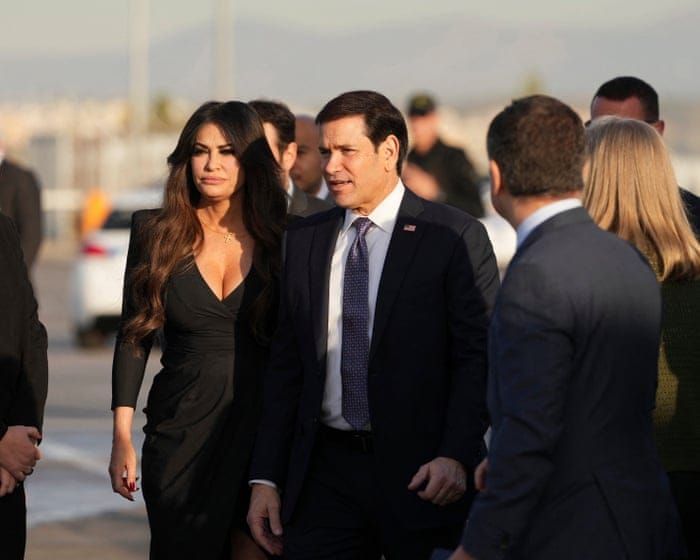
The United States ambassador to Greece is reportedly on the verge of being fired. According to The Guardian US, a senior U.S. official said Sunday that Donald Trump and Secretary of State Marco Rubio are "extremely pissed off" by Kimberly Guilfoyle's conduct and are expected to decide on her fate this week. The alleged misconduct is described as improper and possibly illegal, occurring both before and during her tenure in Athens.
But the story is not really about whether Guilfoyle gets fired. It is about why it took this long — and what that timeline tells us about how this administration uses diplomatic appointments and who it protects, and for how long, before the protection becomes a liability.
Guilfoyle's path to the ambassadorship in Greece was not built on foreign policy credentials. She is the ex-fiancée of Donald Trump Jr. and a former Fox News host who spent years as one of the more visible faces of MAGA media. Her appointment followed a pattern well-documented across this administration: plum diplomatic posts rewarded to political loyalists, donors, and figures from the president's personal orbit, regardless of experience or suitability. As Tinsel News has reported on the State Department's loyalty-first personnel model, the diplomatic corps has been systematically reshaped around political allegiance rather than professional competence — a shift with consequences that eventually arrive at moments like this one.
The specific allegations against Guilfoyle have not been fully detailed in public reporting, and The Guardian's account relies on a senior official speaking without attribution. What is notable is the language: "improper and possibly illegal" is not a minor personnel complaint. It describes conduct serious enough that the Secretary of State — himself a political operator of considerable discipline — is reportedly involved in the decision. Rubio does not make noise about ambassadors over trivialities.
Kimberly Guilfoyle was nominated as U.S. ambassador to Greece after years as a Fox News host and prominent Trump campaign surrogate. Her nomination was confirmed despite limited foreign policy background. The Greece posting, a mid-tier NATO ally with geopolitical significance in the Eastern Mediterranean, is typically held by career diplomats or experienced political appointees.
What the sourcing does not tell us — and what matters enormously — is when the administration first became aware of the conduct now being described as grounds for dismissal. Allegations against high-profile political appointees rarely materialize overnight. They accumulate. Reports circulate internally. Complaints move through channels. The question of when Trump's inner circle knew what Guilfoyle was allegedly doing, and chose to do nothing, is the accountability question the current framing of this story is carefully avoiding.
The pattern here is structural, not personal. This administration has demonstrated a consistent tolerance for misconduct among loyalists, right up to the moment when the political cost of continued tolerance exceeds the political cost of action. The calculation is not ethical — it is transactional. Guilfoyle is not being considered for removal because her alleged conduct is newly discovered. She is being considered for removal because the allegations have become public enough that inaction is no longer costless.
That distinction matters for how we understand accountability in this diplomatic corps. Career foreign service officers face rigorous vetting, regular performance reviews, and have in some cases been subjected to loyalty screening that has no precedent in the history of the Foreign Service. Political appointees in the same corps have operated under a different standard — one where proximity to the president's family or media ecosystem substitutes for professional accountability structures. That two-tier system does not collapse when one loyalist is fired. It is reinforced by the fact that she lasted as long as she apparently did.
Greece is not a peripheral posting. It sits at the intersection of NATO's southeastern flank, migration policy in the Aegean, and ongoing tensions with Turkey — a fellow NATO member whose relationship with the alliance has been complicated and consequential. The U.S. ambassador to Greece has a substantive job. What the Greek government, its foreign ministry, and the communities most affected by U.S. diplomatic engagement in the region have experienced during Guilfoyle's tenure is a question that American political coverage has not yet seriously asked. The story, as framed in Washington, is about Trump family drama and political embarrassment. The story, as experienced in Athens, may be something else entirely.
There is also a question about what "extremely pissed off" actually means as a policy posture. Senior officials in this administration have been described as furious at subordinates before — and done nothing. The language of outrage, leaked to a reporter, serves a function: it distances the president from the appointee's conduct while the actual decision remains pending. It is the rhetorical equivalent of being placed on administrative leave. It signals displeasure without committing to consequence.
The broader context is a State Department that has been hollowed of institutional memory and professional norms. As Tinsel News has documented, DOGE-driven cuts have stripped the department of experienced personnel at precisely the moment when U.S. diplomatic credibility faces pressure on multiple fronts. Into that vacuum, political appointees with thin credentials and strong personal connections to the president have been installed in posts that require neither. When those appointments go wrong — as some inevitably will — the accountability mechanisms that would normally catch problems early have been weakened or eliminated.
The Guilfoyle situation is the predictable outcome of treating the diplomatic corps as a patronage system. The argument is not abstract: every ambassadorship filled by a loyalist is a post not held by a career officer with language skills, regional knowledge, and professional obligations to something beyond the president's approval. The cost of that trade-off is usually invisible. In this case, it is being reported as a senior official's fury and a decision expected sometime after a federal holiday. That dynamic is not unique to the State Department — it surfaces wherever political loyalty substitutes for institutional oversight, leaving accountability structures too weakened to catch problems before they become public embarrassments.
If Guilfoyle is fired this week, it will be framed as accountability. The administration will accept credit for acting decisively once the facts became clear. What will go unexamined is the interval between when the facts became clear internally and when the decision was finally made — and what that interval protected, and who it served. That is the question that outlasts any individual ambassador's tenure.