Immigration enforcement in the United States has always carried a documented racial logic: who gets stopped, who gets questioned, who gets handcuffed. What happened to Ricardo Gonzalez in Long Beach, California on October 17 fits that pattern with an exactness that should trouble anyone paying attention — not because it is unusual, but because it is not.
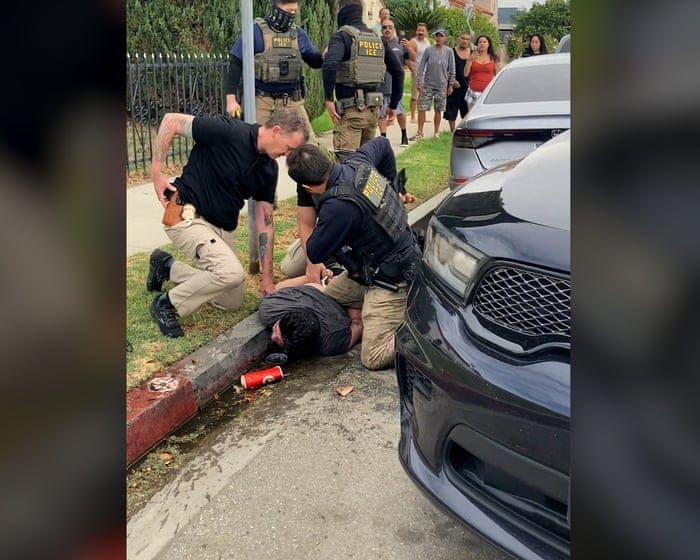
According to The Guardian US, Gonzalez — a US citizen — was detained and injured by ICE officers during an enforcement action in Long Beach. His arm was broken during the encounter. The Long Beach Police Department stated in a public release that its officers arrived to find what they described as "a large group disturbance" involving federal agents. Local police removed the handcuffs from Gonzalez and transported him to a hospital for treatment. As of publication, the Department of Homeland Security has not commented publicly on why Gonzalez was detained in the first place.
That silence is not incidental. It is the policy.
ICE has a documented history of detaining US citizens — disproportionately Latino men — during immigration enforcement operations. The agency is not required to publicly justify individual detentions, and DHS has no standing policy of explaining cases where citizens are mistakenly or unlawfully held. Local police, not federal agents, freed Ricardo Gonzalez.
The accountability structure governing ICE field operations has a specific and consequential gap. The agency can detain someone, injure them, and release them without ever explaining its reasoning to the public, to elected officials, or in many cases to the person detained. DHS is not legally required to issue a public justification when a citizen is held in error. There is no mandatory incident report, no automatic review, no civilian oversight body with the authority to compel an explanation. The silence DHS is maintaining in the Gonzalez case is not a failure of procedure — it is the procedure.
This gap has been filling with bodies for years. A 2021 report from the Government Accountability Office found that ICE had issued detainers — the legal instrument used to hold individuals for immigration processing — against more than 1,700 US citizens between 2012 and 2018. The agency's own data showed it had no reliable system for verifying citizenship before initiating detention. Critics have long argued that the enforcement model ICE uses in street operations — broad geographic sweeps, reliance on appearance and language as proxies for immigration status — makes citizen detention not a bug but a predictable output. As Tinsel News has reported, 93 percent of ICE street arrests have targeted Latino individuals, a figure that does not track with undocumented population demographics and that civil liberties organizations have characterized as a profile, not a mission.
Gonzalez is Latino. His name has not appeared on any public charging document. DHS has not alleged he committed any crime. He was handcuffed by federal agents, his arm was broken during that detention, and he was freed not by ICE but by local police who arrived and, apparently, saw what was happening clearly enough to remove the restraints themselves. The Long Beach Police Department's statement — clinical, spare, attributing the disturbance to the federal agents — does not read as a defense of the federal operation. It reads as a department documenting, for the record, that it was not responsible for what happened to this man.
The jurisdictional choreography here matters. ICE operates under DHS authority. Local police have no power to halt a federal enforcement action. What Long Beach officers could do — and did — was treat the injured man as what he was: a person who needed medical care. That they had to physically remove his handcuffs to do so is the detail that earns its weight. Federal agents had restrained a US citizen. Local police had to undo it.
The body camera question is worth asking directly. ICE announced a body camera program earlier this year with considerable fanfare. As Tinsel News has documented, the footage release policy gives the agency's own director discretion over what the public sees — meaning the cameras exist, but the accountability mechanism they were supposed to provide does not. Whether cameras were present at the Long Beach incident, and whether that footage will ever be released, is unknown. DHS has not said.
There is a specific argument that defenders of aggressive immigration enforcement will make about cases like this: that field operations are chaotic, that agents make split-second decisions, that errors happen in any law enforcement context. The argument is not wrong on its face. What it omits is that the system producing those errors has been deliberately insulated from correction. When a local police officer breaks a citizen's arm in an unjustified detention, there are — imperfect, often inadequate, but at least existing — mechanisms: civilian review boards, internal affairs investigations, the possibility of civil suit. When ICE does it, the agency can simply not comment. The legal terrain for suing federal immigration agents is significantly more hostile than for local police, qualified immunity doctrines apply with particular force in immigration contexts, and the agency faces no institutional pressure to explain itself because no institution has the authority to compel it.
The Gonzalez case is not the first time ICE agents have injured a US citizen during an enforcement action that turned out to be mistaken or unjustified. It will not be the last. What makes it worth examining in detail is precisely what DHS is doing right now: nothing. No statement. No explanation. No acknowledgment that a citizen was harmed. The department's silence is itself a statement about who it believes is accountable to whom.
California has been a recurring theater for these confrontations. The state has some of the strongest sanctuary protections in the country, which means federal immigration enforcement there often proceeds without local cooperation — and sometimes in direct tension with local police. The Long Beach incident, where city officers effectively intervened to release a man federal agents had detained and injured, is a visible example of that friction. It is also a reminder that the political argument over sanctuary jurisdictions is not abstract: it is, at its core, an argument about which level of government gets to decide what happens to people's bodies. That argument has been expanding well beyond California — the nation's second-highest law enforcement official has floated deploying armed immigration agents to monitor polling places, a proposal that would extend the same enforcement logic into the architecture of democratic participation itself.
Gonzalez is recovering. DHS is still not commenting. The next Ricardo Gonzalez — the next US citizen swept up in an ICE enforcement action, injured, and released without explanation — is somewhere in the enforcement pipeline right now, and the system that produced this outcome has not changed in any way that would prevent it from producing the same outcome again. That is not a prediction. It is a description of how the machine is built.