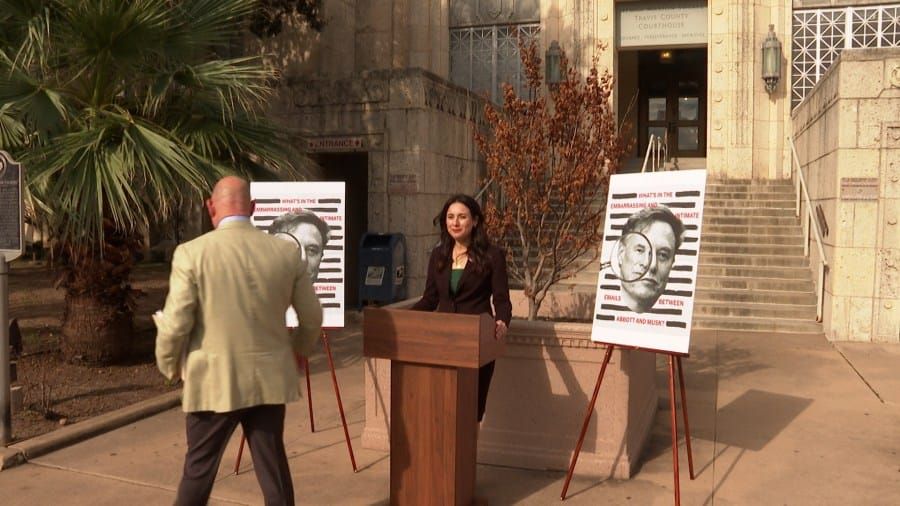
The word the court used was "embarrassing." Not privileged. Not classified. Not protected by executive authority or attorney-client doctrine. The communications between Elon Musk — the world's wealthiest individual, a federal contractor, and a man who spent more than $250 million to elect Donald Trump — and Greg Abbott, the sitting governor of Texas, were sealed from public view because releasing them might cause embarrassment. That designation, reported by The Hill, is now the center of a lawsuit filed by Texas Democrats who argue the public has a right to know what its governor is discussing with the man who has become the most powerful unelected figure in American government.
The lawsuit was filed by Texas Democratic Party Chair Gilberto Hinojosa, who is seeking judicial review of the decision to shield the communications. The emails were deemed confidential on the grounds that they are "embarrassing" and "intimate" in nature — a description that raises more questions than it answers, and that almost certainly was not written with the public interest in mind.
Gilberto Hinojosa is the chair of the Texas Democratic Party. His lawsuit seeks court-ordered review of communications between Governor Greg Abbott and Elon Musk that were sealed under a confidentiality designation citing their "embarrassing" and "intimate" nature. No national security claim, no legal privilege, no executive authority has been cited to justify the seal. The legal basis for confidentiality appears to rest entirely on the reputational comfort of the parties involved.
What makes this more than a story about powerful men hiding something is the shield itself. "Embarrassing" is not a recognized category of government record protection. It is not a FOIA exemption. It is not a privilege recognized by Texas public records law. It is, at best, an improvised shield constructed around the feelings of a governor and a billionaire who apparently communicated in ways they would prefer voters not read.
That improvisation should concern anyone who cares about how public officials conduct public business. Greg Abbott governs a state of 30 million people. Elon Musk, through SpaceX, Tesla, Starlink, and his role directing the Department of Government Efficiency under the Trump administration, holds contracts and regulatory relationships with the federal government worth hundreds of billions of dollars. These are not private citizens exchanging personal correspondence. They are a sitting governor and a man with documented influence over federal policy, communicating in ways that at least one court found sensitive enough to seal — and sensitive enough that the seal had to be justified on the grounds of personal embarrassment rather than any recognized legal doctrine.
The money behind this does not require speculation. Musk spent more than $250 million backing Republican candidates in the 2024 election cycle, according to Federal Election Commission filings. He was rewarded with a White House role that gave him access to federal agency data, personnel decisions, and regulatory frameworks. Texas, under Abbott, has been one of the most hospitable states in the country for Musk's business interests — SpaceX operates its Starbase launch facility in Boca Chica, Texas, and the state has provided substantial regulatory accommodation for Musk's various ventures. The question of what Abbott and Musk discussed, and when, and in what register intimate enough to require sealing, is not a gossip question. It is a governance question.
As Tinsel News has documented, the pattern of billionaire political spending reshaping government accountability is not unique to Texas. 172 billionaire families have spent $1.7 billion on the 2026 midterms, and the returns on that investment increasingly include not just favorable legislation but favorable opacity — the ability to conduct relationships with public officials outside the view of the public those officials serve. The Musk-Abbott emails, whatever they contain, fit a pattern in which the wealthiest political actors in the country are not just buying policy outcomes but buying the right to conduct business with government in private.
The use of "intimate" as a descriptor for the communications adds a layer that the public record does not yet explain. In legal contexts, "intimate" typically refers to personal or private matters — correspondence that might be protected precisely because it has nothing to do with official duties. If that is the correct reading here, the question becomes why a sitting governor was conducting personal correspondence with a federal contractor and major political donor through channels that ended up subject to a public records request in the first place. If "intimate" is being used more loosely — to describe frank, informal, or candid exchanges about policy or politics — then the word is doing work it was not designed to do, and the confidentiality designation becomes even harder to defend.
Hinojosa's lawsuit is asking a court to make that determination. The specific relief sought is judicial review of the confidentiality designation — not immediate public release, but a legal examination of whether the grounds cited for sealing the communications are legitimate. That is a modest ask. It is also, given the parties involved, a significant one. A ruling that "embarrassing" is insufficient grounds to shield communications between a governor and a billionaire donor would set a precedent with implications well beyond this case.
The pattern extends beyond Texas. The relationship between Musk and elected officials across the country has become one of the defining accountability gaps of this political moment. Musk's role in DOGE gave him access to government systems and personnel files that career officials describe as unprecedented for a private citizen. His political spending has made him a kingmaker in Republican primaries. His business interests span industries regulated by the very governments whose officials he courts. The pattern of large donors receiving favorable regulatory treatment is well-documented — but what is less documented is the content of the private communications through which those relationships are managed. The Musk-Abbott emails represent a rare case where those communications were captured in a public records context and then sealed — which means there is at least a legal mechanism to challenge the seal.
The question the Hinojosa lawsuit poses is not whether Musk and Abbott did anything illegal. It is simpler and more fundamental: does a governor have the right to conduct substantive communications with one of the most powerful private actors in the country and shield those communications from public view on the grounds that releasing them would be uncomfortable? The answer, under any reasonable reading of public records law, should be no. The embarrassment of powerful men is not a public interest. The conduct of public officials is.
Texas voters go to the polls in 2026. Whatever Abbott and Musk discussed — in whatever register the court found intimate enough to seal — they will do so without knowing what their governor and the world's wealthiest man said to each other in private. Hinojosa's lawsuit is an attempt to change that before the window closes. Whether a Texas court agrees that embarrassment is not a legal defense against transparency may be the most important question the case decides — not for Abbott or Musk, but for every governor who conducts business with billionaires and assumes the correspondence stays private.