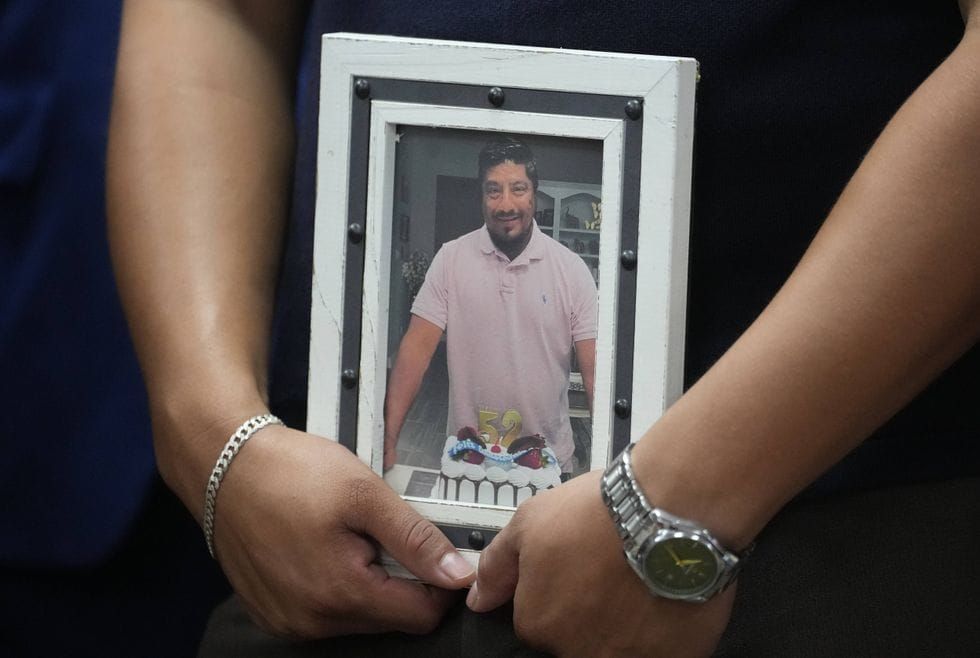
Lorenzo Salgado Araujo spent 35 years in the United States. He ran a small construction business. On Tuesday morning, he was driving to work in Houston with three coworkers when ICE officers in unmarked vehicles pulled him over. By the end of that stop, he was dead — shot by a federal agent. He was 52 years old.
ICE's account of what happened next became the official record almost immediately: Salgado Araujo had tried to ram his vehicle into agents. A frightened officer, fearing for his life, opened fire. The shooting, the agency implied, was the foreseeable consequence of resistance.
There are three people who say that account is a lie. They were in the van with Salgado Araujo when he was killed. All three are now in federal detention. And according to Juan Proaño, CEO of the League of United Latin American Citizens — who is serving as a representative for the Salgado Araujo family — they are being pressured to sign self-deportation orders. As Proaño told Common Dreams, citing his interview with The New Republic: "They're currently in detention. These men hold the key to what actually happened."
A 52-year-old Mexican national who had lived in the United States for more than 35 years. He ran a small construction business in Houston and had no known criminal record. He was driving to a job site with three coworkers when ICE officers in unmarked vehicles stopped his vehicle. He was shot and killed during that stop.
This is not a coincidental immigration enforcement action that happens to affect people who saw a shooting. It is the institutional mechanism by which an agency that may have killed a man without justification removes the only people positioned to prove it. Deportation, in this context, functions as evidence suppression.
The witnesses' accounts, as reported by The Washington Post, are specific and consistent. Detainee Jose Trinidad Rojas, 51, submitted a hand-written statement obtained by the Post through his attorney, Hugo Balderas-Ibarra. "That is a lie," Trinidad Rojas wrote of ICE's claim that Salgado Araujo tried to drive into officers. "It is impossible for them to say that they were going to get run over … there were no officers in front of or behind the vehicle. They were on the sides." Balderas-Ibarra told the Post he interviewed the other two men separately. Both gave the same account. "All of them reiterated that there were never any ICE agents in front of the van," he said. "They came in and started shooting from the sides."
That testimony does more than contradict ICE. It describes a factual impossibility in the agency's version of events. You cannot be run over by a vehicle if you are standing beside it. The agency's own framing — that an agent feared being struck — requires a geometry that the witnesses say did not exist.

Physical evidence appears to support the witnesses. David Bier, director of immigration studies at the libertarian Cato Institute, examined video footage of the shooting scene and noted in a Friday social media post that Salgado Araujo's van showed no visible damage to its front end — despite ICE's claim that he had used it as a weapon by ramming an agency vehicle. "ICE appears to have lied yet again about killing someone," Bier wrote, adding: "Unbelievable. But actually totally believable given that they lie about events fully captured on video."
That last clause matters. Bier is not a progressive critic of law enforcement. He works at an institution that opposes most federal regulation. His assessment that ICE has a documented pattern of lying about the circumstances of deaths in its custody is not a political position — it is an institutional observation grounded in prior incidents. This is not an isolated failure of one agent's judgment. It fits a pattern that Tinsel News has covered repeatedly: an ICE agent in Minnesota was arrested after body camera footage caught him filing a false report about a shooting. The pattern of post-hoc justification — labeling, reframing, or misrepresenting the circumstances of an enforcement action after the fact — is documented and recurring.
Which makes the move to deport the witnesses less surprising, and more damning.
Federal law does not automatically protect undocumented witnesses to crimes from deportation. There are mechanisms — U visas, prosecutorial discretion, stays of removal — that can shield witnesses whose testimony is material to a law enforcement investigation. But those mechanisms require someone in the federal system to invoke them. When the agency under scrutiny is also the agency controlling the witnesses' detention, the conflict is not abstract. ICE is simultaneously the subject of the potential misconduct allegation and the authority deciding whether the people who can speak to that allegation remain in the country long enough to do so.
This is the structural problem that accountability journalism on immigration enforcement keeps running into: the agency is not merely a subject of oversight. It is, in many cases, the only institution with access to the people and records that oversight would require. ICE's own detainee tracking systems have been documented as deliberately opaque, making it difficult for attorneys and family members to locate people in custody. The same opacity that makes it hard to find detainees makes it easy to move them — to transfer, to process, to remove — faster than legal intervention can follow.
Proaño framed the stakes clearly: "These men hold the key to what actually happened." That is true in the most literal sense. There is no dashcam footage that has been made public. There is no body camera footage that has been released. There is ICE's account, and there are three men who were present and say ICE's account is false. If those three men are deported before their testimony is preserved in a form that can withstand legal scrutiny, the official record becomes, by default, the only record.
The Houston case does not exist in isolation. As Tinsel News has reported, 93 percent of ICE street arrests have targeted Latino individuals — a number that does not match any neutral enforcement logic and that has prompted civil rights challenges in multiple jurisdictions. Salgado Araujo, a Mexican national who had lived in the country for 35 years, driving to a construction job in an unmarked van, fits a profile that federal data shows ICE targets at rates that cannot be explained by criminal history alone.
The question this case forces is not whether ICE agents sometimes make split-second decisions in dangerous situations. They do. The question is whether an agency with a documented pattern of misrepresenting those situations — and with sole custody of the people who can contradict its version — can be trusted to preserve the conditions under which accountability is even possible. The answer, in Houston, appears to be: only if someone stops them before the deportation orders are signed.
What happens to these three men in the next several days will determine whether there is ever an honest account of how Lorenzo Salgado Araujo died. That is not a question about immigration enforcement. It is a question about whether the law applies to the people who enforce it.