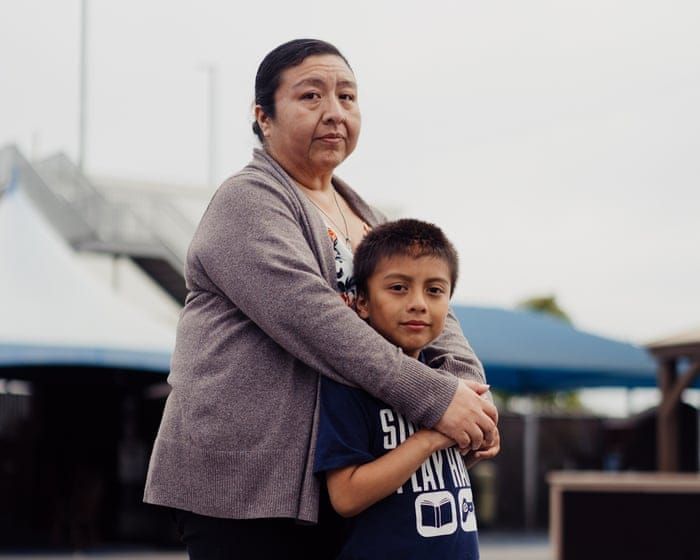
The carwash where Angelenos dropped off their keys, the department store where families shopped on weekends, the street corners where neighbors recognized each other by name — last summer, these places became sites of arrest. Armed, masked immigration agents moved through Los Angeles pulling people out of their daily lives, as The Guardian US documented in a sweeping account of the raids and their aftermath. Partners, primary breadwinners, grandparents, and children were detained, processed, and deported — disappearing from their neighborhoods within days, sometimes within hours.
The government's version of this story has a clean arc: a surge operation, a policy objective, an enforcement number. What that version leaves out is everything that came after. The raids ended. The vans drove away. The press moved on. And three families in Los Angeles were left to reconstruct their lives from the pieces.
What The Guardian's reporting makes plain — and what the official enforcement tallies will never show — is that deportation does not conclude when a person crosses a border. It continues, daily, in the households where someone is missing. It continues in the children who stopped going to school. In the rent that cannot be paid. In the legal status of a U.S.-born child whose only parent is now in a country they may not remember. The human cost of last summer's ICE operations in Los Angeles did not end when the operations did. It compounded.
ICE street arrests have disproportionately targeted Latino communities. A Tinsel News analysis found that 93% of ICE street arrests targeted Latinos — numbers that, as we reported, match a profile more than a mission. The families described in The Guardian's account fit that profile precisely.
The three families whose stories The Guardian traced are not abstractions. They are people who built lives in Los Angeles — working, raising children, paying into a city that now, officially, does not want them or their relatives. Their accounts collectively describe what enforcement policy looks like from the inside: not a deterrent, not a procedure, but a rupture. Something that happens to a family and does not stop happening.
One of the most consistent patterns across the accounts is economic devastation that hits immediately and does not recover. When a primary earner is detained, the household loses income the same day. Rent is due regardless. Utilities do not pause for deportation proceedings. Children's needs do not pause. What follows — eviction risk, debt, children pulled from school to help manage — is not an incidental side effect of enforcement. It is a predictable, documented consequence that policymakers have chosen not to weigh against the stated objectives of the operations.
The legal situation for U.S.-born children whose parents have been deported is among the most poorly understood dimensions of this crisis. These children are American citizens. They have the constitutional right to remain in the United States. But that right, in practice, means little to a six-year-old whose mother was taken in a parking lot and whose father works double shifts to cover what she earned. An estimated 145,000 U.S. citizen children have been separated from their parents through the current wave of deportations — a figure the government has declined to call family separation, because the children technically remained on American soil.
The terminology matters. "Family separation" conjures a specific image — children in cages, a border crisis, an emergency. What is happening in Los Angeles does not look like that. It looks like a child coming home from school to a house that is quieter than it should be. It looks like a grandmother who cannot explain, in words a seven-year-old can accept, why their parent is not coming back for dinner. The absence is legal. The rupture is total.
The operations that swept Los Angeles last summer did not emerge from nowhere. They were the operational expression of a policy architecture that has been under construction for years — and that has accelerated sharply. Expedited removal is now legal nationwide, meaning that people who have lived in the United States for years can be deported without a hearing, without a judge, and without meaningful opportunity to contest the decision. The legal scaffolding that once slowed enforcement — due process protections, immigration courts, judicial review — has been systematically dismantled or bypassed.
What that means, practically, is that the families described in The Guardian's account had few mechanisms to stop what happened to them. Some did not know their relative had been detained until hours after the fact. ICE's own detainee locator system — the tool families are supposed to use to find detained relatives — has been documented to fail in exactly the moments it is most needed. Families cannot find their detained relatives because ICE's tracking system is designed in ways that make disappearance possible. That is not a technical failure. It is a design outcome.
The private detention industry sits at the center of this system and profits directly from its expansion. GEO Group, one of the largest private prison and detention contractors in the country, has watched its revenues grow in direct proportion to the scale of enforcement operations. The congressional committee with oversight authority over how many people get detained is chaired by a lawmaker who has received significant contributions from the industry. That relationship — between detention bed contracts, congressional oversight, and the scale of enforcement — is not incidental to what happened in Los Angeles last summer. It is the financial logic that made it possible.
The families in The Guardian's account are living inside a system whose incentives run entirely against them. The government is rewarded, politically and financially, for higher enforcement numbers. Detention contractors are rewarded for higher occupancy. Elected officials who champion the operations face no electoral consequence from the communities most harmed — because those communities, by definition, cannot vote for or against them. The people bearing the cost have no lever to pull.
Los Angeles itself responded to last summer's operations with a public posture of resistance. City officials condemned the raids. Local police were directed not to cooperate with federal immigration enforcement. Advocates mobilized. Community organizations ran know-your-rights trainings. These responses matter — they reflect genuine political will at the municipal level, and they created real, if limited, protections. But they could not stop the federal agents who arrived with masks and authority and took people away anyway.
The tension between city resistance and federal enforcement power is not a new story in Los Angeles, or in any sanctuary city. What the families described by The Guardian make clear is that the limits of that resistance are felt most acutely by the people the resistance was meant to protect. Sanctuary policies did not keep their relatives home. The city's political opposition did not prevent the arrests. What those policies did was signal a set of values — values that the federal government has spent considerable effort and legal authority overriding.
There is also the question of what the operations actually achieved, measured against their stated objectives. The administration has framed mass enforcement as a public safety and national security measure. The people detained in Los Angeles last summer — carwash workers, department store regulars, partners, grandparents — do not fit that framing. The enforcement numbers are real. The public safety rationale, applied to the specific people taken, is not. This gap between stated purpose and operational reality is not a bug in the enforcement logic. It is, for the communities targeted, the entire experience.
The immigrant parents writing wills in case ICE takes them, the underground food networks neighbors build when families are afraid to leave their homes, the children whose school attendance collapses after a parent's detention — these are not separate stories. They are the same story, playing out across dozens of American cities, in neighborhoods that were already bearing disproportionate costs from a system that was never designed with their welfare in mind.
The three families in Los Angeles whose lives The Guardian documented are, in the most important sense, representative. Not because their specific circumstances are identical to thousands of others — they are not — but because the structure of what happened to them is. A person was taken. The household was destabilized. The legal system offered limited recourse. The city expressed sympathy. The federal government expressed nothing. And the family was left to manage a loss that no official account will ever fully describe, because the official account ends when the van pulls away.
What the families of Los Angeles are living through is not the aftermath of last summer's raids. It is last summer's raids, still happening — in a different form, at a different pace, but with the same weight. The enforcement operation concluded. The sentence did not. And the people serving it are the ones who were never charged with anything at all.