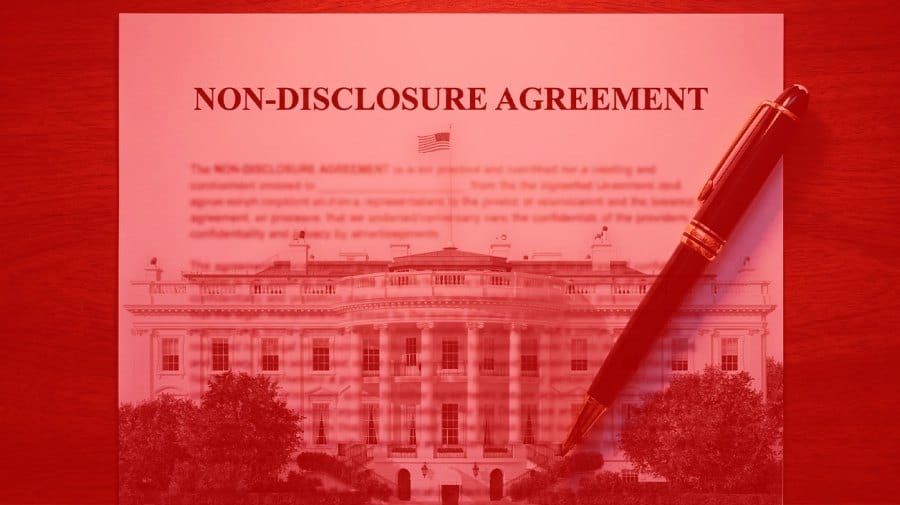
The Office of Personnel Management proposed this week that every federal worker — new hires and existing employees alike — sign a nondisclosure agreement. The stated rationale, according to The Hill, is protecting sensitive government information. The actual mechanism is something different: a binding legal instrument, signed under threat of termination, that would give the executive branch new power over the 2.2 million civilian employees who constitute its only meaningful internal check.
NDAs in the private sector are routine. NDAs for a government workforce are not. The distinction matters because federal employees occupy a categorically different role than corporate workers. They are not protecting a company's trade secrets. They are custodians of public information, funded by taxpayers, operating under a legal framework that was specifically designed — through the Whistleblower Protection Act, through congressional oversight statutes, through the First Amendment itself — to ensure that the public retains some visibility into how its government behaves. An NDA does not just restrict speech. It reorders the accountability relationship between government and governed.
The proposal arrives at a moment when that accountability relationship is already under sustained pressure. The administration has fired inspectors general across multiple agencies, ignored court orders, and moved to concentrate oversight functions inside the White House rather than in the independent offices Congress created for that purpose. The NDA proposal fits that pattern — not as an aberration, but as its logical extension. Each previous move constrained oversight from outside the executive branch. This one goes inside it.
Federal employees are currently protected by the Whistleblower Protection Act, which allows them to report waste, fraud, abuse, and legal violations to Congress, inspectors general, and the press. An NDA creates a contractual obligation that can conflict with those protections — and forces workers to choose between their legal rights and their jobs. Critics argue the chilling effect alone, regardless of enforcement, would dramatically reduce disclosures.
Whistleblower protections under federal law are already narrower than most people assume. The Whistleblower Protection Act covers disclosures of waste, fraud, and legal violations — but it has gaps, it has been eroded through litigation, and it depends on enforcement mechanisms that sit inside the same executive branch that is now proposing the NDAs. Add a signed agreement to that picture and you have not just a legal risk but a psychological one: a worker who has put their name on a document promising silence will think twice before reporting misconduct, even when reporting it is technically still protected.
That chilling effect is the point. Governments that want to suppress internal dissent rarely need to prosecute everyone. They need to make the cost of speaking feel uncertain and large. An NDA accomplishes that without a single enforcement action. The worker who witnessed the procurement irregularity, the analyst who saw the data get altered before publication, the administrator who watched a program get dismantled in ways that contradicted congressional intent — all of them now have a signed document in their personnel file that makes a lawyer's first question obvious: did you violate your agreement?
The administration's framing — protecting sensitive information — is not without merit as an abstract principle. Governments do have legitimate secrecy interests. Classified information law already addresses most of them. The Espionage Act addresses the rest. What those existing frameworks do not cover is the category of information this proposal would actually suppress: unclassified information about policy decisions, program outcomes, internal dissent, and the gap between what agencies tell Congress and what they actually do. That is precisely the information the public most needs, and it is not a coincidence that an NDA's broadest application would fall there.
The backlash reported by The Hill spans ideological lines — federal employee unions, civil liberties organizations, and Republican-aligned government accountability groups have all raised objections. That breadth is worth noting, because it maps onto a genuine constitutional concern that does not sort neatly by party. The First Amendment's protections for government employees are limited but real. More fundamentally, Congress has a constitutional interest in receiving information from the executive branch, and an NDA that discourages employees from communicating with congressional oversight committees implicates separation of powers in ways that no administration has previously tested at this scale.
There is also a foreign policy dimension that domestic coverage of this story has largely missed. The United States has spent decades funding press freedom programs, whistleblower protection initiatives, and government transparency infrastructure in other countries — often as explicit conditions of aid or diplomatic engagement. American officials have lectured foreign governments about the importance of civil servants being able to report misconduct without fear of retaliation. The OPM proposal does not just contradict that posture; it eliminates the moral standing from which that posture was ever made. Governments in Hungary, Turkey, and elsewhere that have used employment contracts and loyalty requirements to suppress internal dissent will note the precedent.
The systemic pattern here extends beyond this administration. Once the legal architecture for federal NDAs exists — once the Office of Personnel Management has established the regulatory framework, once courts have had the opportunity to rule on enforceability — the tool is available to every future administration. The question is not only what this White House would do with it, but what the next one would. Accountability infrastructure, once dismantled, does not automatically rebuild. The federal workforce's capacity to serve as an internal check on executive power is not a partisan asset. It is a structural one, and it is degraded for everyone when it is compromised for anyone.
The administration has already demonstrated a willingness to use employment as a political instrument — firing inspectors general, purging career officials, and, as the DOJ's recent proposal to shield federal prosecutors from state ethics rules showed, restructuring the legal environment around government employees to reduce external accountability. The NDA proposal is the civilian workforce version of the same logic: make the people inside the machine less able to tell anyone outside it what the machine is doing.
What the source reporting frames as a controversy — a proposal that has "sparked accusations" — is more precisely described as a constitutional stress test. The accusations are not unfounded. The proposal does what critics say it does. The evidence for that is not in anyone's motives; it is in the plain operation of how nondisclosure agreements function. They restrict speech. They create legal liability for disclosure. They shift the burden onto the speaker to show their disclosure was protected, rather than onto the government to show it was not. Applied to 2.2 million people who collectively know more about how federal power is exercised than any journalist, congressional staffer, or inspector general ever could, that shift is not administrative housekeeping. Consider, too, that $1.8 billion in public money vanished without public explanation — precisely the kind of disclosure a chilled federal workforce would be less likely to surface.
The public comment period on the OPM proposal is the formal mechanism for pushback. But the more durable defense is the one that members of Congress have so far been slow to articulate clearly: that the executive branch does not have the authority to contractually bind its own workforce into silence about the exercise of public power. Congress created the whistleblower protections. Congress funds the agencies. Congress has a constitutional role in overseeing them. An NDA that compromises employees' willingness to communicate with Congress is not a human resources matter — it is an assertion that the executive branch can wall itself off from the legislature's oversight function by contract. If that assertion goes unchallenged, the NDA is the least of what comes next.