For five weeks, the administration's public posture on Iran rested on a specific, reassuring claim: that U.S. forces were operating against an adversary too degraded, too outgunned, and too strategically exposed to threaten American personnel directly. That claim is now wreckage on Iranian soil.
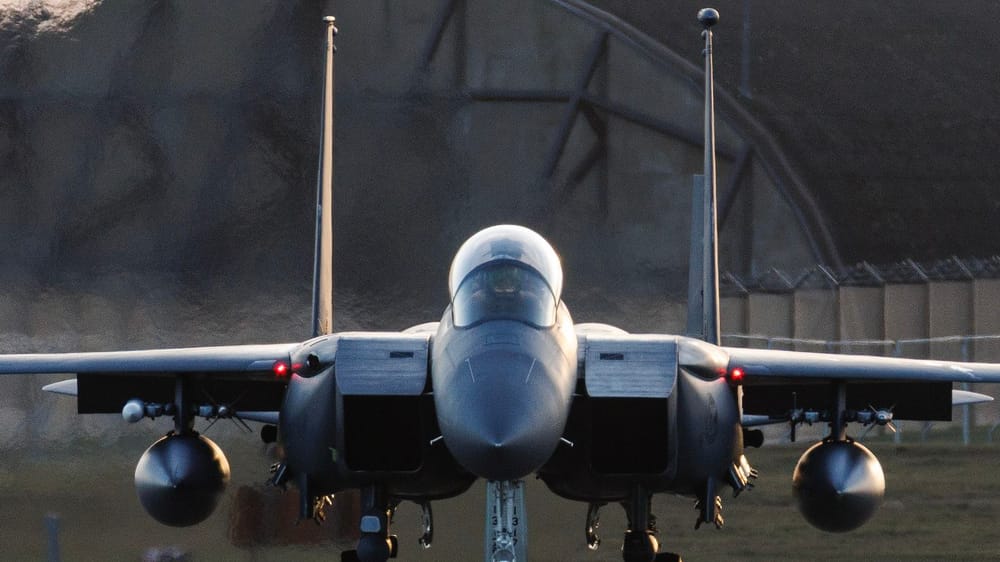
An F-15E Strike Eagle was shot down over Iran, Axios reported, citing an Israeli official and a second source with knowledge of the situation. One of the two crew members — an F-15E carries a pilot and a weapons-systems officer — was located and rescued by U.S. special forces operating on Iranian territory. The search for the second crew member was ongoing. Iran, simultaneously, was mobilizing civilians in the area to join its own search, with state television promising government rewards to anyone who located U.S. troops. White House press secretary Karoline Leavitt told Axios that the president had been briefed.
This is the first time in the current conflict that a U.S. aircraft has been downed by enemy fire. It is also, by the logic the administration has used to justify the war's conduct, something that was not supposed to happen.
The gap between what the White House has said and what is happening over Iranian airspace has been widening for weeks. The administration's public framing consistently cast Iran as a regime on the verge of collapse, its air defenses degraded, its military capacity neutralized by the opening strikes. That framing served a political purpose: it made the war feel manageable, its costs bounded, its risks to American lives minimal. A downed F-15E, two crew members in hostile territory, and a special forces rescue operation inside Iran do not fit that framing. They contradict it directly.
The Boeing-made F-15E Strike Eagle is not a marginal aircraft. It is one of the most capable dual-role fighters in the U.S. inventory, designed for both air-to-air combat and precision ground strike missions. Losing one to Iranian fire — not to mechanical failure, not to friendly fire, which claimed three F-15Es earlier in the campaign — means Iranian air defense assets retain enough operational capability to threaten advanced American aircraft. That is a material fact about the state of the war that the White House's public communications have not prepared the American public to receive. The political costs of that gap are already accumulating.
The accountability question here is not primarily about the crew members — whose safety is the immediate and legitimate concern of everyone covering this story. It is about the decision-makers who sent them into an operational environment while publicly misrepresenting its danger. Thirteen Americans have now been killed during the campaign. Three previous F-15Es were lost to friendly fire. The fourth was lost to the enemy Iran was supposedly incapable of mounting a meaningful defense. Each of those facts was available to the planners who designed the mission profiles and to the officials who briefed the press. The public version of the war and the operational reality of the war have been running on separate tracks.
Israel's response to the downing is also telling. According to the Axios report, Israel cancelled planned strikes in Iran specifically to avoid interfering with U.S. search and rescue efforts. That decision — operationally reasonable, tactically cooperative — also means that a second military conducting its own strike campaign inside Iran had to stand down its operations because an American crew was missing on Iranian soil. The entanglement of U.S. and Israeli military operations, and the degree to which each constrains the other, is a structural feature of this war that has received far less scrutiny than it warrants. There is no public exit strategy, and now there is evidence that the two allied campaigns are operationally dependent on each other in ways that limit both.
The human dimension of what happened over Iran should not be abstracted away in the accounting of strategic miscalculation. Two people ejected from a stricken aircraft over hostile territory. One was recovered by special forces — meaning U.S. troops conducted a ground operation inside Iran, the country the United States is bombing, to retrieve him. The second remains unaccounted for, with both American forces and the Iranian government actively searching. Iranian state media is treating the search as a public event, incentivizing civilian participation with government rewards. Whatever the second crew member's status, his situation is being shaped in real time by the political and military choices made long before he climbed into that cockpit.
The war's architects have a consistent pattern of releasing information on a delay and at a scale that minimizes its political impact. Iranian media reported the shootdown first. That sequencing — adversary state media breaking news of American military losses before the U.S. government confirms them — has become a recurring feature of this conflict. The administration has invested heavily in controlling the war's public image, but the operational facts keep arriving through channels it does not control.
The systemic pattern is not subtle. Every major military escalation in this conflict has been preceded by official assurances that the next phase carries limited risk and will produce decisive results. Every phase has produced casualties, strategic complications, and evidence that the adversary retains more capacity than the official briefings suggested. This war has no congressional authorization, no published budget, and no defined endpoint — and the public case for it has rested, from the beginning, on the premise that Iran could absorb American airpower without being able to strike back meaningfully at American forces. That premise just failed a live test.
There will be pressure in the coming hours to frame the rescue of the first crew member as a success story — a demonstration of American military capability and commitment to its people. That framing is not wrong, exactly. Recovering a downed crew member from hostile territory under fire is genuinely difficult and genuinely brave. But the rescue does not retroactively validate the intelligence assessment that said the aircraft was operating in a manageable threat environment. It does not answer why that assessment was wrong, or whether the missions being flown are calibrated to the actual threat rather than the claimed one.
The second crew member is still out there. Iran is hunting for him. So are U.S. forces. The outcome of that search will determine the immediate human stakes. But the larger reckoning — about what the American public was told this war would cost, and what it is actually costing — does not wait for the search to conclude. It started the moment an Iranian missile found an American jet.