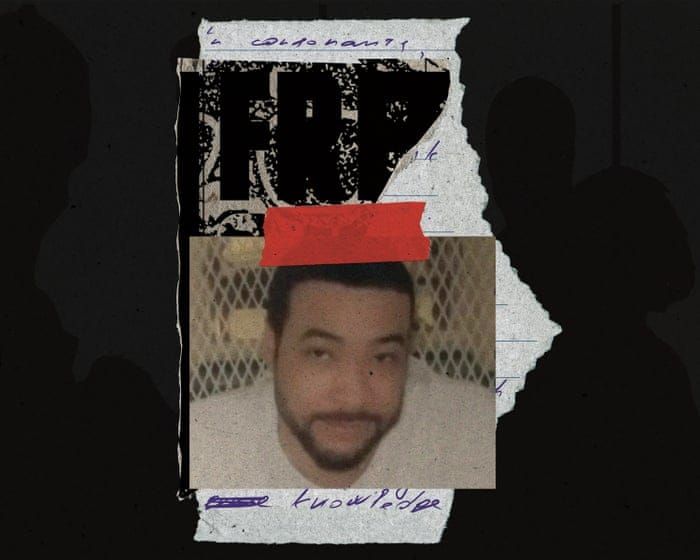
James Broadnax writes poetry at a small desk in a 6-by-10-foot cell on Texas death row. He loses himself in the work for hours at a time — what he calls a "time gap." The irony is not subtle: the creative act that helped condemn him is now the one keeping him sane. Broadnax, now 37, has spent more than 16 years in that cell after a Texas jury convicted him of capital murder as a teenager. Among the evidence prosecutors used to secure the death sentence was his rap music — presented not as motive, not as confession, but as evidence that he posed a future threat to society, as The Guardian US documented in an investigation published this month.
That framing — "future dangerousness" — is specific to Texas capital punishment law. To sentence someone to death in Texas, a jury must find beyond a reasonable doubt that the defendant represents a continuing threat. It is a prediction about a person's soul. And in Broadnax's case, prosecutors asked a jury to make that prediction based, in part, on the music he made. The argument was not that the lyrics described the crime. The argument was that writing them made him dangerous by nature.
This is not a fringe legal maneuver. It is a documented pattern. Prosecutors across the United States have introduced rap lyrics as evidence in criminal trials for decades, and the targets are overwhelmingly Black men. Legal scholars and defense attorneys have tracked the practice for years, and the throughline is consistent: lyrics that would be read as fiction, metaphor, or artistic expression when written by white artists are treated as autobiography — or worse, as criminal confession — when written by Black ones. As The Guardian's investigation makes clear, Broadnax's case is not an outlier. It is an illustration of a system operating as designed.
The original thesis here is not that rap lyrics were used in a criminal trial. It is that the "future dangerousness" standard — unique to Texas capital law — creates a legal vacuum where cultural bias can function as evidence. When a jury is asked to predict whether a person will be dangerous for the rest of their life, and when the evidence offered to support that prediction is creative work that prosecutors have coded as inherently threatening, the outcome is not a legal determination. It is a cultural verdict. And that verdict has been rendered almost exclusively against Black defendants whose art form was treated as a behavioral profile rather than an artistic genre.
The mechanics of this matter. Under Texas law, the state must establish future dangerousness to obtain a death sentence. That means prosecutors need evidence that speaks not to what a defendant did, but to who they are. Rap lyrics — particularly those written in the first person, which is a foundational convention of hip-hop — offer a prosecutor an apparent shortcut. The lyrics say "I." The defendant wrote them. Therefore, the argument goes, the defendant is telling us who he is. That logic would make every crime novelist a murder suspect and every blues singer a man with nothing left to lose. It is applied to rap because rap is Black American art, and because the criminal legal system has spent decades treating Black cultural production as evidence of pathology.
The power dynamic embedded in this practice is stark. No prosecutor has ever introduced a country song about shooting a man in Reno to establish a white defendant's future dangerousness. No heavy metal lyric about death and destruction has been submitted as a risk assessment. The selective application of this evidentiary framework is not incidental — it tracks the racial architecture of the death penalty itself. Texas executes more people than any other state. Black Americans are incarcerated and executed at rates wildly disproportionate to their share of the population. The use of rap lyrics as death penalty evidence is not a quirk of one trial. It sits inside that larger structure.
Defense attorneys and civil liberties organizations have challenged this practice in various jurisdictions, arguing that it violates First Amendment protections and introduces impermissible racial bias into criminal proceedings. Several states have passed or considered legislation specifically restricting the use of rap lyrics as criminal evidence — acknowledging, at least implicitly, that the courts have failed to police the practice on their own. The fact that legislation is necessary to stop prosecutors from using song lyrics to send people to death tells you something about where the courts have drawn the line. They haven't. This connects to a broader erosion of First Amendment protections for expression deemed threatening by the state — a pattern Tinsel News has tracked in cases ranging from professors fired for off-campus political speech to artists sued by police departments for mocking them in music videos.
What makes the Broadnax case particularly instructive is the specific evidentiary function the lyrics served. They were not introduced to establish that he committed the crime for which he was convicted. They were introduced to establish that he should die for it. That is a different claim, and a more insidious one. It means the state argued that his artistic expression — made before, during, or after the crime, the timeline matters less than the principle — demonstrated an irredeemable character. That a teenager who wrote rap music was, by virtue of writing it, someone society could never safely release. That the music itself was the danger.
Broadnax has now spent more than half his life in a cell the size of a parking space. He still writes. A short documentary, Solitary Minds, features one of his recent poems — a reflection on how he creates, on the "time gap" that takes him somewhere else. There is something the legal system did not account for when it used his creativity against him: it did not stop him from creating. It just changed what the creation costs.
The accountability question here has multiple layers. Who bears responsibility for a capital sentencing framework that allows juries to weigh poetry as prophecy? The Texas legislature built the future dangerousness standard. Prosecutors chose to use it this way. Courts allowed it. And the broader legal system — including federal courts that have reviewed capital cases for decades — has not drawn a firm line against the practice. Each institution had the power to stop this and didn't. The result is a man on death row, in part, because of what he wrote. This pattern of prosecutorial misconduct in capital cases is not limited to Texas — as seen in the case of a Louisiana prosecutor who withheld death row evidence and compared a Black child to a dog, and is now seeking a judgeship.
There is also the question of what the criminal legal system believes art is for. When prosecutors introduce rap lyrics as evidence of character, they are making a claim about the relationship between a person and their creative work — that the work is confessional, that it is literal, that it tells you something true and fixed about the person who made it. That claim would be contested in any MFA seminar. It would be laughed out of a literary criticism class. It is accepted in Texas capital murder trials because the defendant is Black and the genre is rap, and because the system has decided, without saying so plainly, that Black artistic expression is not expression at all. It is evidence.
The states that have moved to restrict the use of rap lyrics in criminal proceedings are not doing so out of sentimentality about artistic freedom. They are responding to documented evidence that the practice produces racially skewed outcomes and undermines the reliability of convictions. That is a narrow, procedural argument — and it is correct as far as it goes. But it does not go far enough. The deeper problem is a capital punishment system in Texas that asks juries to predict the future, then hands them a Black teenager's notebook and calls it a forecast. James Broadnax is still in that cell. The system that put him there has not changed. And the desk where he writes is still the only place he can disappear. This selective targeting of Black Americans by institutions with unchecked power mirrors what happened when Defense Secretary Hegseth blocked promotions of Black and female officers in a sweeping military personnel purge — a reminder that racial bias in institutional decision-making is not confined to the courts.