Cándido Álvarez has made it his policy never to go to the doctor. Not when he is sick. Not when it is serious. The policy is not born of indifference to his own health — it is born of a calculation that going to the doctor carries risks that staying home does not. Álvarez is an immigrant living in Houston, Texas, and in 2025, seeking medical care means entering a system where paperwork can become a paper trail, where a hospital visit can trigger a data-sharing request, and where the waiting room is, in the most literal sense, no longer safe. His decision, reported by The Guardian US, is not unusual. It is, in Houston's immigrant communities, increasingly the norm.
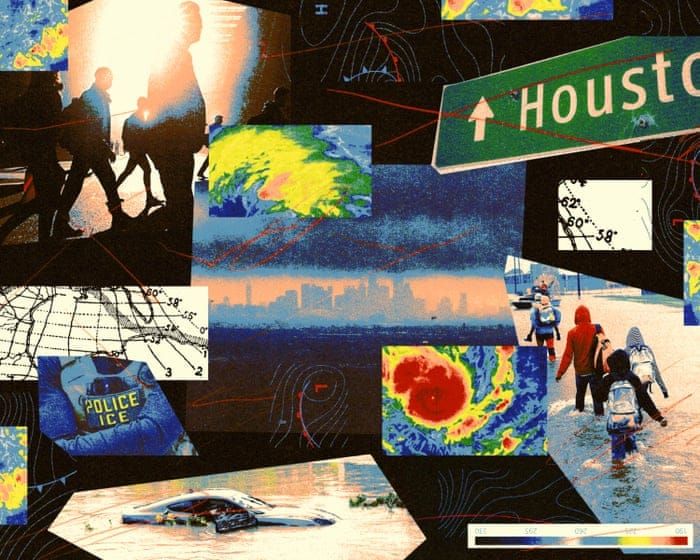
Houston is the fourth-largest city in the United States and one of the most ethnically diverse on earth. It is also, by multiple measures, one of the most hazardous places to be poor and foreign-born in America. The city sits inside a petrochemical corridor that stretches from the Ship Channel to Beaumont, studded with refineries, chemical plants, and industrial facilities whose pollution maps almost perfectly onto its lowest-income neighborhoods — which are also its most heavily immigrant neighborhoods. It floods with catastrophic regularity, displacing families who cannot afford to lose what little they have. And it now operates under an intensified federal immigration enforcement regime that has transformed daily life into a series of threat calculations: whether to drive to work, whether to take a child to school, whether to call an ambulance.
These are not four separate crises that happen to affect the same people. They are a single, compounding system of exposure — and the people bearing the cost of that system did not design it, did not vote for it, and have almost no institutional power to change it.
The health consequences of the enforcement environment are not theoretical. When people avoid emergency rooms, they delay treatment for conditions — chest pain, respiratory distress, uncontrolled diabetes — that become life-threatening precisely because they go untreated. Community health workers in Houston's East End and Pasadena neighborhoods have described a measurable drop in clinic visits since ICE enforcement intensified. The patients who stop coming are not getting healthier. They are getting sicker at home, in silence, hoping the crisis passes before they have to make a choice between their health and their safety.
What makes Houston's situation distinctive — and what the conventional immigration debate almost entirely misses — is that the enforcement pressure is landing on communities that are already medically compromised by their environment. The neighborhoods where ICE operations are concentrated are the same neighborhoods that have absorbed decades of industrial pollution from the Houston Ship Channel, one of the most contaminated waterways in the country. Residents in Manchester, Harrisburg, and Galena Park live within miles of benzene-emitting refineries, vinyl chloride processing plants, and facilities that have repeatedly released toxic chemicals into the air and water without adequate warning or remediation.
The relationship between environmental racism and immigrant settlement patterns in Houston is not accidental. As environmental racism research has consistently shown, the communities with the least political power are the ones where industrial facilities get sited. In Houston — a city with no traditional zoning code until relatively recently, and with a long history of industry-friendly regulation — that has meant petrochemical infrastructure concentrated in communities of color, many of them immigrant. The people who moved there did so because housing was affordable. It was affordable, in part, because no one with options chose to live next to a refinery.
Then came the floods. Harvey in 2017 was the most catastrophic, but Houston has flooded repeatedly in the years since — and each flood carries a specific danger for communities near industrial sites. When the Ship Channel and its surrounding facilities flood, contaminated water spreads into residential neighborhoods. The toxic load is not always immediately visible. It accumulates. Children play in floodwater. Families return to homes where the walls have absorbed chemicals they cannot smell. The long-term health consequences — elevated rates of asthma, developmental disorders, certain cancers — take years to document and decades to litigate.
The Houston Ship Channel is home to one of the largest concentrations of petrochemical facilities in the world. Communities adjacent to the corridor — including Manchester, Galena Park, and Harrisburg — are predominantly Latino and lower-income. These neighborhoods experience disproportionate rates of respiratory illness and toxic chemical exposure events. When Hurricane Harvey struck in 2017, at least a dozen petrochemical sites reported releases of hazardous materials into floodwaters that spread through residential areas.
For immigrant families, the flood response itself becomes another site of exclusion. Federal disaster assistance through FEMA has documentation requirements that screen out undocumented residents. Community organizations and mutual aid networks fill some of the gap, but the structural shortfall is enormous. A family that loses everything in a flood and cannot access federal assistance, cannot safely go to a hospital, and cannot risk drawing official attention faces a recovery calculus that is simply different from what most Americans understand recovery to mean. You do not rebuild. You absorb the loss and continue.
The healthcare dimension of this story deserves particular scrutiny, because it involves active policy choices at multiple levels of government. Texas has not expanded Medicaid under the Affordable Care Act — it is one of ten states that has refused to do so — leaving it with the highest uninsured rate in the country. Undocumented immigrants are categorically excluded from ACA marketplace coverage regardless of their ability to pay. Community health centers operating under federal funding face their own documentation pressures. The result is a city where a large portion of the workforce — the people who clean the offices, build the houses, process the food, and staff the warehouses — has essentially no access to routine medical care.
This is not an oversight. It is the architecture of a system that extracts labor from a population while denying that population the basic infrastructure of a healthy life. The people working in the heat and the chemical air of Houston's industrial corridor go home to neighborhoods that flood, breathe air that burns, and now live under an enforcement regime that makes seeking help feel more dangerous than suffering alone. The question of who benefits from this arrangement is worth asking plainly: the industries that have located in these corridors have done so in part because the communities nearby lack the political power to demand better. The labor that keeps those industries running is cheap in part because the workers performing it have no power to demand more.
The current enforcement environment has compounded every existing vulnerability. ICE's expanded domestic operations, funded at record levels, have moved well beyond the border into the interior of cities like Houston. Workplace raids, courthouse arrests, and neighborhood sweeps have created a climate of generalized fear that does not distinguish between undocumented residents and legal permanent residents, between people with pending cases and people with final orders. The fear is, in a functional sense, the point — a deterrent effect that keeps entire communities from engaging with public institutions, including schools, hospitals, and courts.
The consequences radiate outward. When parents stop taking children to the doctor, pediatric conditions go unmanaged. When workers avoid reporting workplace injuries, the injury data that drives safety regulation disappears. When tenants stop reporting housing code violations, landlords face no accountability for conditions that affect health. The enforcement regime does not just threaten deportation — it produces a shadow population that becomes, for all practical purposes, invisible to the systems that are nominally designed to protect them. Families trying to locate detained relatives often cannot even confirm where their loved ones are being held.
Community organizations in Houston have responded with the kind of infrastructure that fills the gaps left by institutional abandonment. Mutual aid networks distribute food, medication, and legal information. Mobile health clinics run by nonprofits attempt to reach people who will not come to fixed facilities. Know-your-rights workshops have proliferated in church basements and community centers. These efforts are real and they matter to the people they reach. They are also, by definition, insufficient to the scale of the problem. A mutual aid network cannot replace a functioning public health system. A know-your-rights training cannot neutralize a federal enforcement apparatus with a $75 billion budget.
What Houston's situation makes visible is the logic of what researchers and advocates have called a sacrifice zone — a community that has been, through a series of policy decisions made elsewhere by people who do not live there, designated as a place where costs are absorbed so that benefits can flow elsewhere. The petrochemical industry produces profits that accrue to shareholders in Houston's wealthier zip codes and to investors with no connection to the city at all. The pollution stays in Manchester. The flood risk stays in Galena Park. The enforcement operations concentrate in the East End. The people who live in these places are not collateral damage in a system that has gone wrong. They are the intended recipients of a system that is working exactly as designed.
The convergence of these crises also exposes a specific failure of political representation. Texas's congressional delegation, which wields enormous influence over federal environmental enforcement, immigration policy, and disaster funding, has consistently prioritized the interests of the petrochemical industry and the enforcement apparatus over the interests of the communities bearing their costs. The state's refusal to expand Medicaid is not a fiscal decision — Texas would save money by expanding Medicaid — it is an ideological one, and its costs are paid almost entirely by low-income Texans, disproportionately people of color, disproportionately immigrants.
For Cándido Álvarez, the abstraction ends at his body. He knows what it costs to stay home when he is sick. He has made the calculation that this cost is lower than the cost of going to the doctor. That calculation is not irrational — it is a precise and accurate reading of the system he lives inside. The tragedy is not that he has made the wrong choice. The tragedy is that this is the choice the system has given him.
Houston's immigrant communities are not waiting for the system to change on its own. As in other cities where enforcement has intensified, the response has been to build parallel infrastructure — mutual aid, mobile health, legal defense funds, rapid-response networks that alert communities to enforcement activity in real time. These networks are a form of collective survival, and they are more sophisticated and more resilient than they have ever been. But they exist because the official infrastructure has failed, and the question that Houston poses to the rest of the country is whether failure at this scale, sustained over this many years, affecting this many people, is something that can be addressed at the margins — or whether it requires a reckoning with the decisions that produced it in the first place.