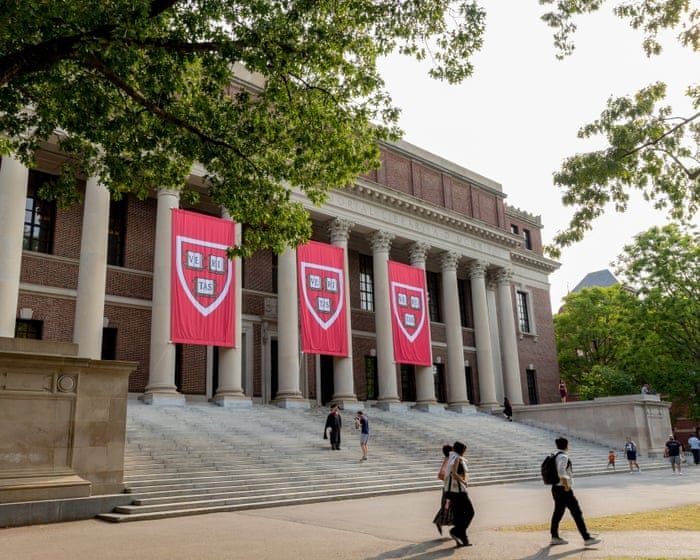
The deadline is August 31. According to a U.S. official who provided the full list to The Guardian US, thirty American universities — among them Harvard, MIT, Johns Hopkins, Georgetown, Yale, Stanford, and Cornell — have been ordered to review and terminate any foreign academic partnerships the Pentagon deems a national security risk, or face the loss of federal funding. Two weeks. Decades of collaborative research. No published criteria for what qualifies as a threat.
The directive is framed as a national security measure, aimed primarily at institutional ties to Chinese universities and research programs. That framing is not without any basis — academic espionage is a documented problem, and the FBI has prosecuted real cases of research theft. But what the Pentagon has constructed here is not a targeted counterintelligence operation. It is a blunt instrument applied to some of the most complex and consequential institutions in American intellectual life, on a timeline that makes genuine review impossible and treats compliance theater as the goal.
The federal government provides roughly $50 billion annually in research funding to American universities. Institutions like MIT, Johns Hopkins, and Stanford receive hundreds of millions each year — funding that underwrites basic science, medical research, and defense-relevant technology development. A funding cutoff is not an administrative penalty. It is a structural disruption to the research pipeline the U.S. has depended on for technological leadership since World War II.
Here is the argument the source reporting does not make, but the evidence demands: the Pentagon's directive is not protecting American research dominance — it is threatening the conditions that produced it. The postwar American research university became the most powerful knowledge-generation engine in human history precisely because it was open. It recruited globally. It collaborated internationally. It treated the cross-pollination of scientific traditions as a feature, not a vulnerability. The directive now demands that universities treat that openness as a liability, on a two-week clock, with no published standard for what constitutes an acceptable partnership and what does not.
The institutions named in the directive are not peripheral actors. MIT receives approximately $2 billion annually in federal research funding. Johns Hopkins, through its Applied Physics Laboratory alone, is one of the largest recipients of Defense Department research contracts in the country. Harvard's research enterprise spans medicine, public health, economics, and basic science, with federal grants constituting the majority of its research budget. These are not universities that can restructure their international partnerships in fourteen days. They are organizations whose research timelines operate in years and decades, whose graduate programs are built around international collaboration, and whose scientific output is woven into the fabric of American technological capacity.
The McCarthyism parallel is not rhetorical decoration — it has structural precision. The original Red Scare's assault on American universities did not destroy them through mass arrests. It damaged them by creating a climate in which association itself became dangerous, in which the cost of international intellectual engagement outweighed the perceived benefit, in which researchers self-censored and self-isolated to avoid scrutiny. The mechanism here is identical: a vague national security standard, applied broadly, with severe financial consequences for non-compliance, and no transparent process for contesting the designation. The chilling effect does not require the funding to actually be cut. The threat alone reshapes behavior.
Consider what international academic collaboration actually produces. The Human Genome Project was a multinational effort. The detection of gravitational waves — one of the most significant scientific achievements of the 21st century — involved researchers from eighteen countries. COVID-19 vaccine development, including the mRNA platform that now underpins multiple therapeutic approaches, drew on decades of international scientific exchange. The argument that severing these ties makes America more secure requires believing that isolation produces better science than collaboration — a claim that the entire history of American research dominance directly contradicts.
Follow the money and the directive's logic collapses. Federal research funding to universities is not charity — it is the primary mechanism by which the U.S. government purchases scientific capacity it cannot produce internally. The Defense Department, NIH, NSF, and DOE collectively use university research infrastructure to generate the basic science that eventually becomes military technology, pharmaceutical development, energy systems, and economic productivity. A threat to defund these institutions over foreign partnerships is, in a precise sense, a threat to defund the Pentagon's own research pipeline. The directive is, structurally, self-defeating — unless the goal is not actually to improve security outcomes, but to demonstrate political control over institutions perceived as resistant to the current administration's priorities.
That framing is consistent with a broader pattern. Federal licensing and funding mechanisms have been deployed against institutions — broadcasters, universities, nonprofits — that the administration views as culturally or politically adversarial. Harvard, in particular, has been a sustained target: the university has faced threats over its admissions practices, its diversity programs, and now its international partnerships. The national security framing is available and convenient, but the pattern of targeting suggests the operative logic is institutional compliance, not counterintelligence.
The global dimension matters here and is largely absent from the domestic coverage. When the U.S. restricts academic exchange with China, China does not simply stop doing science. Chinese universities have been accelerating their research output for two decades; in several fields, including battery technology, quantum computing, and certain areas of materials science, they have moved from follower to peer or leader. The researchers who would have collaborated with American institutions, shared data, and contributed to joint publications will collaborate elsewhere — with European universities, with South Korean institutions, with each other. The isolation is not symmetric. American researchers lose access to global scientific networks. The networks continue without them.
There is also the question of who is actually enrolled in American graduate science programs. Roughly 40 percent of STEM doctoral students at U.S. universities are international students, with Chinese nationals representing the largest single group. These students are not security vulnerabilities — they are, in the aggregate, the labor force of American basic research. Many stay and build careers in the United States, contributing to the research and technology sectors that the Pentagon claims to be protecting. A policy environment that treats their presence as inherently suspect, that pressures universities to sever institutional ties with their home countries, that creates a surveillance and compliance apparatus around international academic exchange — that environment will reduce the number of the world's best scientists who choose American institutions. That reduction is a national security problem, not a solution to one.
The question is direct: who benefits from this directive, and who bears the cost? The universities bear the cost — in compliance burden, in damaged partnerships, in the chilling effect on international recruitment and collaboration. The researchers whose joint projects are disrupted bear the cost. The graduate students whose programs depend on international exchange bear the cost. The American scientific enterprise, which has operated as the world's premier research destination for eighty years, bears the cost. What the directive produces in return is a posture of toughness on China that is legible in domestic political terms and essentially meaningless in security terms — because the actual mechanisms of academic espionage operate through individual actors and targeted recruitment, not through the existence of institutional partnerships between Harvard and a Chinese university.
The universities named in the directive have two weeks to dismantle relationships built over decades. The use of federal funding as a lever to compel institutional compliance is not new to this administration, but the scale here is different — thirty institutions, a two-week deadline, no published criteria, and targets that sit at the center of American scientific capacity. The assault on academic institutions as sites of independent inquiry has been building for years across multiple levels of government. What the Pentagon directive does is bring that assault to the research infrastructure itself — the part of the university that is not ideologically contested, that has historically commanded bipartisan support, and that is the actual source of the technological advantage the directive claims to protect.
The research capacity the United States built over the last century was not the product of isolation. It was the product of openness — to talent, to collaboration, to ideas that crossed borders because science does not recognize them. A directive that treats that openness as a threat, enforced on a two-week deadline with federal funding as the hostage, is not a security measure. It is a managed act of self-sabotage, dressed in the language of national defense.